Wrestling knows that Olympic history offers no guarantee of an Olympic future. In February 2013, the IOC Executive Board recommended leaving it out of the core program for 2020. An international campaign followed, alongside changes to the federation’s leadership, competition rules and representation of athletes and women. In September, the IOC Session voted wrestling into the 2020 and 2024 programs. Its removal was averted before it happened, but the warning was unmistakable.
Thirteen years later, the question returns in a different form. The IOC’s programme policy, approved on October 30, 2026, places individual disciplines at the center of the review for Brisbane 2032. A sport can therefore face changes within its Olympic offering without disappearing altogether. THE IN, SportsIn’s independent research series, begins with wrestling and focuses on Greco-Roman. Our first assessments examine sports and disciplines that, in our judgment, could face reductions. This is our editorial selection, not an IOC list of disciplines facing exclusion.
Our assessment is that, if the review produces a reduction within wrestling, Greco-Roman is particularly exposed. It carries substantial historical weight and an established international competitive presence, but we judge its ability to attract a broader audience less favorably. Its male-only Olympic competition also raises a distinct question when participation and inclusion are examined at discipline level. Women’s freestyle strengthens female representation across wrestling; it does not provide women with Olympic opportunities in Greco-Roman itself. These considerations inform our judgment without determining what the IOC will decide.
We apply the eleven published indicators of the THE IN Olympic Discipline Evaluation Framework. Global appeal and relevance, delivery requirements, and universality and athlete participation each carry 30 percent of the total; Olympic heritage and educational value account for 10 percent. The review considers audience appeal, sustained interest and media and spectator demand; venue feasibility, resource efficiency and delivery resilience; geographic representation, active competitive depth and athlete access; and historical and educational contribution. Our source review includes the IOC policy, official Olympic and World Championship records, published audience research and institutional material. Evidence is assessed at its stated scope. The scores and weights are THE IN’s independent judgments, not the IOC’s scoring system.
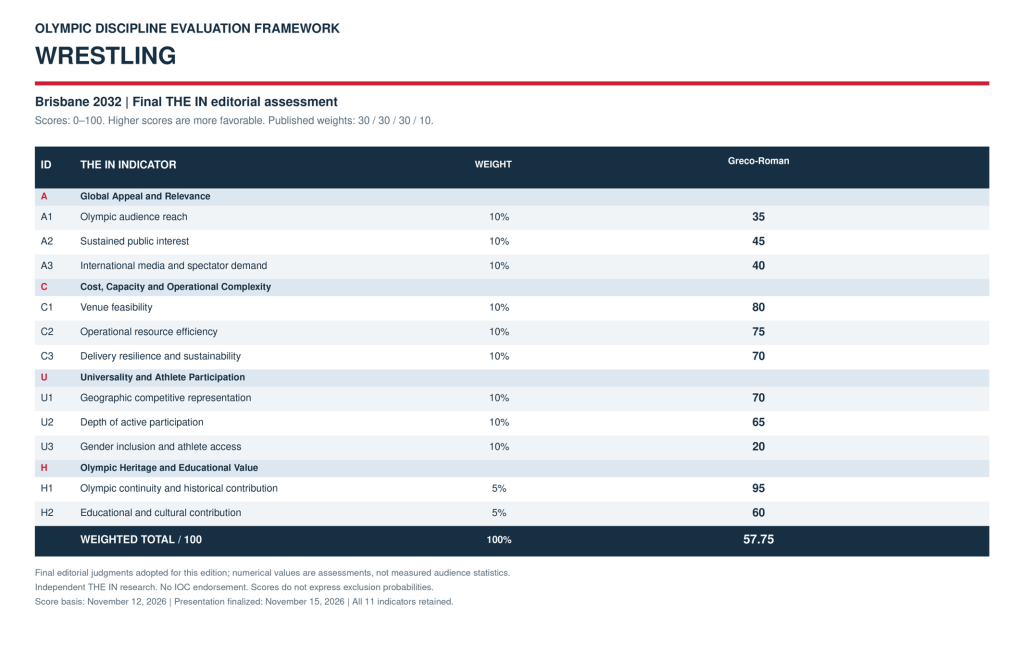
Greco-Roman Wrestling | THE IN assessment | 57.75/100
Greco-Roman finishes with 57.75 out of 100. The profile matters more than the headline number: audience reach, sustained interest and media and spectator demand receive 35, 45 and 40 respectively. Delivery scores are stronger, at 80, 75 and 70. Shared wrestling facilities and infrastructure are a practical advantage, although sharing does not establish either zero incremental cost or a specific saving. Historical continuity receives 95, while gender inclusion and athlete access receive 20. These are final THE IN editorial ratings for this assessment, not viewing percentages or probabilities of exclusion.
That balance explains our concern. Greco-Roman’s history and delivery advantages make a serious case for its continued inclusion, and our assessment gives them substantial credit. Yet the IOC’s Fit for the Future direction places demonstrable public interest, meaningful participation and manageable delivery demands at the center of programme decisions. In our reading, Greco-Roman’s more difficult task is to demonstrate the contemporary audience and participation value of its separate Olympic presence. Tradition contributes to that argument, but cannot settle it.
The IOC has announced no decision confirming our prediction. Its published timetable envisages intermediate steps in December 2026 and a programme decision at the Session in April 2027. Our 57.75 is an independent SportsIn assessment, based on our framework and weighting, open to documented challenge and revision when material evidence warrants it. In 2013, wrestling mobilized to defend its collective place. Under a discipline-focused review, Greco-Roman may now need to explain much more clearly why its own place is essential to the Olympic Games of the future.
THE IN’s next evaluation will be this Wednesday for Modern Pentathlon.
 Last related articles