Fernando Aguerre, president of the International Surfing Association -ISA-, is confident that the sport will retain its Olympic place at Brisbane 2032. “Having featured successfully in Tokyo and Paris, and having been selected as part of the initial programme for Los Angeles, we’re quite confident that we’ll be among the sports chosen,” he told ‘Reuters’. Surfing is confirmed for its third consecutive Olympic appearance at Los Angeles 2028, while a decision on the Australian edition remains pending. Its case combines Olympic experience, international expansion and audience growth with the sport’s cultural, sporting and economic roots in the 2032 host country.
The International Olympic Committee -IOC- has scheduled the decision on the Brisbane 2032 programme for April 2027, at its session in Punta Cana, Dominican Republic. Before then, in December 2026, the Executive Board intends to determine which disciplines it will recommend directly, which will proceed to a combined comparison phase and which candidates will go no further. Part of the Fit for the Future reforms, the process introduces assessment at discipline level, considering global relevance, athlete participation, integrity, costs, operational complexity and sustainability. For surfing, that framework provides an opportunity to present both the results of its first Olympic appearances and its suitability for an Australian Games.
Australia brings participants, industry and champions
Surfing’s place in Australian society provides a starting point. The Australian Sports Commission estimates that 313,000 people aged fifteen or over and 22,000 children below that age surfed at least once in 2025. Its economic significance has also been studied: research published in 2024 by the Australian National University estimated that recreational surfing contributes A$2.71 billion directly to the economy each year through equipment purchases and domestic travel. Researcher Ana Manero explained that the estimate excluded “overseas visitors who travel to Australia to go surfing or money generated through professional surfing”. The activity therefore supports a market extending across retail, travel and coastal communities.
Those roots are reflected in competitive success. Molly Picklum, the 2025 World Surf League -WSL- champion; Jack Robinson, an Olympic silver medallist in Paris; Stephanie Gilmore, an eight-time world champion; and Tyler Wright, a two-time champion, are among Australia’s leading names. Their achievements were followed by the results on 15 November at the World Surfing Games in Peru, where Australia won the team title and Ethan Ewing and Leihani Zoric claimed individual gold medals. The proximity of established surfing locations adds another argument: Aguerre highlighted the possibilities offered by the Gold Coast, south of Brisbane, whose World Surfing Reserve stretches from Burleigh Heads to Coolangatta. Breaks such as Kirra form part of that sporting heritage and the region’s options for a future venue selection.
An international presence that keeps expanding
Surfing’s ambition to remain in the Games also rests on a broader international structure. The ISA reached 120 affiliated national and territorial federations in September after admitting Zimbabwe. The recent World Surfing Games brought together 239 athletes from 53 countries, with Romania and Uzbekistan making their debuts. These are signs of expansion beyond the sport’s traditional markets, creating more opportunities to compete for a national team. Beginning a new term in September, Aguerre identified reaching new countries and communities, supporting federations and delivering a successful third Olympic appearance in Los Angeles as priorities. “We will continue to showcase the very valuable contribution surfing makes to the Olympic Movement,” he said.
Audience figures offer further support. Roku Advertising estimated that surfing reached around 46 million viewers on US linear television during Paris 2024, an increase of 58% over the Tokyo Games held in 2021. That growth provides a reference point in an important market for the next Olympics. Aguerre also recalled to ‘Reuters’ the impact of the photograph of Gabriel Medina suspended above the wave in Tahiti, one of the most widely circulated images of those Games. “For a sport that has a very short history and a sport that has the smallest amount of athletes of any sport in the Games, we punch much above our weight,” he said. His argument connects the competition’s limited size with its ability to generate striking images and international attention.
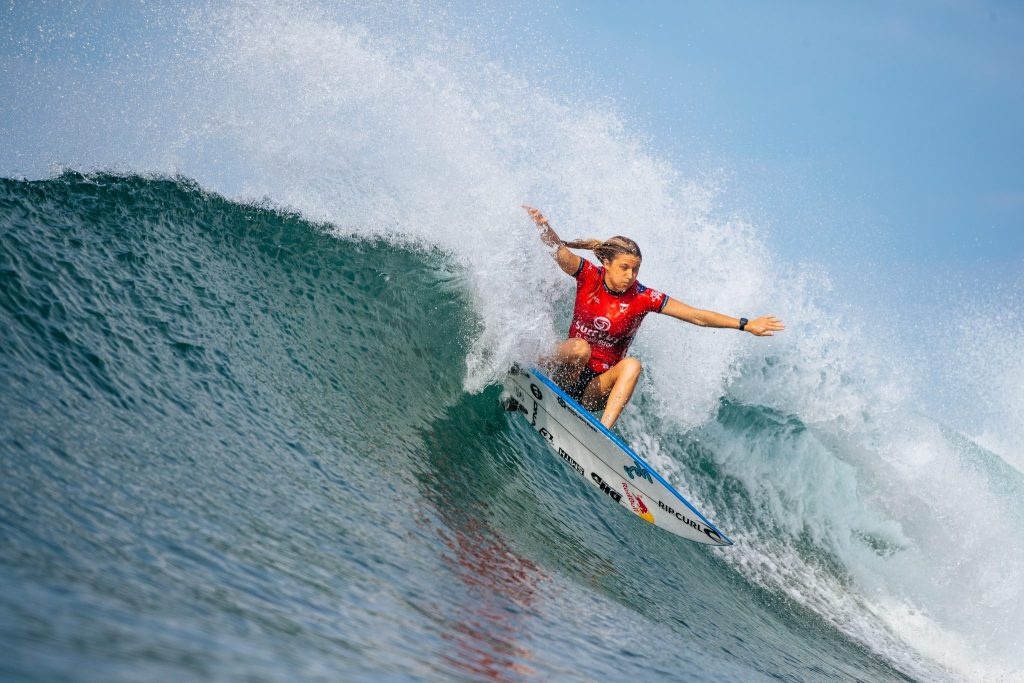
How surfing fits the new Olympic programme
The IOC assessment allows those figures to be considered alongside the Games’ requirements. The ISA’s reach and participation by national teams from different continents support the case for universality; audience figures demonstrate Olympic surfing’s appeal; and Australia offers a local community familiar with the sport. The confirmed quota for Los Angeles 2028, with 48 surfers divided equally between men and women, combines a compact field with gender parity. Using a natural break allows competition to take place in an existing sporting environment, although organisers must address safety, access, temporary facilities and broadcasting, while adapting the schedule to sea conditions. The venue’s appeal and its operational feasibility will need to be considered together.
The next confirmed Olympic competition will take place at Lower Trestles, near San Clemente, California, in 2028. The venue sits within a region closely associated with surfing’s industry and culture and will accommodate thousands of spectators, following pandemic restrictions in Tokyo and limited access to the Teahupo’o reef break for Paris. Aguerre told ‘Reuters’ that preparations were progressing well: “We selected the best surf spot, which is Trestles, and it’s a great wave.” The ISA president also highlighted the timing of the competition: “It’s the best time of the year for good quality waves, in the middle of the summer, so everybody is very happy and we are very confident.”
 Last related articles