Shooting’s Brisbane 2032 case should not be reduced to a choice between Olympic tradition and modern audiences. The more useful question is which parts of its program offer the strongest combination of international competition, understandable presentation and efficient delivery. Rifle, pistol and shotgun have distinct technical requirements and sporting identities. THE IN’s assessment places shotgun under the closest comparative scrutiny, while recognizing that an existing Brisbane venue and a balanced athlete program materially strengthen shooting’s broader case.
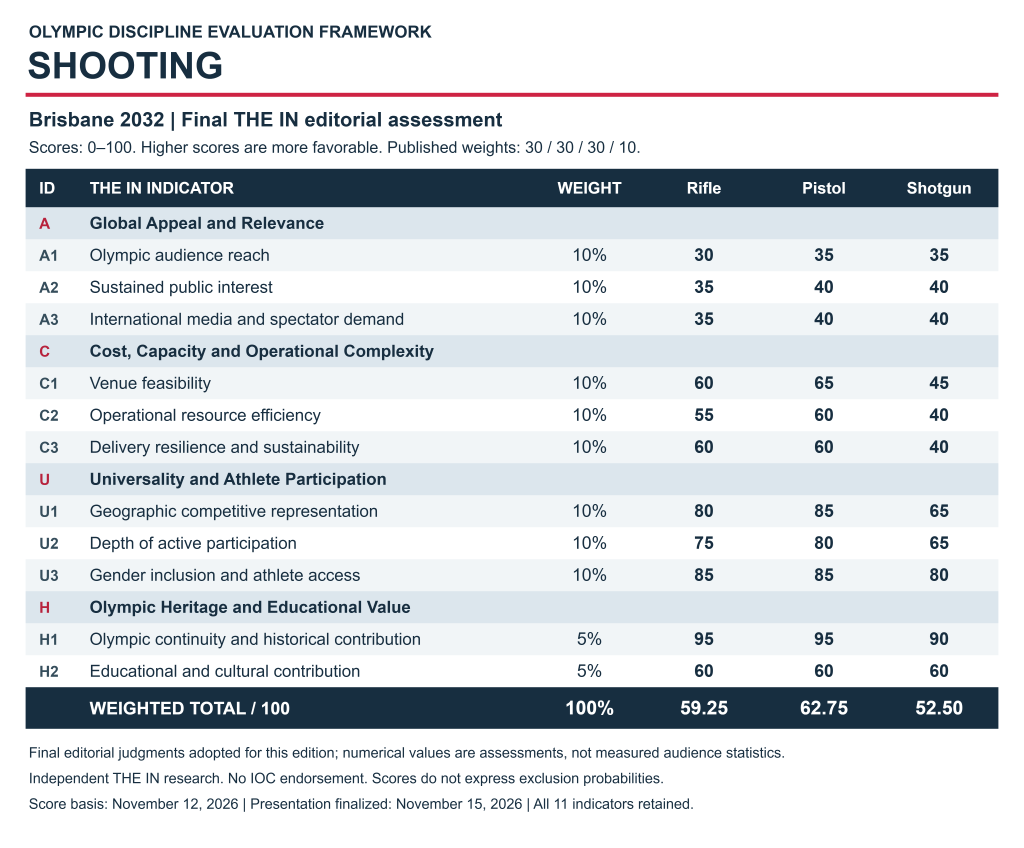
We apply the same eleven indicators as elsewhere in the series: appeal, delivery and participation each carry 30 percent, with heritage and educational value carrying 10 percent. Rifle receives 59.25 out of 100, pistol 62.75 and shotgun 52.50. These are independent editorial assessments, not an IOC ranking or a forecast expressed as a probability. Shotgun’s lower total reflects our more demanding judgment of its delivery profile. It does not identify trap or skeet as a confirmed target, and a whole-shooting audience measure has not been relabeled as a separate measured audience for any of the three units.
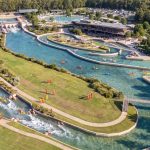
Brisbane has a tangible infrastructure advantage. The Brisbane International Shooting Centre, within the Belmont complex, already hosts shooting and was upgraded for the Gold Coast 2018 Commonwealth Games. GIICA proposes further improvements for 2032 and lists the project in planning and approvals. Existing facilities weaken any argument that shooting necessarily requires a wholly new Games venue. They do not establish the final upgrade budget or the avoidable operating cost of a particular discipline. The indoor rifle-and-pistol and outdoor shotgun requirements must still be examined separately.
The audience question remains central. In Omnipoll’s April 2024 online survey of 1,237 Australian adults, 3 percent spontaneously named shooting among up to five Olympic sports they intended to follow or watch. That is evidence of limited unprompted prominence in one host-market survey, not a global television rating. It does not separate rifle, pistol, trap or skeet. Nor should the appeal of a familiar medal-winning athlete be mistaken for a complete measure of sustained public demand. The sport needs a presentation that makes its technical drama legible beyond its existing audience.
The ISSF is responding. Its confirmed June 2026 LA28 formats bring four mixed teams into one medal final, expand shotgun and men’s rapid-fire pistol finals to eight athletes, and revise the timing of the kneeling and prone phases in three-position rifle. These are specific attempts to improve competition flow and spectator understanding. They should be assessed in their current form, rather than criticized as though no reform had occurred. A redesigned final is nevertheless an intervention intended to build engagement, not proof that audience demand has increased.
LA28 retains fifteen medal events and 340 athlete places, divided equally between men and women. The mixed shotgun event there is trap; the Paris mixed-skeet program should not simply be carried forward as the current Olympic template. Australian relevance also deserves recognition: Penny Smith’s women’s trap bronze in Paris is a concrete example of host-country achievement in the part of shooting that our assessment rates lowest. Competitive success is a legitimate contextual strength, although it cannot by itself settle questions about delivery efficiency or wider audience demand.
If program pressure produces a proposal for reductions, the first task is to identify what would actually change. Removing one event may shorten a schedule while leaving most range infrastructure and athlete services intact; removing a discipline is a larger intervention with different sporting consequences. Our view is that shooting must defend the value of its individual program components, with shotgun facing the harder resource comparison in our model. That conclusion remains an independent assessment, not evidence of an IOC decision. Belmont’s existing infrastructure and the federation’s reforms deserve credit; neither exempts the program from demonstrating contemporary value.
Next in the series: Aquatics — Monday, November 30, 2026.
 Last related articles