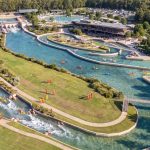
Canoeing enters the Brisbane 2032 review with two very different propositions. Sprint shares a flatwater delivery setting with rowing; slalom needs a whitewater course, but offers a distinctive spectacle and powerful Australian sporting recognition. Treating the two as one cost or audience profile would miss the central question. THE IN’s view is that the strongest case for closer scrutiny concerns the additional demands of whitewater delivery, while the host’s commitment and sporting strengths make a simple forecast of removal unconvincing.
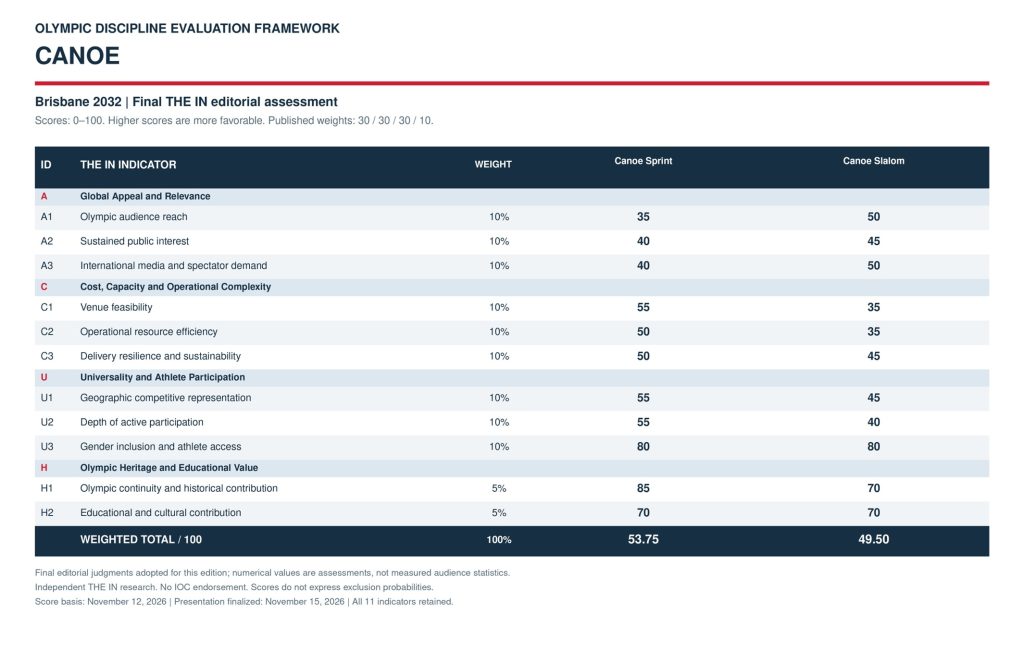
Our eleven-indicator framework assigns 30 percent each to appeal, delivery and athlete participation, and 10 percent to heritage and educational value. Canoe Sprint receives 53.75 out of 100 and Canoe Slalom 49.50. These are independent editorial judgments, not IOC scores or probabilities. Slalom’s more demanding delivery assessment explains much of the difference. The table keeps kayak cross within the slalom analytical unit; it does not give the newer event an invented separate score or claim that this is the final IOC classification for Brisbane.
The LA28 program provides a clear baseline: 236 athlete quota places for sprint and 82 for slalom, with ten and six medal events respectively. The places and events are balanced between men and women within each discipline. Slalom includes canoe singles, kayak singles and kayak cross for both sexes. Those figures describe a planned Olympic field, not the worldwide participation base, and do not establish how many additional athletes could be saved by dropping one event. A paddler may contest more than one event.
Sprint’s Brisbane proposition has become more concrete. The four-federation statement of September 18, 2026 accepted that the Rockhampton flatwater course could provide suitable competition under the conditions assessed, while requesting further technical and service confirmations. Because rowing and sprint would share the setting, the relevant calculation is their separate incremental requirement within a common operation. Charging the whole river project to sprint would overstate its burden; treating shared infrastructure as a zero-cost venue would understate it.
Whitewater has a different infrastructure question, and the latest evidence deserves attention. On November 20, GIICA announced GHD as principal consultant for the Redland Whitewater Centre, supported by Whitewater Parks International. The planned facility includes an international-standard channel and recreational and emergency-service training uses. That appointment shows a project advancing through design, not a facility already completed. Its broader uses also mean the cost of the entire community precinct cannot responsibly be presented as the cost of Olympic slalom alone.
Australia’s sporting connection is substantial counterevidence to any claim that slalom lacks host relevance. Jessica Fox won the women’s canoe and kayak titles in Paris, and Noemie Fox won the inaugural women’s kayak-cross title. Three gold medals across those events create recognizable athletes and stories for the host market. They do not constitute a broadcast audience measurement, just as the federation’s enthusiasm for kayak cross cannot substitute for an attributable viewing series. Our appeal ratings remain editorial assessments, rather than a numerical allocation of all canoeing viewers to individual formats.
The resulting argument is demanding but specific. Sprint must defend the depth and audience value of its event program; slalom must demonstrate why a specialized course produces sufficient sporting, public and long-term community value. Shared use, gender balance and Australian success all count in their favor. None makes the resource question disappear. Our lower slalom score identifies where our independent assessment sees the harder delivery test. It does not establish that the IOC has chosen slalom, kayak cross or canoeing for exclusion. The case should be decided by the value delivered and the genuinely avoidable burden
Next in the series: Shooting — Thursday, November 26, 2026.
 Last related articles