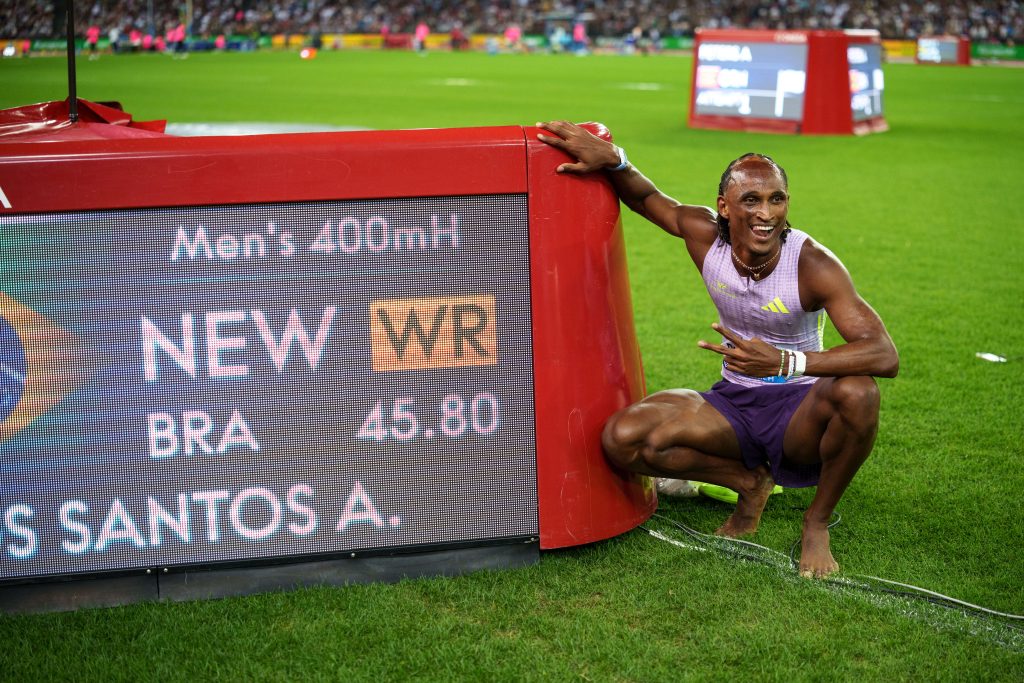
Alison dos Santos was ten months old when a pan of boiling oil fell over his body. He suffered third-degree burns, spent around four months in hospital and was left with permanent scars on his head, face, chest and left arm. For years, he tried to hide them under a cap. This Thursday, at the age of 26, that shy boy from a small town in the Brazilian countryside became the fastest man in history over the 400m hurdles after breaking one of athletics’ great records in Zurich.
The Brazilian stopped the clock at 45.80 seconds at the Zurich Diamond League, 0.14 seconds faster than the 45.94 with which Karsten Warholm had won Olympic gold at Tokyo 2020. The Norwegian was running in the lane immediately outside dos Santos and finished second in 46.69. “To break a record no matter how is amazing, but to do it with Karsten was different, because we’re cool. He led the way, showed that 45 was possible. I was there when he ran 45 and he was here when I ran 45,” the Brazilian explained. Four days earlier, he had already run 46.43 in Silesia despite admitting that he had run much of the race attacking the hurdles with the wrong leg. His conclusion then was simple: “OK, we’re cooking. We have something special.”
The ‘wound’ of Tokyo 2020 and surgery
Dos Santos was also there for that historic Olympic final in Tokyo. He ran 46.72, faster than the world record that had stood before the race, and still finished third behind Warholm (45.94) and Rai Benjamin (46.17). That stayed with him. “It was painful. It was annoying and I was like, the next time that I break the record I’ve got to make sure I get it first.” Since then, he became world champion in Eugene in 2022 with 46.29, suffered a serious knee injury that required surgery in 2023, returned to claim another Olympic bronze at Paris 2024 and won world silver in Tokyo in 2025. He has now taken almost half a second off his previous personal best.
Alison dos Santos and his record. (Gtres)
From Teco to Piu
The perseverance and determination that helped him achieve his world record were forged far from the track. Alison Brendom Alves dos Santos was born on 3 June 2000 in São Joaquim da Barra, in the state of São Paulo. He is the youngest of four siblings and lived with his grandparents until he was eight. At home, they called him Teco. As mentioned, at ten months old he suffered burns to several parts of his body, including his head. Those scars made him particularly shy during childhood and he wore caps to hide them, although today he also needs them to protect the sensitive skin on his head from the sun.
Before athletics, he practised judo from the age of six until he was 14, a sport he has admitted he loved but whose costs became difficult for his family to afford. At 14, he eventually joined the Correndo para Vencer social athletics project after its coaches spent months trying to convince a teenager who initially did not even want to come along to training.
That was where Piu was born, the nickname by which almost all of Brazil knows him today. Its origin is far from epic: another athlete had been given the nickname because of his resemblance to a homeless man known locally by that name and, when the athlete left the group, his teammates decided to pass it on to Alison. He did not like it and simply refused to respond whenever someone shouted “Piu”, which ultimately had the opposite effect and made the nickname stick for good.
Athletics also transformed the boy who had once tried to go unnoticed. Dos Santos is now one of the most expressive athletes on the circuit, smiling, dancing and using music, particularly rap, as part of his mental preparation. Before the Olympic final in Tokyo, for example, he was seen doing breathing exercises and listened to Brazilian rapper Kyan to ease the tension before competing.

Alison dos Santos at Stadion Letzigrund on August 27, in Zurich. (Gtres)
A Brazilian life 6,000 kilometres away from Brazil
His everyday life is now in Clermont, Florida, where he moved at the end of 2023 with his coach Felipe de Siqueira and where he continues to prepare for his seasons. He trains at the National Training Center, which has an athletics track, gym, swimming pool and performance facilities, and found in this town near Orlando the climate and tranquillity he was looking for to train virtually all year round.
Moving countries has not meant leaving Brazil behind. Dos Santos has said that he shops at Brazilian supermarkets, eats at restaurants where Portuguese is spoken and cooks Brazilian food at home, thanks to the area’s large Brazilian community. “I’m still living the Brazilian life in the United States,” he has explained. Orlando is close by when he wants a change of scenery, although he now physically returns to Brazil approximately twice a year, particularly during his holidays.
One Alison dos Santos, many ways to call him
Today, after so many different stages in his life, when someone calls out to him or says hello, he can quickly work out where they know him from simply by the name they use: if someone calls him Dos Santos, they usually know him through international athletics; Alison tends to mean someone connected to his school years; Piu quickly identifies a Brazilian who follows his career; while Teco is almost exclusively reserved for those who were there long before the medals.
That teenager who took months to accept an invitation to start athletics eventually became a world champion, a two-time Olympic medallist and one of the leading figures of a generation that has transformed the 400m hurdles.
 Last related articles