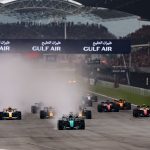
The FIA failure in Malaysia exposed one of the most uncomfortable contradictions of modern Formula 1: while the series seeks to establish a new technological era and defend the appeal of its current regulations, a software problem left several cars with virtually no response during the laps leading up to the race. The incident occurred in wet conditions at Sepang, with drivers circulating slowly behind the safety car, and ultimately forced the start to be delayed while the governing body worked against the clock to implement an update that would allow the cars to move again.
The problem took on greater significance because it was not simply an isolated mechanical issue. Power management in the current hybrid engines, increasingly dependent on electronic systems and software, was exposed when a combination of low engine speeds, limited grip and extremely low speeds triggered a situation that had not been accounted for during testing. Max Verstappen was among the first to report a loss of power, while Lewis Hamilton came to a complete stop and other drivers described an unusual sensation in the accelerator pedal. The scene, with several cars unable to move normally, even led the drivers themselves to joke about what had happened while they waited for a solution.
The rain exposed a failure that FIA testing had not anticipated
According to the explanation provided by Nikolas Tombazis, the FIA’s single-seater director, the cause was software developed by the governing body together with the teams over several years. The system includes a reduction in electrical power to 250 kW under certain wet-weather conditions, but it had not been tested in a situation like the one that occurred at Sepang: cars travelling at exceptionally low speeds, grouped behind the safety car and constantly changing pace. Some cars entered a kind of loop that prevented power from being deployed again, leaving drivers without a normal response from the accelerator.
The nature of the problem meant that its effects were not identical across the field. Some cars reached speeds low enough to trigger the failure, while others never entered that condition. The so-called accordion effect created by changes in pace behind the safety car generated differences even between cars using power units from the same manufacturer. For the drivers, the experience was particularly confusing. Oliver Bearman explained that he had never experienced anything similar and that the pedal appeared to have stopped being connected, while the FIA is still analysing why the problem also affected the perceived operation of the internal combustion engine.
An emergency solution that allowed the race to resume
With the race stopped, the FIA had to find a response within minutes. The governing body quickly identified the relationship between the extremely low speeds and the power restrictions and developed an update that removed those limitations in the mini-sectors where the failure had been triggered. The teams had to install the modified software before returning to the track, creating a considerable delay but ultimately allowing the race to get underway. Tombazis defended the speed of the technical team’s response, although he acknowledged that the update could not undergo the usual testing due to the lack of time.
The incident, however, opened up a much broader discussion about the degree of technological dependence of modern single-seaters. The software had previously been tested by several teams, but never under the specific conditions encountered at Sepang. The FIA itself acknowledges that the scenario was not adequately considered, despite the fact that a race in wet conditions makes the appearance of a safety car, and therefore reduced speeds, particularly likely. The governing body will now have to review with the teams and power unit manufacturers not only the specific failure, but also the procedures used to validate systems that directly affect the delivery of power to the cars.
 Last related articles