World Environment Day 2026 arrives with climate change as its central focus and with a message that calls for moving from commitment to action. In sport, the date offers an opportunity to look beyond symbolic campaigns and examine how some international and continental federations are developing concrete projects around sustainability, climate resilience, ecosystem protection, circular economy, air quality, mobility and environmental education.
The cases show an increasingly clear trend: sport no longer treats the environment as an external issue, but as a condition that directly affects its competitions, infrastructure, athletes and communities. Oceanian football looks to the islands of the Pacific, rowing to rivers and coasts, sailing and cycling to high-performance materials, athletics to the air breathed by runners and fans, biathlon to the loss of snow, and motorcycling to technological and energy transition.
Oceania, where climate change is already altering football
The Oceania Football Confederation -OFC- has used World Environment Day to reaffirm its commitment to environmental sustainability and climate resilience across the Pacific. Its case is especially relevant because the region is already experiencing direct impacts such as rising temperatures, stronger cyclones, coastal flooding, water shortages, extreme rainfall and changing weather patterns. Research commissioned by the OFC from Madeleine Orr, of The Sport Ecology Group, concluded that all its member associations are already experiencing the effects of climate change, with consequences for matches, training, travel, venues and infrastructure.
OFC Head of Social Responsibility Teeny Aiken said the future of Oceania’s football community depends on collective action and recalled that communities across the region experience these impacts “on a daily basis”. The confederation has also become the first continental football association to join the Sports for Nature framework, an initiative linked to the International Union for Conservation of Nature -IUCN-, the International Olympic Committee -IOC-, the United Nations Environment Programme -UNEP-, the Secretariat of the Convention on Biological Diversity and Dona Bertarelli Philanthropy. Its agenda includes environmental education, community clean-ups, tree planting, recycling, awareness campaigns, sustainable policies and partnerships with environmental organisations.
Water, coasts and materials: projects that look at sport’s surroundings
World Rowing and WWF have focused on the resource on which rowing directly depends: healthy waters. Their Healthy Waters initiative aims to protect and restore rivers, lakes and coastal ecosystems through collaboration between national federations, clubs, athletes, organising committees and WWF offices. In Genoa, during the World Rowing Coastal Championships and Beach Sprint Finals 2024, the alliance presented pilot projects such as a seabed clean-up at Bagni San Nazaro and the involvement of Italian clubs in the WWF Mediterranean Adopt a Beach initiative, designed to monitor marine litter and fight plastic pollution.
Sustainability is also entering the field of equipment. The Carbon Fibre Circular Demonstration Project, coordinated by the World Sailing Trust and supported by the IOC, brings together federations such as World Sailing, the International Biathlon Union -IBU-, the International Tennis Federation -ITF- and the Union Cycliste Internationale -UCI-, alongside manufacturers and research centres, to give a second life to carbon fibre components. The UCI recalls that sport is the third-largest global user of this material, that many carbon sports products have an average lifespan of around three years and that 90% ends up in landfill. The project works to recover fibres from broken components and reuse them in new sports products, such as ski poles, sailing parts, bicycles or rackets.
Clean air, snow and athletes as voices
World Athletics brings sustainability into the field of urban health through its Air Quality Project, launched in 2018. The initiative installs air quality monitors in stadiums and event routes to create a real-time global database, study the impact of pollution on performance and health, and provide useful information for athletes, recreational runners, organisers and authorities. The project starts from a wide-reaching figure: around 1.4 billion people run regularly around the world and are exposed to a problem that, according to the World Health Organization -WHO-, causes more than seven million deaths each year.
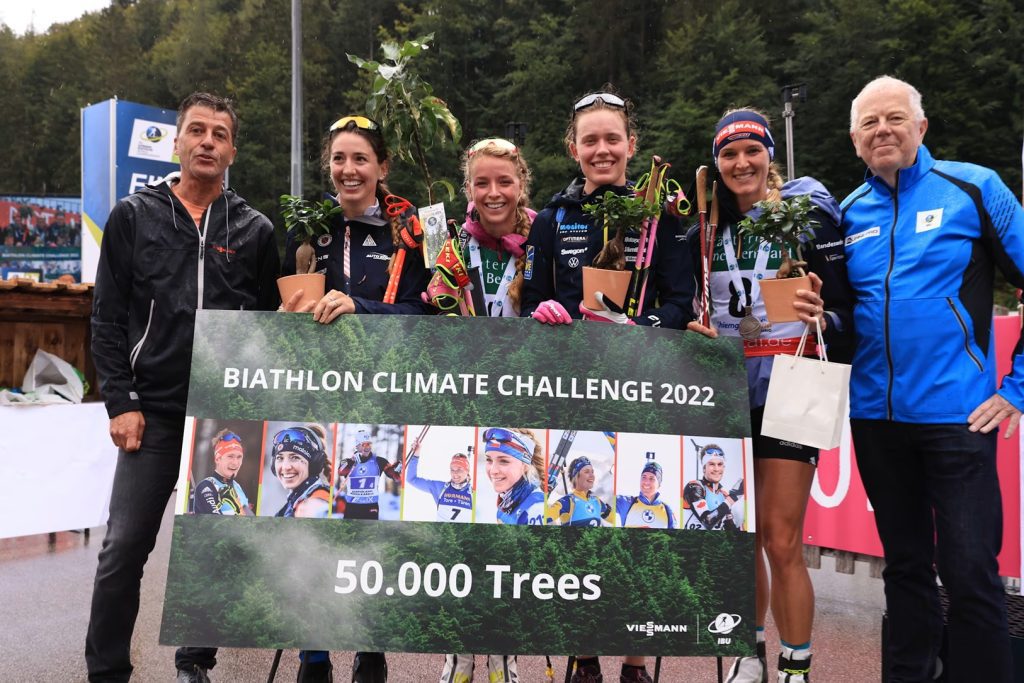
In winter sports, the International Biathlon Union has made climate a strategic priority. Its 10-year sustainability plan includes reducing the environmental impact of events, reviewing materials, education, governance and an athlete ambassador programme. The case of Canadian athlete Jules Burnotte captures that approach: he skied around 250 kilometres from Sherbrooke to Québec City to draw attention to the climate threat facing winters. “Snow is what makes us who we are,” he said. Riikka Rakic, the IBU’s Head of Strategy, Sustainability and Governance, explained that climate has become the federation’s number one focus because biathlon needs cold and snow, but also because its events and travel generate emissions.
Motorsport is also trying to respond to its contradictions
The Fédération Internationale de Motocyclisme -FIM- represents a different case, precisely because of the relationship between motorsport, emissions and technological transition. Its Sustainability Week 2026, from 1 to 7 June, coincides with World Environment Day and aligns with the #NowForClimate message. The federation places its action on several fronts: reducing the use of fossil fuels in MotoGP, transitioning towards sustainable fuels, consolidating electric motorcycles in disciplines such as Enduro and Trial, measuring and offsetting the carbon footprint of events, and the KiSS -Keep it Shiny and Sustainable- programme, focused on sustainable mobility, transport, waste and operational efficiency.
World Environment Day therefore leaves a shared reading for very different sports. The most credible initiatives are those that connect sustainability with the reality of each discipline: football with vulnerable island communities, rowing with rivers and coasts, sailing and cycling with circular materials, athletics with clean air, biathlon with snow, and motorcycling with mobility and technology. The challenge is no longer only to communicate environmental commitment, but to show which parts of the sporting system can change to protect the places, resources and communities on which it depends.
 Last related articles