The first blow for Bosnia against Qatar did not come from Edin Dzeko. Nor from Miralem Pjanic, or from any of the names who had carried the national team for years. It came from Kerim Alajbegovic, an 18-year-old born in Cologne, the son of Bosnian parents, who opened the scoring in the 29th minute with an individual move that brought Bosnia and Herzegovina closer to the knockout stage of the World Cup for the first time in its history. The 3-1 win had sporting value, but it also left an image of change: the familiar Bosnia was still there, with Dzeko as its symbol, but the story was beginning to be written from somewhere else too.
Alajbegovic may represent a different Bosnia to Dzeko’s, but not one separated from it. Dzeko is the memory of the generation that survived the siege of Sarajevo, took the country to its first World Cup in 2014 and turned the Bosnian shirt into a form of international recognition. Alajbegovic belongs to another geography: he was born in Germany, developed in German and Austrian academies, and reached the senior team after coming through Bosnia’s youth categories. He is not Dzeko’s footballing heir; he is the emotional heir to a shirt of which Dzeko, with Pjanic’s permission, has been the symbol and goalscorer for more than a decade.
Two Bosnias in the same shirt
Dzeko’s story explains an essential part of Bosnia’s relationship with football. His childhood was tied to Sarajevo, to parks and pitches marked by war, before his career took him on to become the country’s great sporting symbol and the first UNICEF ambassador for Bosnia and Herzegovina. In a letter addressed to Bosnian children before the World Cup, he described that journey as the passage from a childhood shaped by war to a life that ended up resembling a fairytale. His figure retains that weight because it brings together personal memory, the national team and international recognition.
At 40, Dzeko remains a reference point within a group that is beginning to change. In a recent interview, he admitted that he had not imagined he would still be playing at that age, but also explained that experience has become an essential part of his value. That presence helps explain the transition Bosnia is going through: the captain who took the country to its first World Cup at Brazil 2014 is still alongside a new generation trying to take the national team further in 2026.
The father, the diaspora and the road from below
Alajbegovic, by contrast, tells another part of Bosnia: that of the diaspora. He was born in Cologne on 21 September 2007, grew as a footballer between 1. FC Köln, Bayer Leverkusen and Red Bull Salzburg, and will return to Leverkusen after a spell in Austria. His personal map does not begin in Bosnia, but it leads back to it. Cologne is the place of birth; Leverkusen and Salzburg, the path of development; Bosnia, the choice that connects his career with his family history.
In that journey, one figure is central: Semin Alajbegovic, his father. He was also a footballer, although at modest levels of the German game, and is now an important presence in Kerim’s career, combining family support, playing experience and the role of agent. His story adds a human layer to his son’s profile. He is not just the father watching from the stands, but someone who knows the road from below, the lower categories, the limits of football and the difficulty of reaching the elite.
That family bond helps explain why Alajbegovic’s story is not simply that of a talent developed abroad who chooses a national team. It is also the story of a generation born far away, but emotionally educated close to the country of their parents. Bosnian local media and publications have linked the family to Bugojno, his father’s hometown, a detail that fits that dual geography: Germany as a place of life, Bosnia as a family root and the national team as the space where both identities can meet.
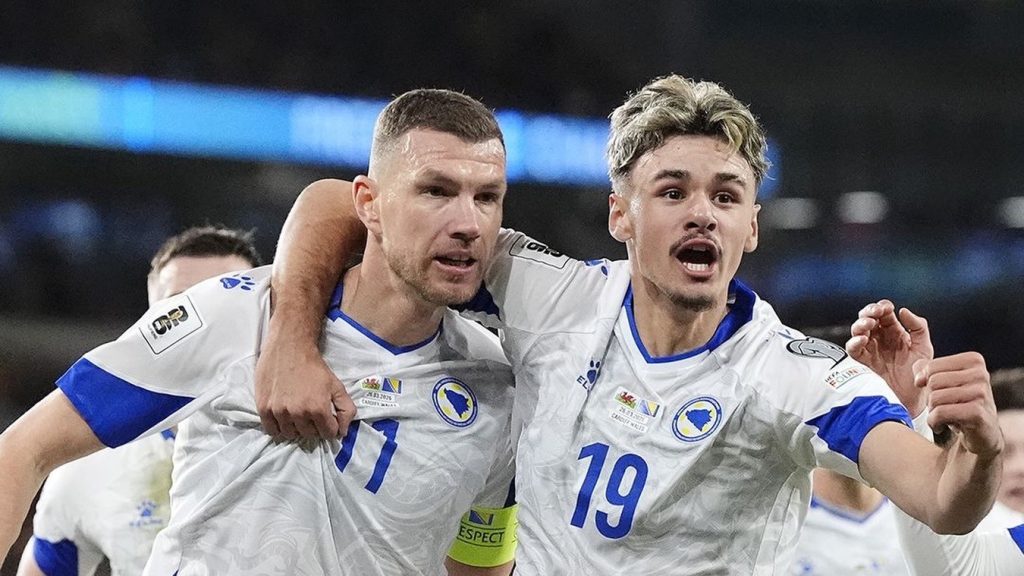
A transition that had already begun with Dzeko on the pitch
The connection between Dzeko and Alajbegovic is not only symbolic. Before the goal against Qatar, they had already shared a decisive moment on the road to the World Cup. In the qualifier against Wales, Alajbegovic assisted Dzeko and then scored the winning penalty. That sequence sums up Bosnia’s transition better than any label: it is not about a young player waiting for the great symbol to leave, but about a young player starting to win matches with the symbol still on the pitch.
Bosnia is gradually rebuilding itself. The national team still leans on veterans such as Dzeko, but it is beginning to find fresh air in younger players such as Alajbegovic, Ermin Mahmic and others from a generation growing between the country and its diaspora. It does not have the depth of talent of Europe’s major national teams, but it does have an identity that is expanding.
Alajbegovic’s career has accelerated in a short space of time. He came through 1. FC Köln, entered Bayer Leverkusen’s academy, moved to Red Bull Salzburg and later saw Leverkusen activate a clause to bring him back. Before appearing at the World Cup, he was already one of the young players being followed in European football.
 Last related articles