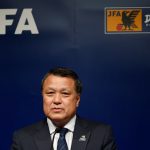
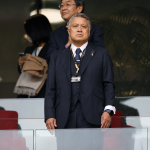
Kozo Tashima wants to challenge Gianni Infantino for the presidency of the International Federation of Association Football -FIFA-. On 5 November, the Japanese official announced his intention to stand in the 2027 election with the backing of the Japan Football Association -JFA-, which he led from 2016 to 2024. At 68, his career spans the national team, youth coaching, coach education and the FIFA Council, where he has served since 2015. At his press conference, he argued that the organisation needs to restore the honesty and integrity that he believes Japanese football has upheld.
Tashima made his final decision during the last week of October, after consulting JFA president Tsuneyasu Miyamoto. He had opposed the FIFA Forward Enterprise proposal, which envisaged opening part of FIFA’s competition business to private investors before it was withdrawn. At the Council meeting on 15 October, he also sought explanations for the suspension of Folarin Balogun’s ban and the difficulties Iran’s team encountered entering the United States during the 2026 World Cup. He believes those decisions raise questions about sporting integrity and host countries’ obligations. “Whether FIFA really has the ability to correct itself is being tested,” he said, explaining why he did not want Infantino to secure another term without an alternative.
The teacher who wanted to understand a different kind of football
Born in Kumamoto prefecture on 21 November 1957, Tashima discovered football while watching the Tokyo 1964 Olympic Games. At junior high school, he founded a team with friends and later captained Urawa Minami to the national high school championship. He continued his education at the University of Tsukuba, made seven appearances for Japan and played for Furukawa Electric, where his teammates included Takeshi Okada. His ambitions were rooted in education: he wanted to become a PE teacher and football coach. At the company, he worked in an occupational health centre, contributing to research into employee fatigue.
Two months in Cologne in 1980 changed how he saw football. He travelled to learn from FC Köln, whose players included Yasuhiko Okudera and Pierre Littbarski, and discovered differences that extended beyond playing ability. The facilities impressed him, as did training sessions in which heart rates were monitored and players were told not to run faster than instructed. He returned to Germany to study at the German Sport University Cologne between 1983 and 1986, learned under Dettmar Cramer and obtained a coaching licence. Back in Japan, he taught at university and, from 1993, helped the JFA develop its coach education programme.
Player development as a national project
His work in youth football led him to coach Japan’s U16 and U17 teams, including at the 2001 U17 World Championship, and subsequently the U19 side. In 2002, he became chair of the JFA Technical Committee and helped establish the JFA Academy Fukushima, serving as its headmaster from its opening in 2006 until 2012. The 2011 earthquake and nuclear disaster forced the academy to relocate its activities to Shizuoka. Maintaining the programme under those circumstances added an educational and community responsibility to a project designed to develop footballers.
In 2016, Tashima won the JFA’s first contested presidential election, beginning eight years in office before Miyamoto succeeded him in 2024. During that period, Japan reached the last 16 at the 2018 and 2022 World Cups, beating Germany and Spain in the group stage of the latter. His administration also provided support to clubs during the pandemic and reformed the association’s registration system and internal structure. In 2026, he was inducted into the Japan Football Hall of Fame, which recognised both his technical work and his institutional career.
The creation of the WE League, which began in 2021 as Japan’s first professional women’s football league, was another project delivered during his presidency. Tashima linked its launch to gender equality and women’s participation in society, although he later acknowledged that turning professional immediately after Japan’s 2011 Women’s World Cup victory might have accelerated its development. “There is no magic or miracle in football,” he told ‘DIME’. He attributed Japan’s progress to decades of development work, regional coaches’ efforts and overseas trips that exposed players to international standards.
The experience he brings and the obstacles he faces
His principal international asset is his knowledge of FIFA from within. He joined its Executive Committee in 2015, before Infantino became president, and remained when it was renamed the Council. He has also worked within the Asian Football Confederation -AFC-, led the East Asian Football Federation -EAFF- and served as vice-president of the Japanese Olympic Committee. He now proposes restoring the influence of FIFA’s committees and strengthening relations with the confederations. He supports generating revenue but insists that decisions about its distribution must be collective: “It is everyone’s money,” he said at his press conference.
His JFA presidency also involved controversial decisions. In April 2018, he dismissed Vahid Halilhodžić, who had qualified Japan for the World Cup in Russia, and appointed Akira Nishino with barely two months remaining before the tournament. Tashima cited a breakdown in communication and trust between the coach and his players. The decision drew criticism, although Japan went on to reach the last 16. He now faces a challenge on a different scale: he has never led an organisation the size of FIFA and must turn his technical and administrative experience into a proposal that appeals to associations with different priorities.
Japan’s backing is his starting point. To formalise his candidacy, he needs nominations from five national associations by 18 November and must pass an eligibility check. Tashima acknowledged that he could not yet be confident of winning, although victory remains his aim. UEFA has been seeking an alternative to Infantino, while AFC president Salman bin Ibrahim Al Khalifa has endorsed the incumbent, a declaration that does not bind Asian associations’ votes. Ramon Vega has also announced his intention to stand. Tashima has until the nomination deadline to secure support ahead of the election on 18 March 2027 in Rabat, Morocco.
 Last related articles