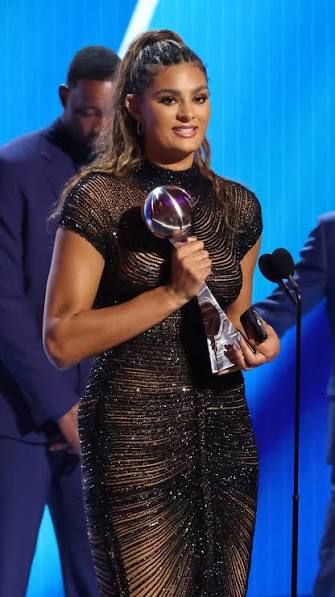
Lauren Betts received the ESPY Award for Best College Athlete in Women’s Sports in New York on Wednesday. The Washington Mystics player, selected with the fourth overall pick in the Women’s National Basketball Association -WNBA- Draft, devoted her speech to depression and the importance of asking for help. “Your mental health is not separate from your success. It’s the foundation of everything you do. The strongest people aren’t the ones who never struggle. They’re the ones who have the courage to let someone walk through their struggle with them,” she said.
Betts took to the stage after leading the University of California, Los Angeles -UCLA- to its first National Collegiate Athletic Association -NCAA- championship and being named the Final Four’s Most Outstanding Player. Behind those achievements is the story of a girl born in Spain who wanted to shrink to escape bullying, a teenager burdened by the pressure of being ranked the best player in her class and a university student who voluntarily admitted herself to hospital after recognising the severity of her thoughts. “I’m a daughter. I’m a teammate. I’m a sister. I’m a friend. Basketball is what I do, but it’s not who I am,” she explained at a Final Four press conference.
From a Spanish childhood to wanting to disappear in Colorado
Lauren was born in Vitoria-Gasteiz in 2003 while her father, Andy Betts, was pursuing a professional career that took the family across several European countries. Selected by the Charlotte Hornets in the 1998 NBA Draft, the British centre spent 14 years playing in Europe for clubs including Real Madrid, Baskonia, Joventut de Badalona, Cajasol Sevilla and Gipuzkoa Basket, as well as teams in Italy, Greece and Ukraine. His contracts meant that Lauren lived in Barcelona, Seville, Málaga and San Sebastián. Her mother, Michelle Betts, won the 1993 college volleyball championship with Long Beach State. “I had a magical childhood, living in Spain and travelling to all those countries,” Betts recalled in ‘The Players’ Tribune’.
The family moved to Colorado when she was eight, and the transition changed her relationship with her body. At her new school, she faced comments about her height, weight, voice and an accent shaped by British and Spanish influences. Some classmates called her an “alien” or a “giraffe” and crowded around her as she walked through the corridors. Lauren began wearing loose clothing, dark colours and understated hairstyles to attract less attention. “If I could, I would literally shrink. Or I would become invisible so that no one could see me. I was just so tired,” she told ‘ESPN’. Her teacher Dane Swanson, who was also very tall, became one of the few people with whom she felt she could identify.
 Basketball turned her height into a source of safety
Betts took part in dance, football and competitive swimming during her childhood. She began playing basketball because several of her football teammates had joined a team and she wanted to continue spending time with them. The court changed what her height meant: there, she could occupy space, stand out and connect with others through a quality that had previously caused her embarrassment. “When I started playing basketball, it was freeing. It became my happy place,” she wrote. A sport she had initially shared with friends eventually earned her, at the age of 15, one of the 12 places on the United States under-16 national team.
During the 2019 FIBA Americas Championship in Chile, a teammate told her over dinner that ‘ESPN’ had ranked her as the leading player in her class. Until then, Betts had been unaware of the influence of those rankings. “That was when the pressure arrived. I felt that I constantly had to prove I deserved to be in that position,” she recalled. She joined Stanford University in 2022 as the country’s highest-rated prospect but came off the bench in all 33 games and averaged fewer than ten minutes. She has described that season as “miserable” both mentally and physically: her sense of personal worth became tied to points, minutes and production. After one year, she transferred to UCLA in search of an environment where she could rebuild her confidence.
The morning Lauren Betts asked for help
In January 2024, during her first season in Los Angeles, months of anxiety and depression developed into a particularly serious crisis. Betts woke up one morning experiencing suicidal thoughts and realised she could not continue with her usual routine. She called a member of the team staff, who collected her, and voluntarily admitted herself to UCLA’s hospital. After receiving medical care, she temporarily stepped away from her studies and missed four games. During that period, she continued to worry about what her teammates might think and even felt responsible for the defeats they suffered in her absence.
Michelle stayed with her for a week after she was discharged and supported her return to the team. Before resuming training, Lauren gathered her teammates in the film room and told them that she was living with depression. She expected them to feel that she had let them down; instead, she was met with hugs, tears and gratitude that she had asked for help. “I realised they loved me for me, because I’m Lauren and I’m their friend,” she wrote. She then began treatment that initially involved therapy sessions almost every day. Her therapist, Joy, helped her separate her identity from her performance and recognise when she needed to stop. “My mental health isn’t perfect. It’s an ongoing project,” she said.
The support network that accompanied her to the WNBA
Her mother remains the “safe place” she turns to when discussing the most personal parts of her life. Head coach Cori Close and the UCLA staff prioritised her recovery over her return to competition; assistant coach Shannon LeBeauf became an almost maternal figure, while Dawn Staley, head coach at South Carolina, remained in contact with Michelle during the most difficult period. Betts also remembers Ervin Johnson, one of her earliest coaches, who defended her in front of classmates who had bullied her for years and told them: “This girl is going to be on national television.” Her sister Sienna Betts completed that support network when she joined Lauren at UCLA for her final college season. They had played together as children and shared a team again four years later before winning the university’s first NCAA title.
Eight days after winning the championship, Betts was selected fourth overall by Washington. Fifteen days after the final, she was already wearing a Mystics uniform at her new team’s media day. “I feel like I haven’t really breathed since I left UCLA. I’m taking it day by day and just trying to breathe and stay present,” she told ‘The Washington Post’. During the Draft, she thanked Joy for the mental work that enabled her to keep turning up on the court. Three months later, she appeared in front of the cameras to collect her ESPY and dedicate it to people facing similar experiences: “Protecting my peace is something I’ve pursued with the same determination as my dreams.”
 Last related articles