“I want young athletes with disabilities to see that they do not have to accept someone else’s definition of their limits. I also want to prove that when I step onto the range, I am not just a great para archer – I am one of the best archers in the world.” With those words, Matt Stutzman announced his return to competition after retiring at the end of 2024. The Paris 2024 Paralympic champion will attempt to secure the United States’ only men’s compound place for the Los Angeles 2028 Olympic Games, where the bowstyle will make its debut through a mixed team event. If he qualifies and reaches the podium, he would become the first archer to win medals at both the Olympic and Paralympic Games and, according to Paralympic Movement records, only the second athlete to do so after Hungarian fencer Pál Szekeres. That possibility remains a distant one: Stutzman must first overcome the leading compound archers in the United States to earn the single men’s place.
“I thought winning gold in Paris was the perfect ending to my career,” Stutzman told USA Archery. “But when compound archery was added to the Olympic program for Los Angeles, I realized my story might not be finished. I have the opportunity to attempt something that has never been done before – and I have to take that shot.” His decision reopens a career he had brought to a close with another statement: “Archery has given me the world, and now it’s time for the next chapter of my life.” At 43, that chapter is taking him back to a bow he first picked up out of necessity, following a childhood spent finding his own way to do what others accomplished with their hands.
A childhood spent learning to adapt
Stutzman was born without arms on 10 December 1982 in Kansas City, Kansas, with doctors unable to identify a specific cause. He later recalled that his biological parents were told he would never be independent and that his care would cost millions of dollars. He was placed for adoption at around three months old and spent approximately ten months in foster care before Leon and Jean Stutzman adopted him at 13 months. He grew up on a farm in Iowa with seven siblings in a family connected to the Mennonite community. His adoptive parents followed an approach that would shape the rest of his life: preparing him to navigate the world instead of expecting the world to be continually adapted for him. If he needed to tie his shoes, eat, write or complete a household task, he first had to try to find his own solution. Over time, he learned to take care of himself, drive, feed livestock and repair machinery using his feet.
Archery did not enter his life until 2010, when he was 28, looking after his children at home and searching for a way to contribute to the family income. After watching the sport on television, he searched online for information about how a person without arms could shoot a bow but found no examples. At an archery shop, he was advised to buy a crossbow because it operated more like a firearm; Stutzman insisted on purchasing a conventional compound bow despite not yet knowing how he would shoot it. He developed his own technique: holding the bow with his right foot, nocking the arrow with the toes of his left, connecting the string to a release aid attached near his shoulder and leaning back to draw before activating the mechanism with his jaw. Apart from that release aid, he has essentially used the same equipment as other competitors. When someone suggested that his first sponsor was supporting him only because he had no arms, he began training for up to eight hours a day. Two years after discovering the sport, he won silver at the London 2012 Paralympic Games.
 From disappointment to gold in Paris
The silver medal made him one of the most recognisable athletes in para archery, but his career did not follow a straightforward upward path. In 2015, he hit a target from 310 yards — around 283 metres — to set a Guinness world record for the longest accurate archery shot, without distinction between archers with or without disabilities. Two years later, he won the compound men’s title at the US National Target Championships while competing against archers without disabilities, before becoming para archery world champion in Dubai in 2022. The Paralympic Games, however, became a source of frustration: he was eliminated in the round of 16 at both Rio 2016 and Tokyo 2020. He arrived in Rio carrying an injury to his shooting leg, and the nock of his final arrow broke; in Tokyo, he discovered after landing that his bow had been damaged during the journey. He also acknowledged a mental barrier: “In the past, when I’ve lost the Games, it’s because of a mental hurdle. I can’t believe I missed a shot, and then it stays in my mind, and then you make another bad shot.”
He changed his preparation before his fourth Paralympic appearance. At one point, he put his bow aside for two months to focus exclusively on confidence and used skydiving to learn how to control adrenaline: he would shoot, board a plane, jump and resume training immediately after landing while his heart rate remained elevated. His place in Paris was not secured until the end. Stutzman began the final stage of the USA trials in seventh place before climbing to second and earning selection. His then-fiancée, Jessica Wasson, launched a fundraising campaign with a target of $35,000 so that the family’s five children, his parents and two sisters could accompany him. It was the first time they had watched him compete at a Games in person. After ranking 19th in a qualification round affected by further equipment problems, Stutzman advanced through the decisive matches, survived two shoot-offs and defeated Ai Xinliang of China in the final with 149 points out of 150, setting a new Paralympic record. Twelve years after London, he had won gold in front of his family at what he called his ‘Memory Games’.
From motor racing to one final target with the bow
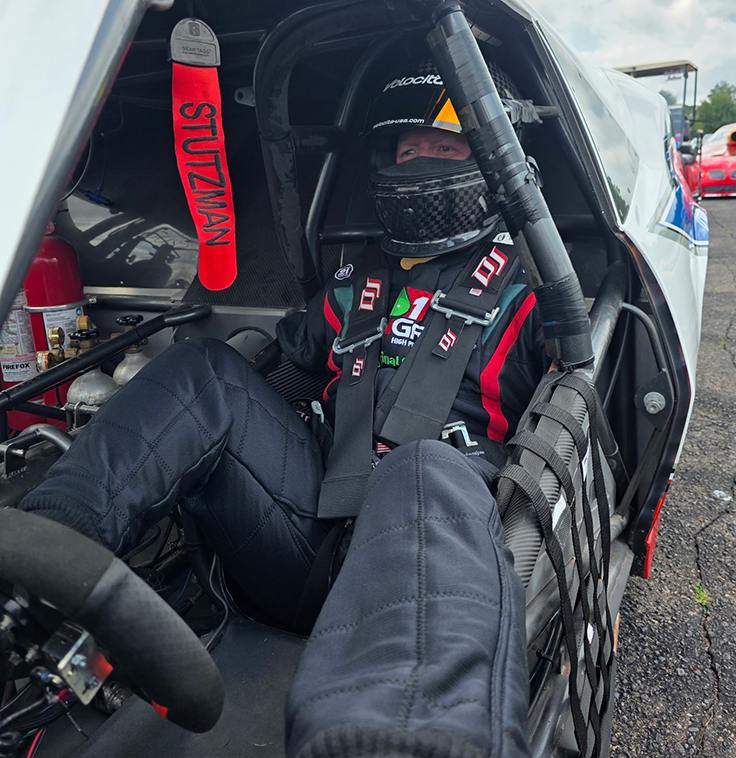
Retirement did not mean that Stutzman intended to leave sport. He had wanted to become a racing driver since childhood. When he was eight or nine, someone gave his father a broken motorcycle and said Stutzman could keep it if he managed to repair it. He spent the summer taking it apart and eventually got it running. “The bike didn’t care that I had no arms; it worked for me,” he later recalled. Over more than a decade, he gradually increased his speed until earning a licence from the National Hot Rod Association -NHRA-. His race car retains a largely conventional design, but the steering wheel is positioned beside the pedals. He controls it with his right foot, which also operates the transbrake and parachutes, while his left foot works the accelerator and brake. Mechanical cables allow him to release his safety belts, window net and door; during a blind exit test, he escaped the vehicle in around 18 seconds. In 2025, he surpassed 200mph, reached 214.69mph — more than 345km/h — at Brainerd and competed in Top Sportsman at the U.S. Nationals.
While pursuing that career, his influence was already spreading among a generation that did not exist when he first searched for a way to shoot without arms. Four archers without arms competed in Paris, and Stutzman faced Mexico’s Víctor Sardina Viveros in the first Paralympic match between two of them. He also advised India’s Sheetal Devi, a mixed team bronze medallist who had used videos of him as a reference when learning the sport. Stutzman must now return to national and international competition to pursue a place in an Olympic event limited to 12 pairs, with one woman and one man representing each country. The United States has a host quota subject to participation requirements, but he must earn the men’s selection. The Olympic qualification pathway begins in 2027, while competition will take place at Dignity Health Sports Park in Carson, with the qualification round scheduled for 19 July 2028 and the medals to be decided on 21 July. “Nothing is guaranteed – not qualification, not selection and certainly not a medal,” he has warned.
 Last related articles