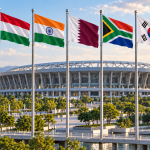
The Olympic movement is once again facing a contradiction that is difficult to explain. Just a few days apart, the Olympic Winter Games Milano Cortina 2026 and the Paralympic Winter Games Milano Cortina 2026 coexist with two different criteria regarding the same conflict: Russia’s invasion of Ukraine. While the International Olympic Committee –IOC-, led by Kirsty Coventry, maintained the ban on any Russian national representation, the International Paralympic Committee –IPC-, led by Andrew Parsons, allows the Russian flag and anthem in case of victory (they already have one gold). Why do two organisations that share values, symbols and a calendar adopt such different positions on the same issue?
The IOC has maintained a clear line for years. Russia’s invasion of Ukraine caused a political and sporting earthquake that led to expulsions, bans and sanctions across almost all international sport. The Olympic movement has only allowed Russian athletes to compete under strict neutrality conditions, without flag, without anthem and without any state reference.
Two Games, two criteria
The message is consistent with the position of most international organisations. The UN, the EU and many sports federations maintain a stance rejecting the Russian aggression. In that context, the IOC tries to preserve an institutional neutrality that avoids legitimising, even symbolically, the aggressor country.
But the IPC has chosen a different path. At the Paralympic Winter Games Milano Cortina 2026 the Russian flag is allowed to be raised and the anthem played if a Russian athlete wins gold. And in fact it has already happened. Russia currently has one gold and two bronze medals, placing it tenth in the medal table and meaning the Russian anthem has already been played in Italy during the Paralympic competition.
The precedent of the Ukrainian skeleton athlete
The inconsistency becomes even more evident if some recent decisions by the IOC itself are observed. During the Olympic Winter Games Milano Cortina 2026, Ukrainian skeleton athlete Vladyslav Heraskevych was disqualified for using a helmet whose design paid tribute to Ukrainian athletes and coaches who died in the war against Russia. The reason was violating the rules of political neutrality and the message was clear. Not even a tribute to victims of war can appear on the Olympic stage if it is interpreted as a political position.

However, just a few days later, during the Paralympic Games, the flag of the invading country has been allowed to wave and its anthem to be played normally. The paradox becomes even greater when looking at the Paralympic medal table itself. Ukraine currently occupies second place, only behind China, with ten medals in total, three of them gold. While Ukrainian athletes compete at the top of the podium, the country that invaded their territory can also hear its anthem in the same Games.
The door to soldiers in 2030
The issue becomes even more delicate with another debate opened by Andrew Parsons. The IPC president has raised the possibility that Russian soldiers -and presumably also Ukrainian ones- who are wounded and disabled in the conflict could compete at the Paralympic Games in 2030 (French Alps).
The proposal has been presented as a matter of inclusion. But it inevitably opens an uncomfortable debate because those soldiers are not only victims of the conflict. They may also have been active combatants in the war. Some could have participated in military operations and everything that entails… including the death of other human beings.
Does it make sense to open that debate now? Even more so when, just a few days ago, the Olympic movement itself was calling for the traditional Olympic Truce, that symbolic appeal to stop conflicts during the celebration of the Games. In that context, proposing the participation of soldiers wounded in the conflict seems, at the very least, an imprudent decision.
A sport that does not speak with one voice
The inclusive message is appreciated, like the one seen in the peaceful Olympic Village of Paris 2024, where there were no problems at all. However, the different position regarding Russia shows that world sport is not speaking with one voice and that creates confusion.
The Olympic and Paralympic movements share history, values and stage. The Games take place in the same cities, use the same infrastructures and symbolise the same idea of sport as a tool for unity. If those values are the same, it is difficult to understand why the political decisions are so different.

Perhaps this is one of those debates that Kirsty Coventry and Andrew Parsons will inevitably have to address. Not to standardise every decision, but to prevent sport from sending contradictory messages about one of the most serious conflicts of our time.
When the flag that cannot appear at one Games can appear at the next ones, held in the same place and only a few days later, the question stops being a sporting one. It simply becomes a matter of coherence. It is not about having more sensitivity with some athletes than with others, it is about having the same rejection or approval of a war or an invasion.
 Last related articles