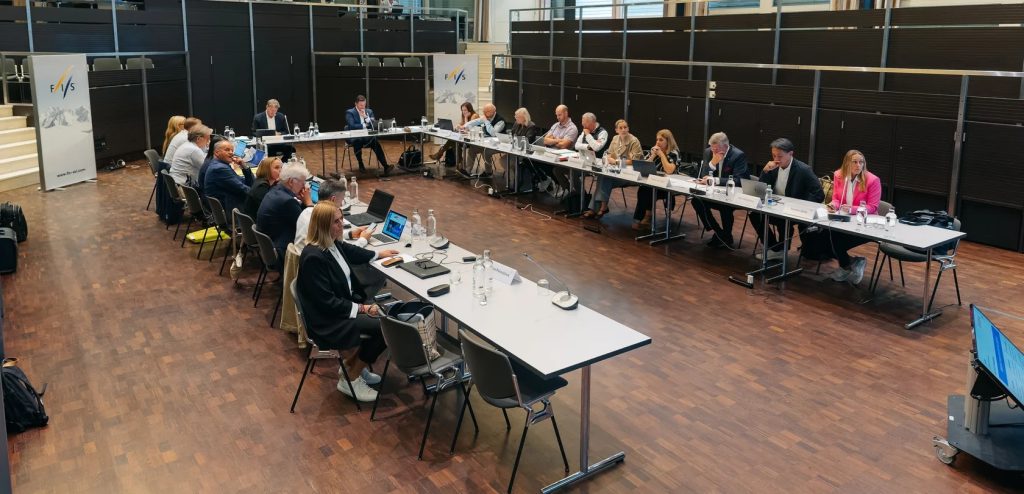
The International Ski and Snowboard Federation -FIS- intends to increase the frequency of its World Championships by staging them in every year without a Winter Olympic Games. Its Council backed the idea during a two-day meeting in Thun, after receiving a preliminary study covering sporting value, calendar implications and commercial and broadcasting potential. The model would begin in 2032, adding editions in even-numbered non-Olympic years to the World Championships currently held every two years during odd-numbered seasons. FIS will also examine whether the change could be brought forward to 2028, although that possibility requires a more detailed assessment. There is therefore an agreement in principle, but no definitive calendar with confirmed hosts, disciplines and formats.
The reform would fill the seasons that currently have neither a World Championships nor an Olympic Games, but it has also opened a discussion about the value of those competitions. Johannes Høsflot Klæbo and Calle Halfvarsson fear that greater frequency will diminish the importance of the title, while Halvor Egner Granerud and several coaches and former athletes believe it will create more opportunities and give every season a major objective. Other questions sit between those positions: whether the World Cup will lose prominence, whether athletes will become even more selective about the events they enter, whether enough organisers can be found and whether increased broadcasting revenue will also benefit host venues. For now, the public discussion is concentrated on cross-country skiing, ski jumping and Nordic combined, without significant responses from leading current figures in Alpine skiing, freestyle skiing or snowboarding.
The value created by waiting
Klæbo, one of cross-country skiing’s leading figures, responded to the proposal with scepticism. “A World Championships should be special enough to mean something,” he said. The Norwegian does not oppose FIS exploring changes, but questions whether the annual model used by other winter sports adequately protects the prestige of their championships. His comparison is the Olympic Games, whose four-year cycle restricts opportunities and increases the significance of every performance. A cross-country skier may spend several seasons preparing before being able to compete for another Olympic medal; under the new FIS calendar, they would have a World Championships almost every year. There would be more opportunities to win titles, but each edition would also spend less time at the centre of the sport.
Halfvarsson used an even more direct phrase: “Less is more”. The Swede believes that anything repeated too frequently stops feeling exceptional and said he would prefer to retain the existing system. His criticism also extends to the federation’s decision-making process: “FIS often goes its own way.” Niklas Jonsson, the new head of Sweden’s cross-country team, acknowledged that he had not known the proposal was under consideration and clarified that Sweden had not pushed for the change. Former cross-country skier and commentator Anders Blomquist identified another competitive consequence: if every season contains a World Championships, athletes may skip more World Cup events to concentrate their preparations on the major championship. The circuit could therefore regularly lose some of its leading competitors.
Austria fears title inflation
The strongest institutional opposition has come from the Austrian Ski Federation -ÖSV-, whose conference of presidents had already voted unanimously against the reform before the Council meeting. The organisation fears an “inflation” of championships, a reduction in the value of the world title and a loss of relevance for the World Cup. It has also requested access to the feasibility study considered by FIS and clarification about how far the decision actually extends. Its sporting director, Mario Stecher, a two-time Olympic Nordic combined champion, shares that opposition: he believes the World Championships would lose their special status and that the regular circuit would pay part of the price. Austria’s criticism therefore brings together the two central concerns: the symbolic value of the medals and the balance of a season that cannot be built solely around one major event.
Granerud looks at the same calendar from a different perspective. The two-time overall ski jumping World Cup winner believes that an annual edition could be more suitable than a biennial cycle because performance can fluctuate considerably between seasons. A ski jumper may dominate one winter and be far from their best two years later, when the World Championships return. Increasing the number of opportunities would prevent an injury or a period of poor form from defining a large part of an entire generation’s career. Olympic and world medallist Teodor Peterson also does not believe that the additional titles will lose their value and argues that more athletes will be able to build their careers around major medals. Petter Soleng Skinstad, a former team director, adds that seasons without an Olympic Games or World Championships currently lack a comparable conclusion.
A showcase beyond northern Europe
Finnish cross-country head coach Joakim Abrahamsson supports the reform because of its potential impact outside the sport’s traditional markets. Norway, Sweden and Finland can maintain strong interest through the World Cup, but the circuit has greater difficulty attracting audiences and coverage in other European territories. A World Championships provides a simple narrative, concentrates attention over several days and presents each discipline to viewers who do not follow the entire season. Abrahamsson says he has encountered no opposition among Finnish cross-country skiers, although he acknowledges that the Tour de Ski will need to be protected. Norwegian experts Torgeir Bjørn and Fredrik Aukland share that view: World Championships can generate media and commercial relevance while offering another platform to disciplines such as Nordic combined, which has been left out of the 2030 Winter Olympic programme.
That potential growth does not remove the financial and organisational difficulties. Stefan Schwarzbach, an official at the German Ski Federation -DSV-, is open to examining the new cycle because it would increase opportunities for athletes and provide greater exposure to disciplines such as Nordic combined and telemark. However, he notes that Alpine and Nordic disciplines do not operate under the same commercial conditions and questions whether viable hosts can be found for the different championships every year. A World Championships can generate more content and rights revenue for FIS, but it does not guarantee a profit for the host territory. Other considerations include the burden placed on federations, volunteers and organisers, the availability of facilities and the need to accommodate the event without compressing the World Cup calendar even further.
A proposal designed for athletes that divides athletes
FIS president Alexander Ospelt argues that the change is intended to give athletes greater visibility and more opportunities. He says he has held numerous conversations with competitors without hearing any negative opinions and maintains that a champion will feel the same pride whether the World Championships are staged annually or every two years. The subsequent responses from Klæbo and Halfvarsson contradict, at the very least, the suggestion that the proposal enjoys general acceptance among athletes. FIS must now explain how the new cycle would affect each championship, what place the World Cup and Tour de Ski would retain and how costs and revenue would be distributed. More opportunities could help athletes and disciplines in need of exposure; preserving the value of each title will depend on ensuring that the additional editions do not turn the season’s leading event into a routine appointment.
 Last related articles