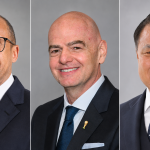
On 19 July, when Gianni Infantino attended the World Cup final, almost every FIFA member association supported his re-election. Nine days later, news broke of his negotiations to bring private investors into the commercial side of the tournament. Four months on, France’s Philippe Diallo and Japan’s Kohzo Tashima are seeking to succeed him. FIFA announced on Thursday that it had referred all three candidacies to its electoral committee. Former Switzerland international Ramon Vega, who had also announced his intention to stand, was absent from the list published after nominations closed on 18 November.
Infantino remains the favourite to win on 18 March 2027 in Rabat, although, if the committee admits all three candidates, he will have to defend his record against challengers for the first time since taking office in 2016. He was re-elected unopposed in 2019 and 2023. He can seek a fourth term because the FIFA Council decided in 2022 that his first three years, when he completed Joseph Blatter’s term, would not count towards the three-term limit in FIFA’s statutes. The English Football Association considered challenging that interpretation but decided against it because it believed a challenge was unlikely to succeed.
The deal that cost Infantino the support
The FIFA Forward Enterprise proposal would have brought commercial rights to the World Cup and other competitions into a single company, with a stake of around 20% to be sold to private investors. The deal could have raised up to $4.2 billion. For the associations, it raised two fundamental questions. The first was how much future World Cup revenue was worth giving up in exchange for that money. The second was who had authorised the president to negotiate on their behalf. The plan was abandoned in late July, and Infantino apologised to the Council for the way he had handled it. For France, England and other European associations that withdrew their backing, the explanation came too late.
Infantino nevertheless retained a broader coalition than either challenger. All ten South American associations expressed their support, as did Mexico and Qatar. The Confederation of African Football’s Executive Committee backed him unanimously, and the Caribbean Football Union announced its endorsement on 6 November. The most significant shift came in Tokyo on 23 October, when Asian Football Confederation president Sheikh Salman bin Ibrahim Al Khalifa endorsed Infantino’s re-election after having accused him of a breach of trust. Infantino also has something tangible to offer associations with fewer resources in the form of his pledge to allocate $25 million to each member association. In Rabat, however, each association will cast its own vote by secret ballot. Only on the day of the Congress will it become clear how many votes a confederation’s endorsement carries.
Diallo needs to take his campaign beyond Europe
Philippe Diallo has led the French Football Federation since 2023 and sits on UEFA’s Executive Committee. He previously represented French professional clubs and worked in FIFA’s dispute resolution bodies. He was also one of the officials who led the break with Infantino. On 16 November, at a meeting chaired by Aleksander Čeferin, the European associations represented on UEFA’s Executive Committee and the FIFA Council unanimously asked Diallo to stand. It is the most organised show of public support either challenger has secured. The scope of that unanimity matters. The statement records the position of the associations represented at the meeting and leaves open where the rest of UEFA’s 55 members stand.
Diallo’s challenge begins where Čeferin’s influence ends. Even a united Europe would account for little more than a quarter of the 211 votes. There are already exceptions, including Azerbaijan, which has publicly backed Infantino. The Frenchman has four months to explain to an African or Caribbean association how he would change the distribution of World Cup revenues and how much say it would have over how the money is spent. His negotiating experience gives him a case to make. The risk is that those associations will find it easier to see why UEFA wants a new FIFA president than why it is in their own interest to vote for Diallo.
Tashima seeks votes in Asia
Kohzo Tashima was a Japan international and a youth coach before becoming president of the Japan Football Association. He has served on the FIFA Council since 2015 and offers an alternative to those who want to curb the president’s power but are wary of a UEFA-backed candidate. During the World Cup, he questioned the decision to put US striker Folarin Balogun’s ban on hold after his sending-off, a specific instance in which Tashima called for greater transparency. Japan unanimously agreed to nominate him on 5 November and formally submitted his nomination on 17 November. Tashima secured the five nominations required but has publicly identified only Japan. His greatest difficulty lies on his own continent, where the confederation president has already come out in favour of Infantino.
The next date is 18 February 2027, the deadline for FIFA to announce which candidates have been admitted. A month later, if all three stand in Rabat and all 211 associations are present and eligible to vote, 141 votes will be needed to win in the first round. In a two-candidate contest with 211 valid votes cast, 106 will be enough. That difference gives Diallo and Tashima room to force a second ballot and explains why Infantino retains the advantage. He could receive 106 votes in the first round and win the final ballot with exactly the same support. To replace him, one of his challengers will have to build a majority that neither can yet claim.
 Last related articles