When Brittany Brown crossed the finish line in the 200 metres at the Paris 2024 Olympic Games, she placed third in 22.20 seconds behind Gabby Thomas and Julien Alfred. It was the first Olympic medal for a sprinter who had never won a collegiate title and had started the year recovering from a hip injury. It was also the greatest result of her career while competing with an endometrioma on one of her ovaries and endometriosis for which she had not yet undergone surgery. “This is for all the women who deal with health issues,” she said afterwards, dedicating the medal to those living with endometriosis or polycystic ovary syndrome and to athletes who felt overlooked.
Brown had spent almost a decade living with extremely painful and heavy periods, pelvic discomfort, gastrointestinal symptoms and episodes that could strike during training or competition. In 2023, she finally received a clinical explanation but postponed surgery because it could have removed her from Olympic preparations for several months. On 23 December 2024, after winning bronze in Paris and the Diamond League Final, she underwent laparoscopic surgery to remove the lesions. She returned to competition in less than four months but needed almost the entire season to recover her best performances. Ten months after the operation, she ran the fastest 200 metres of her life.
The pain she learned to consider normal
Her symptoms began while she was competing for the University of Iowa between 2014 and 2018. Brown has described periods accompanied by pelvic pain, nausea, diarrhoea and headaches while she tried to meet the demands placed on a collegiate sprinter. She also experienced anaemia and received iron infusions. Some flare-ups occurred during training sessions or meetings, but for years she incorporated them into her sporting routine. “At times it feels like this body I’ve been given is literally trying to attack me,” she wrote before the Games, while also recognising its ability to keep responding. Endometriosis is a chronic condition in which tissue similar to the lining of the uterus grows outside it, potentially causing inflammation, pain, heavy bleeding and fertility problems.
Finding an answer was not immediate. Brown has said that some doctors suggested a hysterectomy or having a child as possible solutions. She eventually turned to the medical network of the United States Olympic and Paralympic Committee -USOPC-, which connected her with a specialist associated with Texas Children’s Hospital. Blood tests and a transvaginal ultrasound revealed an endometrioma—a cyst associated with endometriosis—on one of her ovaries, as well as ovarian reserve indicators that were lower than expected for her age. Brown has described the 2023 assessment as a verbal or clinical diagnosis; surgery in December 2024 subsequently allowed doctors to locate the lesions and provide surgical confirmation. The explanation brought relief, but the information about her fertility created another concern. “The pain was something I was used to,” she explained, while the uncertainty surrounding fertility left her feeling isolated.
Competing before surgery
The proximity of the Olympic Games turned treatment into both a personal and sporting decision. An operation could interrupt her preparation for several months, so she initially explored other ways to manage the symptoms. She tried contraceptive pills, an intrauterine device, an implant and acupuncture, while also considering options intended to relax the pelvic floor and alleviate the pain. Most were permitted under anti-doping regulations, but Brown also had to assess how her body might react to any change introduced during the season. She was reluctant to add new medication close to a competition while maintaining the same diet, supplements and daily schedule. As she summarised it: “My body is my job.”
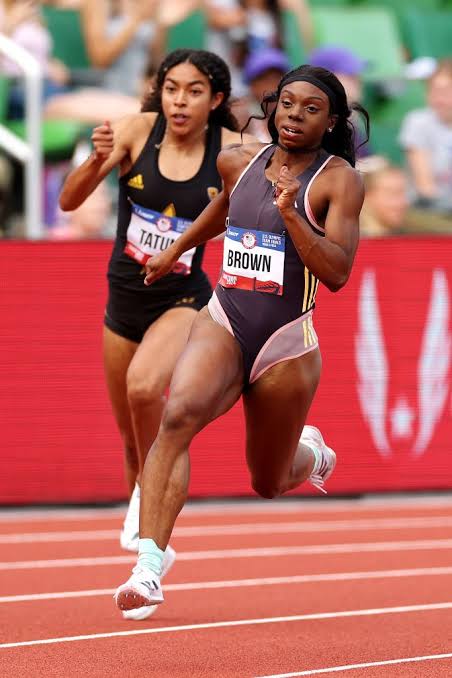 The decision became more difficult after Paris. Further testing indicated that her ovarian reserve markers had declined and that the endometrioma was growing. Brown had to choose whether to begin egg preservation or undergo surgery first. She ultimately prioritised the operation because the pain had intensified and she wanted to restore her physical well-being before considering fertility treatment. By then, she had completed the finest season of her career: she returned fully to the track in February following a hip labrum injury, ran a personal best of 21.90 at the US Olympic Trials, won bronze in Paris and ended the year by claiming the Diamond League Final. Those performances did not remove the condition; they showed how she had learned to compete while waiting to treat it surgically.
Returning without yet feeling like herself
Brown sought an excision specialist outside her usual healthcare network and travelled from Arkansas to Oregon. By her estimate, the surgery, consultations, travel and accommodation cost at least US$15,000. The laparoscopy located and removed endometriosis lesions, but her surgeon warned that being able to run would not mean immediately feeling as she had before. She might return to competition within months, but could need six to eight months—or almost a year—to feel fully herself. Brown raced again in April 2025, less than four months after surgery. “Was my first race good? No. But I did it,” she acknowledged. Her recovery included pelvic-floor physiotherapy, nutritional changes, rehabilitation and a gradual rebuilding of her training programme.
Her performances reflected that process. Brown ran 22.77 in Paris in June, lowered that to 22.21 in Silesia, won in Lausanne with 22.23 and retained her Diamond League title in Zurich with 22.13. After finishing sixth at the World Championships in Tokyo, she travelled to Athlos in New York, where she won the 100 metres in 10.99 and the 200 metres in 21.89, improving her personal best by one hundredth of a second. Brown also noticed that many of her sporting injuries had affected the left side of her body and that much of the endometriosis found during surgery was concentrated on the same side. Her surgeon considered the coincidence interesting, but there is not enough research involving professional athletes to establish a causal relationship.
 Last related articles