The inaugural edition of The Ocean Race Atlantic begins with an unusual feature: the six boats leave New York on 1 September, but the official competition does not start until the following day. The fleet must first sail to a virtual starting line located 145 nautical miles —around 268 kilometres— offshore. From there, four racing sailors and one reporter on each boat will face approximately 3,000 nautical miles —more than 5,500 kilometres— before reaching Lorient, in France, with the first arrivals expected on 8 or 9 September.
Eight days may seem short compared with the months required to sail around the world, but that is precisely where the difficulty lies. The Ocean Race Atlantic has been designed as an ocean sprint: its relatively short duration leaves less scope to sail conservatively, rest for longer periods or recover the distance lost through a poor decision. Teams will need to maintain a high pace almost from the start without exceeding the limits of their sailors or boats. The race was originally announced in 2024 with Barcelona as its destination, but Lorient was confirmed as the final arrival city in April 2026. The Breton city is home to much of the IMOCA fleet and is one of the world’s leading centres for offshore sailing.
Eight days to cross an ocean
The boats belong to the International Monohull Open Class Association -IMOCA-, a class of 18.28-metre monohulls with masts that can approach 29 metres in height. Their retractable foils generate lift, partially raising the hull above the water and reducing drag, although they do not make the boat fly completely as other types of craft can. In suitable conditions, they can exceed 30 knots and cover more than 1,000 kilometres in a single day. The class record stands at 641 nautical miles over 24 hours, a mark that could come under threat if the wind, waves and current align during the crossing.
The challenge lies in knowing when to exploit all that speed. The Gulf Stream moves north-east and can provide several additional knots, but it does not follow a uniform path: it forms bends, branches and eddies that navigators must identify using models, satellite images and water measurements. Its interaction with weather fronts and air masses over the North Atlantic can also create short, irregular waves. On board, every impact is transmitted through the structure and into the sailors’ bodies as they work amid noise, damp conditions, sudden movement and fragmented sleep. Two teams, Team Malizia and DMG MORI Sailing Team, face an additional unknown as they race their new boats for the first time.
Two women and two men on every boat
The race introduces the first mandatory 50-50 gender split in the 53-year history of The Ocean Race. Every team must compete with two women and two men, alongside an onboard reporter -OBR- responsible for producing photographs, videos, interviews and live connections from the ocean without forming part of the four-sailor racing crew. The rule extends a process started in previous editions: women accounted for 18% of competitors in 2014-15 and 28% in 2022-23, when every IMOCA team was required to carry at least one female sailor. The new format now guarantees equal representation and sporting responsibility throughout the crossing.
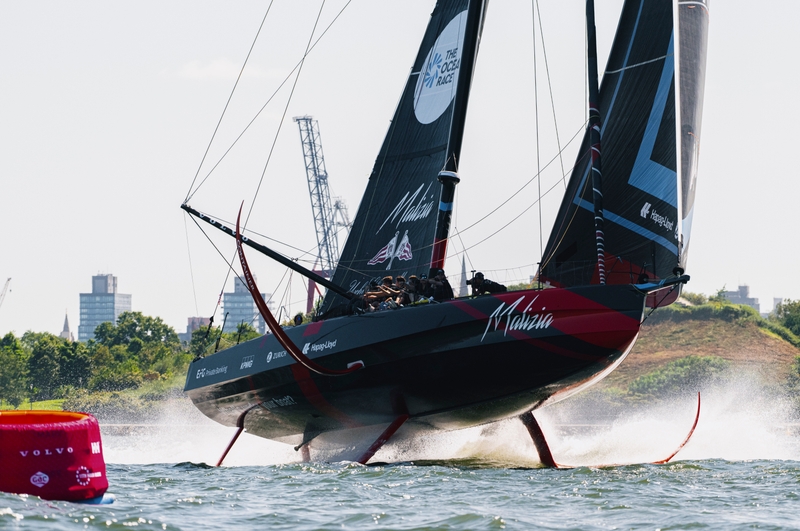
The fleet comprises Team Malizia, led by Boris Herrmann; Team Francesca Clapcich Powered by 11th Hour Racing, with Francesca Clapcich; United by the Ocean, headed by Paul Meilhat and Mariana Lobato; DMG MORI Sailing Team, led by Kojiro Shiraishi; Embrace The Challenge, with Oliver Heer; and New Zealand’s MSIG Europe, skippered by Conrad Colman. The 24 sailors are competing for the sporting title, while their teams simultaneously take part in the ‘Racing for the Ocean Teams Challenge’, which assesses them against 30 criteria covering operations, climate impact, boatbuilding, science, education, communication, inclusion and access to sailing.
Six boats transformed into laboratories
The offshore position of the starting line also reflects environmental considerations. Moving it away from the North American coast reduces the risk of encounters with whales, marine mammals and other megafauna found in those waters. During the crossing, the six IMOCAs will also become research platforms capable of collecting more than 800,000 measurements from the Gulf Stream. Four boats carry an automated unit that continuously records sea-surface temperature and salinity, dissolved carbon dioxide and oxygen, and atmospheric pressure. The other two transport systems designed to collect microplastic samples. The resulting information will be provided to scientific institutions including the GEOMAR Helmholtz Centre for Ocean Research Kiel, the French Research Institute for Exploitation of the Sea -Ifremer- and the French National Centre for Scientific Research -CNRS-.
The Ocean Race Atlantic is new, but it grew out of a history that began on 8 September 1973, when 17 boats left Portsmouth for the first Whitbread Round the World Race. Mexico’s Sayula II, skippered by Ramón Carlin, won that circumnavigation after 152 days of sailing. The competition was known as the Volvo Ocean Race between 2001 and 2018 before adopting its current name. Today’s foiling boats made their round-the-world debut in 2022-23, replacing the open decks and large crews of the early editions with protected cockpits, smaller teams, satellite navigation and yachts designed to maintain speeds that would once have been unthinkable.
Crossing the Atlantic is not without precedent either. The Volvo Ocean Race staged a 3,200-nautical-mile leg from New York to Portsmouth in 2006, while the 2018 edition sailed from Newport to Cardiff. The New York-Vendée also took solo IMOCA fleets from Manhattan to Les Sables-d’Olonne in 2016 and 2024. The novelty of The Ocean Race Atlantic lies in turning that route into a standalone, fully crewed competition rather than one leg of a round-the-world race. For several teams, it will also provide their most demanding test before the next edition of The Ocean Race begins in Alicante in January 2027.
 Last related articles