At Wimbledon, white is more than just a color—it is a centuries-old tradition. Every year, tennis’ most iconic tournament enforces a strict dress code that limits players’ creativity, but Naomi Osaka found in that very restriction the perfect space to tell a story. The Japanese star once again captured everyone’s attention during her 2026 debut by appearing in a spectacular white outfit inspired by her country’s ceremonial attire, transforming the customary walk to the court into a symbolic artistic performance.
Far from being a simple fashion statement, the design was conceived as an extension of the four-time Grand Slam champion’s identity. For several years, Osaka has turned every appearance at major tournaments into an opportunity to express emotions, cultural references, and aspects of her personal story. “I like to use fashion as a way to tell stories,” the tennis player explained, a philosophy that came to life once again at the All England Club through a collaboration that brought together Japanese tradition, haute couture, and elite sport.
A design that reinterpreted Japanese ceremony
The outfit was created in collaboration with Japanese designer Hana Yagi, who is based in Tokyo, and creative director Marty Harper, who has shaped Osaka’s visual identity for years. Their goal was never to recreate a traditional kimono but to reinterpret its essence for the Wimbledon stage. The result was an all-white ensemble adorned with delicate embroidered cranes, cherry blossoms, a dramatic trailing bow, a kanzashi—the traditional Japanese hair ornament—and jewelry by Mikimoto, completing an aesthetic deeply rooted in Japanese culture.
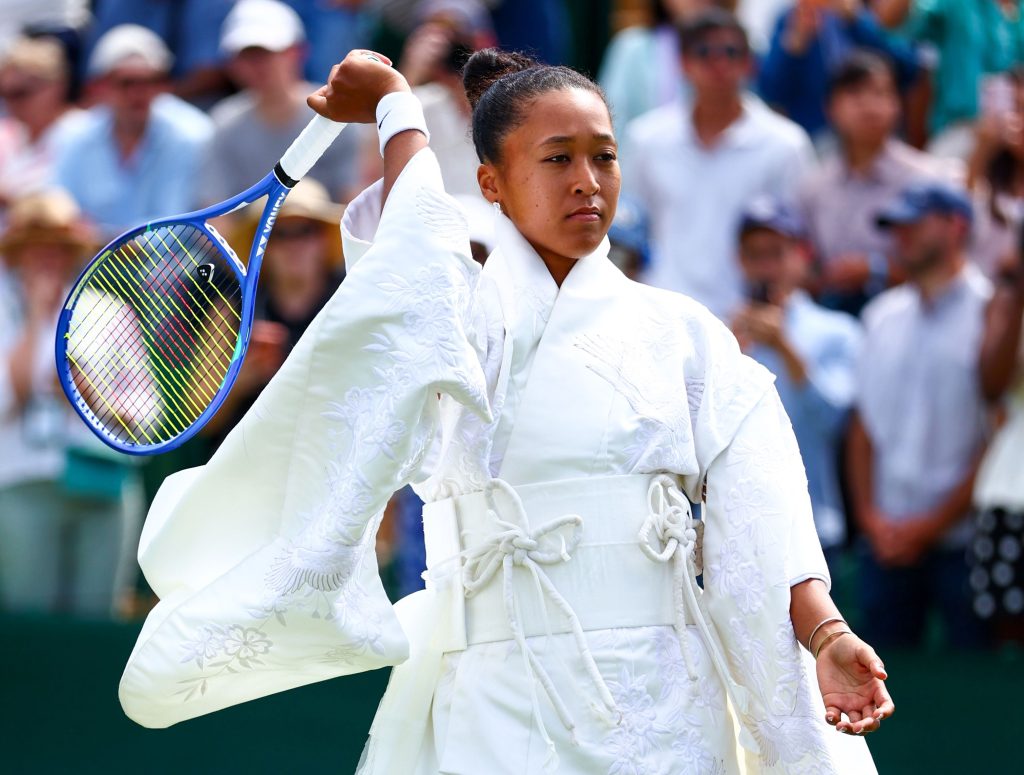
The richness of the design extended far beyond its appearance. Yagi crafted the garment using antique shiromuku wedding robes, kimonos, and repurposed ceremonial dresses that carried memories of significant moments in other people’s lives. For the designer, every fabric held memory, emotion, and history, allowing her to create a piece in which the past was not merely decorative but the true starting point of the narrative Osaka presented before every match.
The athlete’s transformation began before the first point
One of the design’s most striking features was its ability to transform. The garment consisted of multiple removable layers that Naomi Osaka gradually shed before the match began, slowly revealing the Nike competition kit underneath. This process turned the transition from the locker room to the court into part of the performance itself, as though ceremony and competition were two inseparable chapters of the same story.
Even the dress worn beneath the outer layer followed the same creative vision. Inspired by kirigami, the Japanese art of paper cutting, it featured geometric lines and three-dimensional floral appliqués that extended the dialogue begun by the ceremonial garment. Yet all of this craftsmanship had to coexist with the demands of elite performance. Harper explained that Naomi had less than a minute to transition from the ceremonial look to competition, meaning every creative decision also had to solve a technical challenge while ensuring the transformation felt seamless.
Fashion as identity and a new way of experiencing tennis
Wimbledon’s strict all-white dress code, rather than limiting creativity, became a source of inspiration for Osaka’s team. She admitted that working within those restrictions allowed her to focus on textures, materials, and garment construction, while Hana Yagi noted that the absence of color opened new possibilities to explore transparency, silhouettes, and sophisticated tailoring.
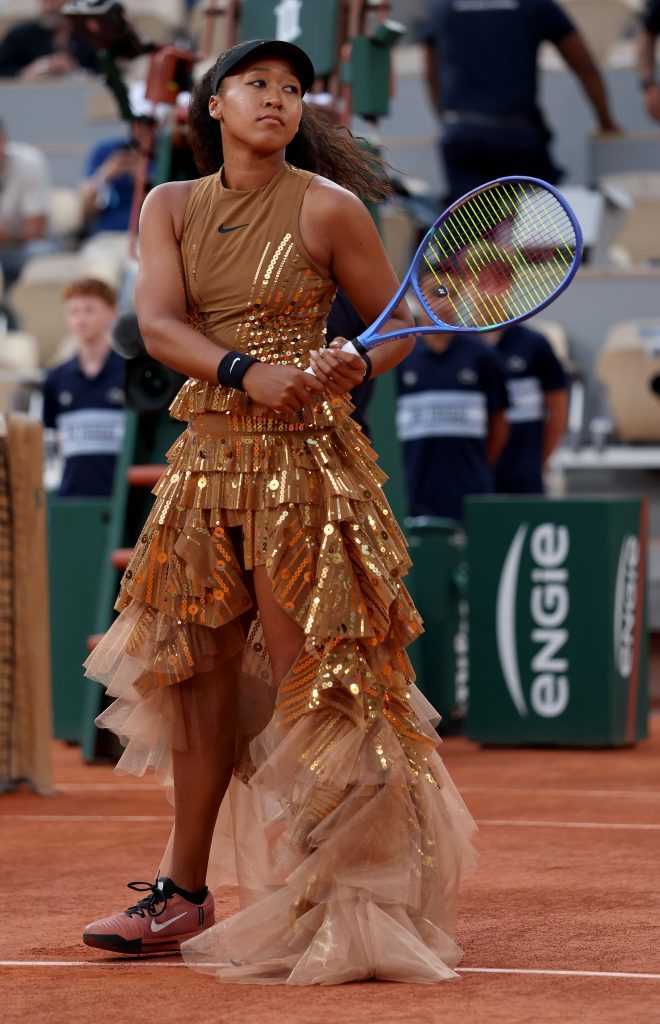
This creative exploration is part of an evolution Naomi Osaka has embraced over the past several seasons. At Roland Garros, she sparked debate with a corset made from recycled Nike uniforms and a crystal-embellished dress, while at the Australian Open, she stunned spectators with a design inspired by the strength of jellyfish and the delicacy of butterflies. Her fashion choices even divided opinions among fellow players: Laura Siegemund criticized the attention given to pre-match outfits, while Donna Vekic defended Osaka’s freedom to express herself. For Osaka, tennis and fashion are not competing worlds; they are two parts of the same identity, one that uses every walk onto the court to carry Japanese tradition into the future while remaining firmly rooted in the present.
 Last related articles