Ramón Navarro grew up beside the sea in Pichilemu, on the coast of Chile, before Punta de Lobos became a global reference point for big-wave surfing. His first relationship with the ocean did not come through a surfboard, but through his father, a fisherman, with whom he learned to fish, dive and understand the sea as a way of life. “I had a connection with the ocean way before I began to surf. It was in my blood, in my DNA,” he has said of a childhood shaped by water, tides and family work.
Navarro often explains that his father was not trying to give him an environmental lesson, but to teach him a trade. Through that life as a fisherman, he learned to respect marine life and to see the coast as a shared space, not as an infinite resource. He also remembers beaches with less pollution and less human impact, an image that contrasts with the pressure his own territory would later begin to face. “I learned to know the sea first. As my father is a fisherman, I learned to fish and dive. I had that connection with the sea long before surfing,” he recalled in an interview with Surfing Latino.
Before surfing, he learned to read the sea
Surfing came later, as a natural evolution of that earlier relationship. He was 12 or 13 when a surfer from the city first lent him a board. At the time, it was not common for fishermen’s children in the area to surf; those practising the sport usually came from Santiago or other urban backgrounds. For Navarro, getting on a board was not about discovering the sea, but about learning to read it from another place: he already knew its seabeds, currents, timing and character.
That way of being in the water eventually defined his career as a big-wave surfer. In Hawaii, on an outer reef in O‘ahu, other surfers remember him sitting quietly, short, with a moustache, holding the rails of his board and only lifting his eyes to scan the horizon. When a large set arrived and several surfers moved towards the channel, Navarro stayed inside, paddled into a huge wave and disappeared for a few seconds in the impact zone. He later appeared far down the line, on the shoulder of the wave, returned to the group without saying a word and sat quietly again. The scene captures part of his character: calm, determination and a relationship with the ocean built before fame.
 Big waves gave him a name, Punta de Lobos gave him a cause
Navarro later built an international reputation in some of the most demanding waves on the planet. He finished fifth at the Eddie Aikau in 2009, travelled to South Africa, Fiji and other parts of the world, and produced one of modern surfing’s most memorable images by riding through a giant barrel at Cloudbreak. His name began to circulate among the great specialists, but his story was never limited to performance. Big waves gave him a platform; Punta de Lobos gave him a cause.
His first major environmental episode came almost by accident, as he has told it. In 2001, in Pichilemu, a submarine outfall was planned to discharge waste into La Puntilla, one of the area’s iconic waves. The community came together against the project: fishermen, local businesses, tourism operators and surfers. Navarro, who was already beginning to stand out in national competitions and at the Ceremonial, took on a visible role from the surfing side. The opposition managed to stop a project that had already been approved, partly because surfers showed that the sandbanks changed and that the technical studies were not understanding the real dynamics of the place. “That opened my eyes to say: wow, we really do have power as surfers and as a community to defend the things we love,” he explained.
Defending Punta de Lobos was defending a way of life
The defence of Punta de Lobos became the next major step. The place was not only a world-class wave, but a cultural landscape, an area linked to traditional fishing, local identity and a way of relating to the sea. As surfing became more popular, tourism grew and real estate pressure increased, the old fishing environment began to change. Navarro became involved alongside other local actors and organisations such as Save The Waves to protect the coastline and prevent development from damaging what made the place unique.
That work helped Punta de Lobos be declared a World Surfing Reserve and protected as one of the most symbolic places in Chilean surfing. The conservation of the area is not understood only from a sporting perspective, but also through biodiversity, landscape, local culture, marine resources and traditional fishing rights. The Fundación Punta de Lobos has since continued conservation and restoration work within a vision that seeks to balance surfing, community and environmental protection.
A cause that continued beyond one wave
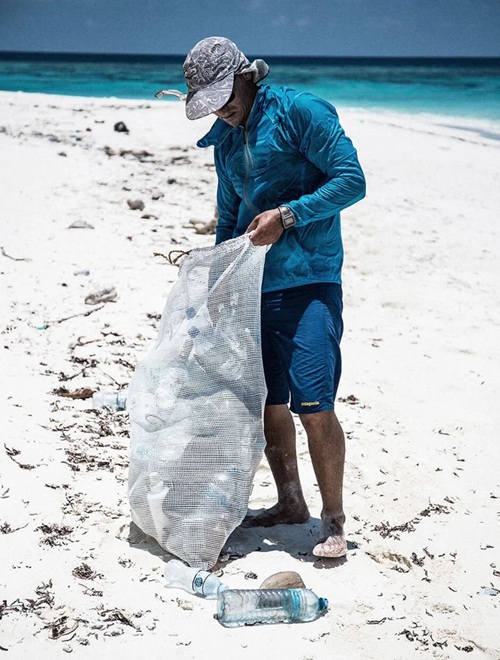
The defence of Punta de Lobos was not an isolated campaign. Since then, Navarro has continued to take part in initiatives to protect the Chilean coast, denounce environmental threats, support community processes and broaden awareness of the relationship between ocean, culture and future. He has also worked on educational projects such as Parley Ocean School, where he has highlighted the impact of taking children into the water and seeing how it changes the way they look at the sea. For him, knowing a place is the first step towards caring for it: “When you know and understand a place, you begin to love and care for it.”
His message has become especially generational. Navarro insists that those who have been able to experience nature have a responsibility not to close off that experience for those who come next. “If we had the opportunity to live it in nature, how can we deny future generations the opportunity to enjoy the beauty of our planet,” he has said. On a date such as World Environment Day, his story is a reminder that climate action does not always begin with big speeches, but with the concrete defence of a home, a beach, a wave and a community that learned to live facing the sea.
 Last related articles