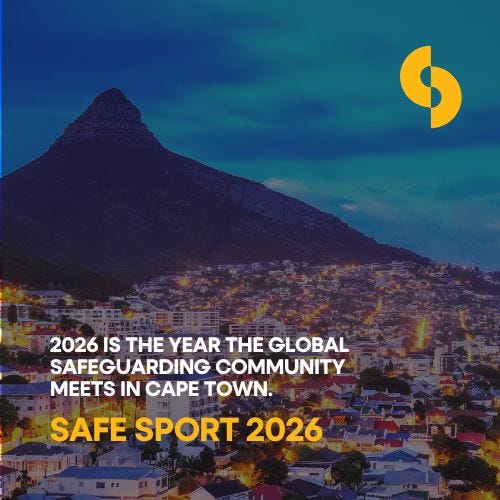
The University of Cape Town -UCT- hosted the Safe Sport Global Conference from 25 to 27 May 2026, an international event focused on protecting athletes and participants from abuse, harassment, exploitation, neglect and violence in sport. The conference brought together more than 500 delegates from 87 countries and was presented by the South African university as the largest gathering of the global safe sport movement ever held on African soil, with researchers, policymakers, athletes, educators, safeguarding specialists and sports leaders meeting under the theme “Moving safeguarding from intention to implementation”.
The significance of the event lay in positioning protection in sport as a matter of governance, integrity and institutional responsibility, beyond the formal existence of policies or internal codes. The conference was led by Safe Sport International -SSI-, UCT, Sport for Social Change Network Africa -SSCN- and the African Union Sports Council -AUSC-, with support and participation linked to the International Olympic Committee -IOC-, the Fédération Internationale de Football Association -FIFA-, World Rugby, World Athletics, UNESCO South Africa, the South African Sports Confederation and Olympic Committee and other bodies connected to integrity and protection in sport.
Safe sport, from intention to implementation
The first major focus of the event was turning safe sport into real systems for prevention, detection, reporting and response. Neal Anderson, CEO of Safe Sport International, summarised that idea by arguing that “safe sport does not happen by accident” and is not created by good intentions alone, but “must be chosen, built, resourced and sustained”. In his remarks, he linked that responsibility to clear values, accountable leadership, trusted systems and safety cultures lived every day inside sports organisations.
The first day, dedicated to knowledge mobilisation, focused on research, data, athlete rights, the design of safeguarding systems and youth participation. Sessions also addressed the relationship between protection and inclusion, mental health in and through sport, trauma-informed practice, the wellbeing of athletes and support teams, child protection and the need for policies to be built on evidence and on the experience of those who have lived through situations of abuse, vulnerability or harm within the sports system.
Research, mental health and survivors
The second day placed African leadership and continental innovation at the centre of the debate. Under that theme, the conference addressed responses adapted to the African context, gender-based violence, mental health, the creation of protection networks, human trafficking through sport, safeguarding in sports academies and the protection of children in low-resource or crisis settings. Specific issues were also discussed, including the inclusion of women and girls with albinism in African sport and strategies to end child sexual violence through research, survivor-led initiatives and practical safeguarding interventions.
Mosa Moshabela, UCT vice-chancellor, argued that sport can transform lives and open professional opportunities for young people from disadvantaged backgrounds, but only if those spaces are free from injury, abuse, harassment, exploitation and harm. David Maralack, associate professor and head of UCT’s School of Management Studies, linked the conference to the need to address the limited presence of Africa and the Global South in safe sport research, an absence which, he explained, has real consequences for athletes, officials, federations and communities facing these problems without enough evidence-based guidance.
 Africa and international federations
The final day, focused on global vision and solutions, addressed accountability, international standards, institutional readiness and the need for protection mechanisms to work in the daily practice of clubs, federations, competitions, academies and international organisations. Anderson warned that sport can become a place of deep harm when power is abused, dependency is exploited, boundaries are crossed or success is placed above people. “Violence, harassment and abuse in or through sport are never acceptable. Safe sport is the only sport that matters,” he said.
FIFA appeared as one of the relevant actors in that conversation. Kathryn Leslie, Senior Safeguarding Manager at the organisation, recognised the work of safeguarding officers operating with limited resources in different countries and argued that the international federation listens to its member associations in order to improve its systems. The conference also addressed age fraud as an issue affecting both protection and integrity, with calls for responsibility not to fall only on athletes, but also on officials and coaches who may facilitate such practices.
Work still to do
World Rugby and Rugby Africa used the conference as part of a broader process to build a continental safeguarding network. The event came after Rugby Africa adopted a continental safeguarding policy and procedures in February 2026 to prevent and respond to abuse, harassment, neglect and exploitation. Coralie van den Berg, Regional Partnership Manager for Africa at World Rugby, stressed that “the adoption of a safeguarding policy was a critical step, but policies alone do not protect people; people do”.
World Athletics also presented its experience after introducing a safeguarding policy in 2023 requiring its member federations to take responsibility in this area. Catherine Pitre, Senior Counsel at the international federation, said more work was still needed to ensure that no complaint is left without a clear route for action. “We still have a lot of work to do in terms of policy adoption and procedures to ensure that no complaint is left without a pathway to move forward and be addressed,” she said.
The conference concluded with the collective adoption of a Safe Sport Principles Pledge, aimed at strengthening accountability and safeguarding practices worldwide. In parallel, Rugby Africa plans to train and certify 25 safeguarding focal points from its member federations and move towards the adoption of protection policies in at least 50% of participating federations in the 12 months following the event.
 Last related articles