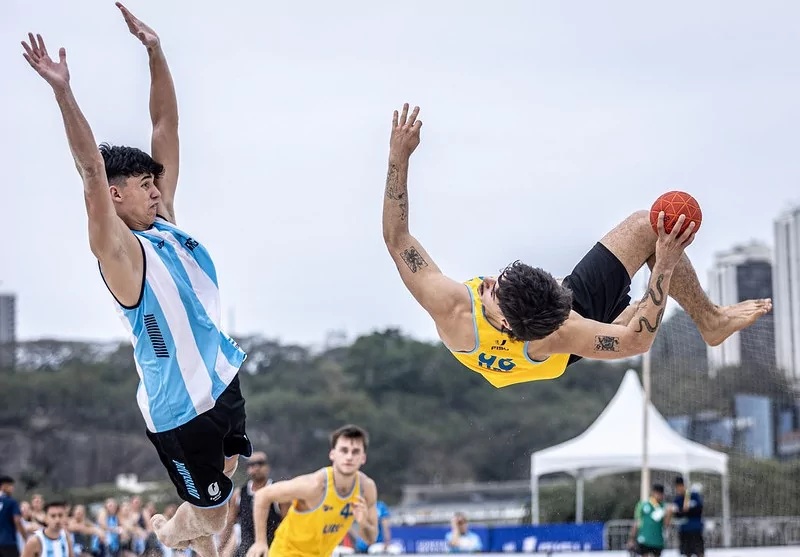
The International University Sports Federation -FISU- has brought around 600 delegation members and representatives of the sporting community from 31 countries and regions to Figueira da Foz, Portugal, for the second edition of the FISU World University Championship Beach Sports. Held from 17 to 22 September at Buarcos Beach, the competition awards world titles in beach handball, beach soccer, beach volleyball and beach wrestling. It is the championship’s first edition in Europe following its debut in Brazil and represents another step towards establishing a dedicated international structure for university beach sports.
The event is more than four world championships taking place at the same time. FISU is seeking to bring together disciplines with different histories and levels of international development within a single multi-sport property that shares venues, services, volunteers, broadcast production and institutional organisation. The format gives sports with smaller fields a platform they would struggle to achieve through separate championships, while allowing the federation to stage several sets of world titles over six days at a single venue. Figueira da Foz will show whether this combined structure can establish continuity beyond its first two editions.
From Rio de Janeiro to its European debut
The inaugural edition was held in Rio de Janeiro from 2 to 8 September 2024 and brought together approximately 1,000 participants from 34 countries. Brazil topped the medal table with six golds, three silvers and four bronzes, ahead of Argentina and Germany. Beyond the results, the event established a joint championship for the four sports and allowed athletes from different university structures to share a schedule, facilities and ceremonies. Figueira da Foz has now taken that format outside its country of origin.
Creating a common event does not mean that every discipline is new to the university sports system. FISU has organised World University Beach Volleyball Championships since 2002, giving the sport a broader international base. The innovation introduced in 2024 was its integration with beach soccer, beach handball and beach wrestling. The federation can therefore use beach volleyball’s accumulated participation and organisational experience to support a shared competition and give greater visibility to disciplines whose international university structures remain less developed.
One beach transformed into a multi-sport venue
The entire Portuguese event is concentrated at Buarcos Beach. The site contains a main beach soccer stadium, a secondary arena for beach handball, four beach volleyball courts and a dedicated beach wrestling area, alongside training and warm-up spaces for each discipline. Organisers have also provided changing rooms, showers, physiotherapy support and services for the delegations. This layout makes it possible to transform a beach already integrated into the city without constructing permanent sports facilities, while allowing spectators to attend the championships free of charge.
Its international reach, however, is not distributed evenly. Beach volleyball includes 25 countries in the men’s competition and 22 in the women’s, while beach wrestling has seven participating delegations. Beach handball features five men’s teams and four women’s teams, while beach soccer is limited to four countries and has only a men’s competition. The presence of representatives from all five continents demonstrates the global reach of the event as a whole, but does not mean that each sport has individually achieved the same level of development. One purpose of the combined format is precisely to provide competitive continuity for those smaller fields.
A programme still taking shape
The project has evolved since Portugal was awarded the event. The initial presentation envisaged more than 700 participants from 34 countries, 12 days of activity and five sports: beach handball, beach soccer, beach volleyball, beach wrestling and beach rugby. A discipline called Beach Ultimate Tennis was also announced as an exhibition event. The final programme has been reduced to around 600 delegation members, 31 countries and regions, four sports and six days of competition. FISU has not described this revision as a setback, but the differences show that the organisation is still adjusting the scale and content of a property created only two years ago.
The president of the Federação Académica do Desporto Universitário -FADU Portugal- and the organising committee, Diogo Salgado Braz, described the championship as “a milestone of great importance for university sport in Portugal” and a demonstration of the organisational capacity of the country’s higher education institutions. FISU President Leonz Eder has presented the event as an experience combining performance, education, social interaction and respect among university athletes. The schedule also includes the International Day of University Sport on 20 September, for which FADU has prepared activities involving participants and members of the academic community.
University, tourism and the blue economy
The event brings together FISU, FADU Portugal, the University of Coimbra, Figueira da Foz City Council and the Associação Académica de Coimbra, with support from the Portuguese Institute of Sport and Youth and Turismo de Portugal. The university’s involvement extends beyond providing athletes or ceremonial support. Coimbra’s Figueira da Foz campus develops teaching and research activities connected to the sea and the blue economy, linking the international competition to an existing academic and regional strategy. The municipality also presented the championship at Lisbon’s BTL tourism fair as an opportunity to attract delegations and visitors and strengthen the city’s identity as a coastal sports destination, although no estimate of its economic impact has yet been published.
Figueira da Foz will ultimately provide more than the results of four championships. FISU will be able to compare participation with the inaugural edition, assess the viability of staging several disciplines on a single beach and decide whether to restore previously proposed sports or retain a more concentrated programme. It must also determine whether the format can expand the beach soccer, beach handball and beach wrestling fields without losing beach volleyball’s contribution as its principal international base. Following Rio 2024 and its first European edition, the championship’s continuity will depend on whether the federation can turn the temporary coexistence of four sports into a recognisable structure for universities, national federations and future host cities.
 Last related articles