Katie Verderber reached the Milano Cortina 2026 Paralympic Winter Games barely two years after learning that she would spend the rest of her life in a wheelchair. A former military lawyer in the United States Army, injured during a mission in Afghanistan and later selected for the U.S. wheelchair curling team, her story does not begin on the ice, but in a hospital bed, in a newly formed marriage and in a sentence that sums up the place the sport would eventually occupy in her life: “I’m convinced curling saved my marriage.”
The injury dated back to 2019, when she was serving as a military lawyer in the United States Army and suffered spinal damage during an advising mission. She continued serving for three more years despite the pain and three failed operations, until in 2023, just months after marrying Danielle, emergency surgery failed to reverse the deterioration. One morning in October that year, she could not get out of bed; from the belly button down, her body had stopped responding. “I remember lying in the bed just thinking, things are eventually gonna wake up,” she later said. After two weeks in hospital, the diagnosis was definitive: paraplegia. “I was distraught, devastated, angry,” she admitted of those first days.
Afghanistan, spinal injury and the end of a previous life
Born in a small town in Montana, Verderber left her surroundings to study law at Syracuse University College of Law, a decision she has described as one of the most transformative stages of her life. There, she found her way into the JAG Corps, was assigned to Fort Hood and eventually deployed to Kandahar, where she advised military commanders on operational decisions. After injuring her back on a mission, her mobility began to deteriorate, but she continued working as a defence attorney for soldiers and went on to represent more than 140 clients. “I put everything into my clients,” she later said, “and not into my health.”
The physical blow came into a life that had already known another loss. Her father died in 2015, before she graduated from Syracuse and before her deployment to Afghanistan, but he remained an intimate presence during her recovery and her Paralympic journey. Verderber has said that her late father, Danielle and her three siblings were part of the motivation that sustained her when the injury changed everything. “He definitely inspires me and I know he’s proud,” she said of her father during the Games, in a week she described as emotional and in which she also spoke about her siblings: “I’m doing this for them and, hopefully, I can inspire them too.”
Danielle, nature and the first refuge before curling
On her return to Montana, Verderber had to relearn basic tasks, accept help she did not want to need and live with anger that also reached those trying to care for her. “I remember in the hospital bed, and them teaching me how to sit up properly and how to get dressed, and I hated everybody,” she acknowledged. At that point, DREAM Adaptive, a Montana organisation that brings outdoor sport to people with disabilities, entered her life. Just days after leaving hospital, Verderber was sit-skiing down Whitefish Mountain, the same mountain where she had married Danielle the previous summer. “It was full circle for Danielle and me,” she said. “Six months ago, I was standing on top of the mountain, and now I’m sit-skiing down it.”
Her bond with nature was a first way of moving again, although the more complex weight was at home. Danielle had gone from newlywed wife to caregiver, emotional support and companion to someone whose life had been suddenly altered. Verderber has acknowledged that curling gave her not only an activity, but also a space to talk about her disability, her mental health and her marriage with people who understood what her family could not always fully grasp. With Laura Dwyer, Steve Emt and other members of the team, she found a community capable of listening to her, but also of telling her difficult truths: she could vent to them, but she also had to hear how Danielle was hurting and be “the partner that Danielle deserves”.
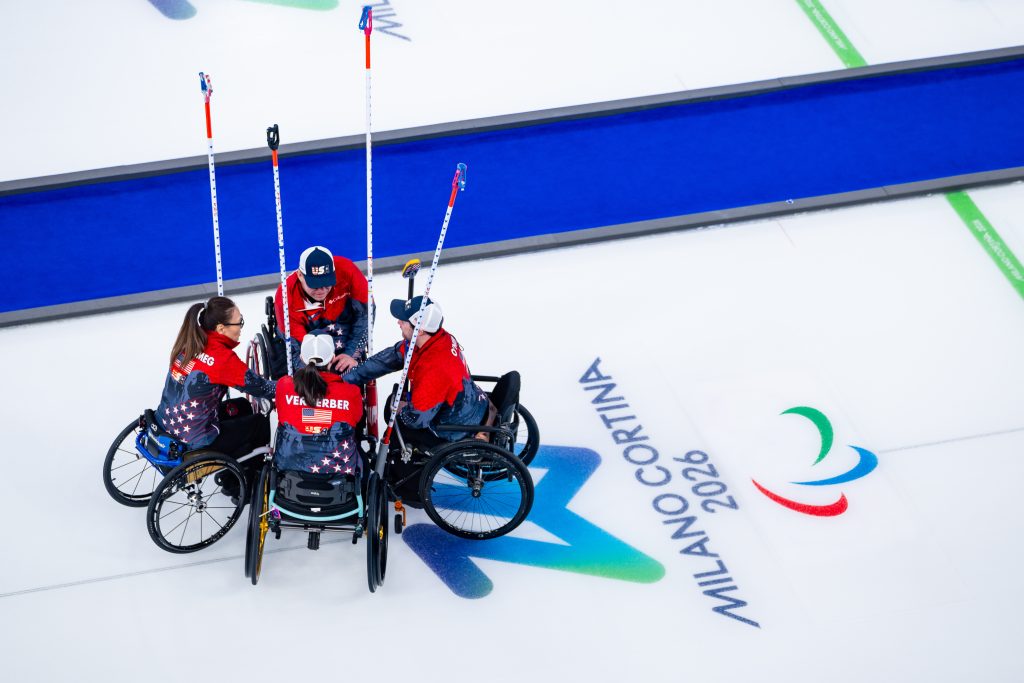
Milano Cortina 2026 Paralympic Winter Games
URANCHIMEG Oyuna, VERDERBER Katie, O’NEILL Sean, THUMS Matthew, USA
Curling appeared almost by chance
Curling arrived in April 2024, almost by accident. Verderber had travelled to Aspen, Colorado, for a winter sports clinic for veterans with the intention of skiing, but she was asked to choose a second activity and picked curling. That morning, Danielle was struggling with altitude sickness and Verderber almost stayed in the hotel. She went onto the ice, threw her first stone and the memory contains no epic gloss: “I was terrible,” she said. She missed the target by several feet and, when a former national coach suggested that she could train seriously, her first reaction was to reject the idea. Four months later, USA Curling called, and she began saying yes to camps, trips and opportunities that brought her closer to people who would become part of her recovery.
That team became a second family. “Getting to know the team is part of the reason I fell in love with it,” Verderber explained, having found in curling not only a sport, but also a judgement-free environment. She was also afraid to say that she was gay and married to a woman, until the group received it naturally. “I still live in a world where I have to judge people to find out if you can share that,” she said. “It’s not always safe. And they were just so incredible.” In June 2025, while waiting to learn whether she would make the Paralympic roster, she texted Steve Emt to ask whether they would still be friends if she did not make the team, because she did not know what she would do without them. Shortly afterwards, she was selected as an alternate for Team USA in the wheelchair curling event at Milano Cortina 2026, just over a year after throwing her first stone.
In Italy, Verderber spent most of her Paralympic experience in the alternate box, but still lived through a moment she keeps replaying whenever she has a bad day. She entered a game against Latvia after the fourth end and the arena began chanting her name. “Two years ago I was told I was never gonna walk again and now I’m like in the biggest arena at the biggest time of our sport and my name was getting chanted,” she recalled. After returning home, she resumed her work as a civil litigation attorney and shifted her focus back to Danielle, who had taken care of the house, the dogs and everything pushed into the background while she trained and competed. “When I found out I made the team I told her this is just as much your moment as it is mine,” she explained. “I know it’s my name they’re going to be chanting, it’s my name on the uniform, but it’s really a testament to you.”
 Last related articles