While much of the World Karate Federation’s promotional narrative has focused on Olympic recognition, there is a widespread belief within the karate community that its traditional and one-dimensional structure is fundamentally misaligned with what the International Olympic Committee expects.
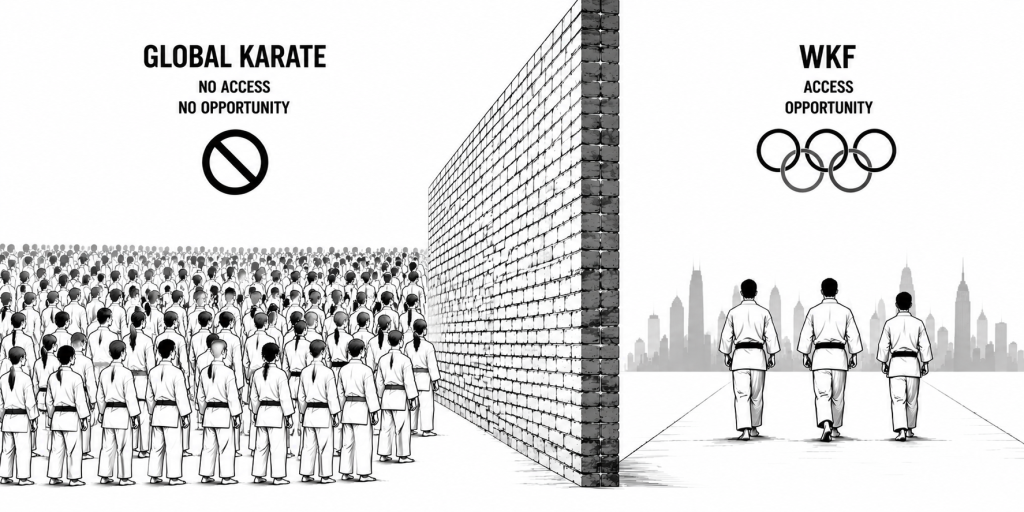
Beyond its internal governance challenges, karate at the international level continues to operate in a fragmented and inconsistent manner. The most pressing issue, which continues to deepen, is the lack of unity across the sport. The Olympic movement’s recognition of the WKF has in practice created a significant divide. This has formed a structural barrier that has become one of the most discriminatory elements affecting karate athletes worldwide.
Although karate made its Olympic debut at the Tokyo Summer Games, its participation was widely viewed as unsuccessful based on many assessments. However, its continued presence in continental events such as the Asian and European Games has allowed the federation to maintain hope for another opportunity at the Olympic Games.
Ironically, both the Asian and European Karate Federations fall below Olympic movement standards in terms of governance and gender equality. In Asia, there are no women represented on the executive board. In Europe, only two out of fourteen executive positions are held by women. This raises serious questions about the credibility of the fourth edition of the European Games and the institutions responsible for organizing it.
In terms of governance and democratic processes, both federations also have troubling histories. In Asia, Nasser Alrazooqi of the United Arab Emirates assumed the presidency without any electoral opposition following the retirement of the former Taiwanese president. In Europe, Antonio Espinos of Spain has served as president of the European Karate Federation since 1999, while also leading the WKF. Neither federation has ever held a genuinely contested election to determine its president.
While the Olympic movement has attempted to address governance issues within international federations, it has become increasingly clear that figures such as Kirsty Coventry and her colleagues, who are involved in revising the Olympic Charter, must address a deeper structural problem. Removing the discriminatory barriers in karate and creating an open environment for global participation is only possible through one path. That path is ending the WKF’s monopoly and enabling the formation of a truly inclusive global karate confederation based on universal Olympic values.
Karate faces another fundamental issue. Equal conditions are not provided for all athletes to participate in continental games that carry Olympic legitimacy and values. In reality, a large structural barrier has divided the sport into Olympic and non Olympic organizations. This division raises serious questions about the WKF’s commitment to the principles of the Olympic Charter.
What is currently presented in karate leagues and continental competitions has moved far from the roots of this elegant martial art. In many ways, WKF branded karate appears to imitate taekwondo. This has reduced the technical beauty of both kata and kumite. Competitions have become monotonous, and the rules are often confusing and controversial. As a result, this once highly popular sport is gradually losing its appeal among audiences, both on television and across social media platforms.
 Last related articles