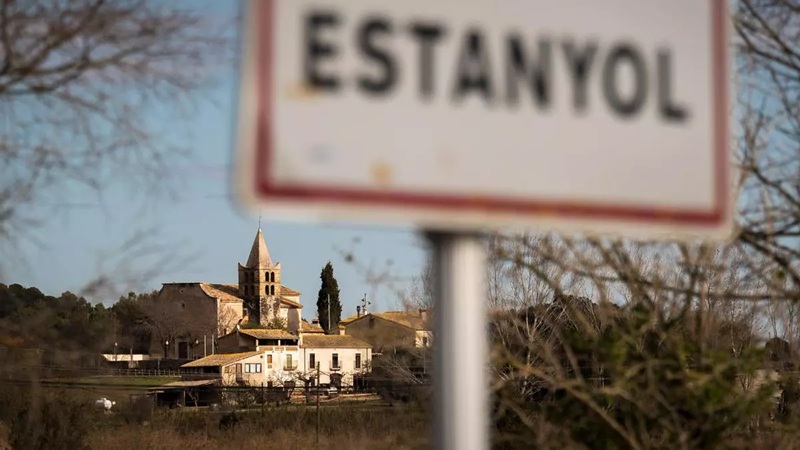
Pau Cubarsí returned from his first World Cup as a champion after playing every minute of the tournament and being named its best young player. At 19, he is already a starting centre-back for Barcelona and Spain, but his story began in a place that does not even have a football pitch. “There are two restaurants, a cemetery and my father’s carpentry workshop,” he says when asked to describe Estanyol, the small settlement in Girona where he grew up.
Estanyol belongs to the municipality of Bescanó and has approximately 187 residents spread between its centre and the surrounding traditional farmhouses. It has no school, pharmacy, health centre, supermarket or football facilities. “There are plenty of fields, but no football pitch,” Cubarsí joked on ‘Denominación de Origen’, an RTVE programme. For him, being from a village means “complete peace and quiet” and having enjoyed a childhood that was “different, simpler and closer-knit”. Its silence, natural paths and close community shaped the environment to which he continues to return after competing in front of tens of thousands of spectators.
A family working with wood since 1905
The carpentry workshop Cubarsí uses to describe his village has formed part of his family’s history since 1905. His great-grandfather began a trade subsequently continued by his grandfather and father, Robert Cubarsí, who now runs Fusteria Cubarsí with other members of the family. During the summer, Pau helped clean the workshop and observed a craft built around precision, patience and repetition. Although his ability with a ball eventually led him away from woodworking as a profession, he retains one lesson from his father: “You have to strive for perfection in whatever you do, as much as you possibly can.”
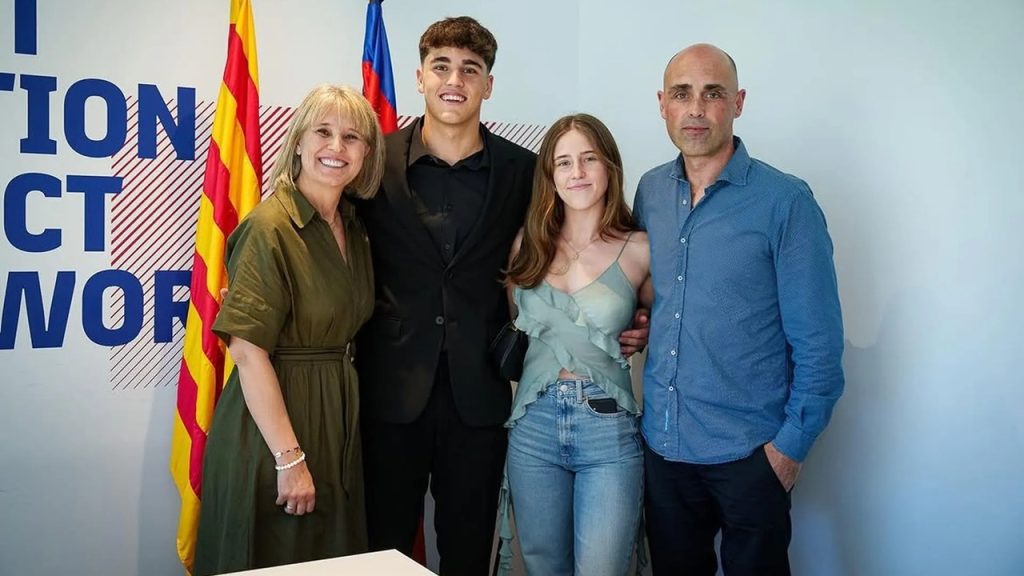
His parents, Robert and Glòria Paredes, have remained away from public attention and never presented football as an obligation. His father accompanied him during his first seasons and served as a team delegate, but encouraged every child from the touchline rather than focusing only on his son. Cubarsí identifies his parents and sister as the people who keep his feet on the ground when photographs, praise and expectations begin to surround him. He also retains the friends he made at secondary school. They form a group of eight, including Cubarsí, who continue to arrange trips, holidays and other plans whenever his schedule allows. During the week they remain in contact through their group chat because Cubarsí lives in Barcelona while the others are still in Girona.
Vilablareix, the first pitch for a boy from Estanyol
The absence of sporting facilities meant that Cubarsí had to begin playing away from his village. He attended school in Vilablareix and joined FC Vilablareix there at the age of six. David García, his first coach, remembers a cheerful boy who rarely became angry and showed concern for his opponents as well as his teammates. On one occasion, a teammate named Jana conceded a goal after going in goal and became upset. Cubarsí collected the ball, carried it forward to score at the other end and immediately ran back to celebrate with her. He played at centre-back but moved through the pitch with his head raised and regularly finished among the team’s leading scorers.
Vilablareix won three consecutive league titles and several tournaments during that period. Cubarsí arrived wearing Barcelona shirts and was already talking about playing for the club one day. His performances soon attracted the attention of Girona FC, who signed him after three seasons. Leaving did not end his relationship with his first team. He has donated equipment, visits its facilities and, whenever he can return, spends time and plays with the club’s children. He also occasionally watches his former friends compete while trying to remain unnoticed. The relationship remains active 13 years after he first arrived, as the club explained in a report by ‘L’Informatiu’.
From Estanyol to living at La Masia at 11
Girona allowed him to compete at a higher level before Barcelona decided to sign him. The club’s coaches had already received positive reports and confirmed their decision after watching him at an under-12 tournament in Cornellà. They found a centre-back with strong distribution, defensive power and an unusual ability to read the game. Cubarsí arrived at La Masia on 1 July 2018, aged 11, and began a life very different from the one he had known in Estanyol. He left his parents’ home and moved into the academy, where he had to combine training, education and personal responsibilities.
In the academy, he played alongside other members of the 2007 generation, including Lamine Yamal and Marc Bernal, and captained several age-group teams. He first trained with the senior side in 2023 and made his competitive debut against Unionistas de Salamanca on 18 January 2024, while still 16. Three days later, he made his first start against Real Betis and, less than two months into his senior career, was named player of the match in a UEFA Champions League fixture against Napoli. He made 48 appearances during the 2025-26 season, starting 45, before playing every minute of Spain’s World Cup triumph. In little more than two years, he progressed from the academy residence to leading two defences built around controlling matches through possession, a rise documented by FC Barcelona.
Living with his sister and studying three afternoons a week
After leaving La Masia, Cubarsí took another step towards independence by moving into a home in Barcelona with his older sister, Irene Cubarsí, who trained as a physiotherapist. Their parents remain in Estanyol and visit them frequently. The defender is learning to handle the domestic responsibilities previously covered by the academy: he washes dishes and prepares omelettes, rice, pasta or lentils. He avoids driving because of the city’s traffic and prefers to rest at home when he does not have to train. “I’m gradually taking in everything I’m doing. It’s like being on a cloud. Everything happens so quickly that you hardly realise it,” he said when describing how he is trying to understand the changes he has experienced since his debut.
His education has not stopped either. Football does not leave enough time for a conventional university degree, but he attends a Business Administration and Management course three afternoons a week. The format gives him time to train, recover and prepare for a future beyond football. At 19, he combines those studies with the responsibilities of starting for Barcelona and the Spanish national team, although his main reference point remains far from the stadiums. Estanyol still has its two restaurants, cemetery, farmhouses and carpentry workshop opening every morning. It is now also the place to which a world champion returns.
 Last related articles