Gianni Infantino has decided to turn FIFA’s commercial business into a company initially valued at $20 billion. FIFA Forward Enterprise would bring together the broadcasting rights, sponsorships, ticketing operations, licensing and commercial activities related to all of the organisation’s men’s, women’s and youth competitions. FIFA would retain control while selling minority stakes of up to 20% to raise $4.2 billion before the end of 2026. The World Cup itself is not being put up for sale in the strictest sense, but part of the machinery that turns the competition into money is. Infantino would be crossing a red line that has so far remained unexplored at competition level in football.
Infantino wants to access now the value that FIFA expects to generate over the coming decades. The money would be used to create an extraordinary programme allowing each of the 211 member associations to access an optional $20 million, while increasing the standard allocation under the Forward Programme from $8 million to $20 million between 2027 and 2030. The promise turns the vote into something more than a debate about the nature of football: each federation will have to decide on an operation capable of placing a multimillion-dollar sum immediately into its own budget. FIFA has not yet confirmed that the decision will formally be taken at a Congress; its statement requires the support of a majority of the member associations and the approval of the necessary regulatory changes by the Council.
The World Cup already has a valuation
The $20 billion figure does not represent the entire value of football or even the full value of the World Cup. It is the initial valuation of a company that would commercially exploit FIFA’s competitions and would be created following a 2023–2026 cycle that generated more than $15 billion in revenue, almost double the previous cycle. The valuation is equivalent to slightly more than five times the cycle’s average annual revenue and remains below the stock-market multiples of businesses such as Formula 1 or TKO, the owner of UFC and WWE. The World Cup already had a price through every television, sponsorship and ticketing contract; Infantino now wants to put a price on the entire business at once.
The investor will also need that valuation to increase. Reuters estimates that a $4.2 billion stake would need to be worth $7.3 billion by 2030 to deliver an annual return of 15%, assuming there were no cash distributions. FIFA Forward Enterprise would have to grow from $20 billion to close to $37 billion in four years. FIFA says that external shareholders would have no operational role and that sporting decisions would remain under its control, but private capital enters an investment in order to make a profit. That growth, according to the way the proposal is being presented, could come from better contracts, new platforms and markets that remain untapped; it also aims to encourage more competitions, more matches and even greater commercial exploitation of ticketing and the fan experience.
Joshua Kushner enters football
The company is the new permanent-capital vehicle created by Joshua Kushner, 41, the founder of Thrive Capital and the younger brother of Jared Kushner, who is married to Ivanka Trump, Donald Trump’s daughter. Joshua studied at Harvard, founded Thrive in 2009 and co-founded the health insurance company Oscar Health. His firm has invested in Instagram, Spotify, Slack, Stripe and OpenAI, manages around $25 billion and has increased his personal fortune to approximately $5.2 billion, according to Forbes. He is not among the world’s 30 wealthiest people, as has been reported, and the $3.6 billion valuation corresponds to an earlier estimate.
Thrive Eternal explains its interest better than the family tree does. The vehicle was created to hold long-term stakes in franchises and cultural institutions that are difficult to replicate through technology. Its first sporting investment was the acquisition of a minority stake in MLB’s San Francisco Giants. The World Cup fits that definition perfectly: a global and irreplaceable brand, protected by an institutional structure and capable of preserving its scarcity for generations. Bob Iger, the former CEO of Disney, serves as an adviser to Thrive Eternal; JPMorgan is working with FIFA on the operation, Greg Maffei —the former Liberty Media executive during the company’s period in charge of Formula 1— is acting as commercial adviser, and OpenEconomics is seeking other international investors.
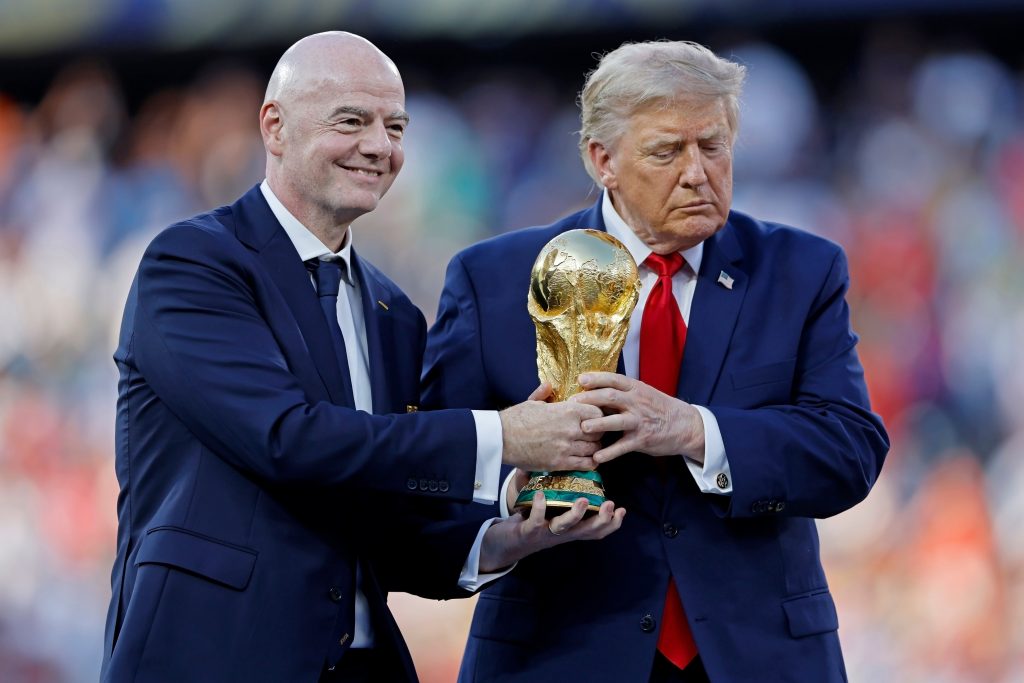
Donald Trump is not listed as an investor and Jared Kushner is not part of the group either, although their presence emerges through the family connection and through the relationship Infantino has built with the US president. FIFA opened an office in Trump Tower, Infantino presented Trump with the organisation’s first Peace Prize, and the two shared the spotlight during the World Cup trophy presentation. The US president found another major international stage in football; Infantino gained direct access to the White House and to the government of the main host country. Everything suggests something more than a simple institutional friendship.
US Congressman Jamie Raskin has now requested communications between FIFA, the Trump Administration and the family’s businesses, as well as documents relating to Trump Tower and a transcribed interview with Infantino. The operation involving Thrive arrives while that relationship is already under political scrutiny.
UEFA has turned its opposition into an open battle. “The soul and governance of football are not assets to be traded. None of us owns football. It does not belong to FIFA to sell,” the European organisation responded to these commercial ambitions. The distance between Aleksander Ceferin and Infantino had already been exposed by the UEFA president’s absence from the final and has now extended to the economic model that will shape the sport. Infantino already attempted in 2018 to promote a $25 billion operation with SoftBank to expand the Club World Cup and create a global national-team competition; European opposition stopped it. Eight years later, he has more revenue, greater support among the federations and 20 million reasons to persuade each one.
The debate goes beyond the sentimental defence of the World Cup. FIFA argues that private capital will allow wealth to be distributed more effectively while preserving full sporting authority. UEFA warns that an investor may be unable to vote on the calendar and still influence its development through the demand for profitability. The part that cannot be written into contracts remains unresolved, as Infantino must still demonstrate that the football world will accept part of its most important competition belonging to someone else.
 Last related articles