Riders picking coins off the ground without slowing their horses, wrestlers trying to pull each other from the saddle and players moving stones across boards used for generations. The World Nomad Games have opened their sixth edition in Kyrgyzstan, transforming skills historically associated with nomadic life into 43 sporting disciplines. The opening ceremony took place on 31 August at Bishkek Arena in Bishkek, where organisers reported that more than 3,000 athletes took part in the parade. Delegations from 104 countries had registered for the event, which runs until 6 September.
The inauguration was only the starting point. Competition now moves primarily to the Issyk-Kul region, across the Cholpon-Ata Hippodrome, several sports complexes and the Kyrchyn highland pasture, which has been transformed into an ethnographic village with around 40 different areas. Organisers have scheduled more than 800 cultural activities, including musical performances, oral storytelling, traditional instruments, crafts, cuisine, fashion, dance, exhibitions and academic events. The Games do not separate competition from heritage: sporting events, yurts, markets, equestrian performances and workshops all form part of the same presentation of nomadic cultures.
Wrestling and picking up coins on horseback
Kok-boru embodies the spectacle of the programme better than any other discipline. Two teams of riders compete for possession of a traditional object —or an approved substitute— and attempt to place it in their opponents’ ‘taikazan’, a large circular goal. The Kazakh sport of kokpar shares the same origins but is contested under its own rules. In er enish, competitors wrestle on horseback and try to unbalance, dislodge or pull their opponent from the saddle. Tyiyn enmei, known in Kazakhstan as ‘tenge ilu’, presents a different test: riders must lean down from a galloping horse to collect coins or other small objects from the ground.
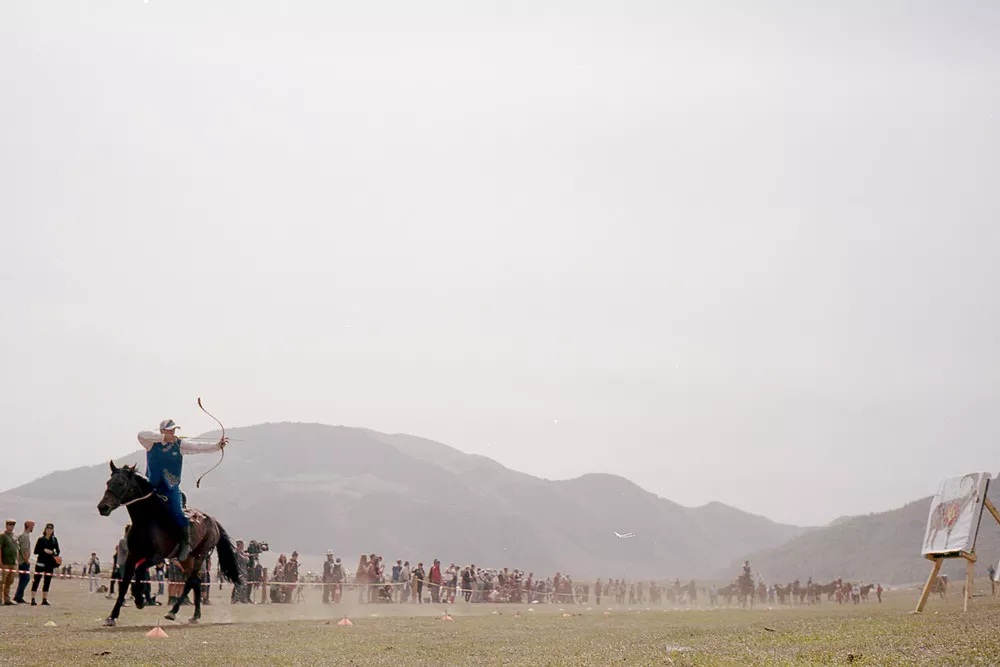
The hippodrome also hosts several forms of racing. ‘Alaman chabysh’ tests the endurance of horses and riders over long distances, ‘kunan chabysh’ is reserved for young horses, while ‘zhorgo salysh’ combines speed with the requirement to maintain the distinctive lateral gait of a pacing horse. Archery is practised both on foot and on horseback under Kyrgyz, Turkish and Hungarian rules. Mounted archers must complete a course within a set time, control their horse without losing speed and hit a series of targets while riding.
Eagles, wrestlers and tests of strength
Kyrchyn hosts salbuurun, a collection of skills rooted in traditional Kyrgyz hunting practices. Its modern events assess the recall, flight and pursuit of lures by golden eagles, falcons and goshawks, alongside ‘taigan’ sighthound races and archery competitions. The programme also includes international falconry displays and demonstrations of equestrian skills. Another of its more unusual contests comes from the Buryat tradition: competitors must break a dried cattle vertebra cleanly with a single-handed strike, combining strength with accuracy.
National wrestling styles occupy a particularly extensive section of the schedule. Kyrgyz alysh, Uzbek kurash, ‘kazakh kuresi’, Korean ssireum, Japanese sumo, ‘mongol bökh’ and styles originating in Türkiye, Turkmenistan, Azerbaijan, Tajikistan and the Tatar and Sakha communities retain their own grips, clothing and victory criteria. Many share the objective of unbalancing and throwing an opponent from a standing position. ‘Mas-wrestling’ produces an entirely different image: two athletes sit opposite each other, brace their feet against a board and pull on the same stick until one takes it from the other or drags their rival forward.
Competition also takes place around a board
Not every discipline depends on speed or physical strength. Ordo symbolically represents the defence and capture of a khan’s headquarters. Teams throw pieces inside a marked circle in an attempt to break the opposing formation and reach its central element. Kyrgyz toguz korgool, Turkish mangala and West African oware belong to a family of games based on distributing and capturing stones or counters through calculation, memory and anticipation. Toguz korgool and its variants from Kazakhstan and Türkiye were added in 2020 to the Representative List of the Intangible Cultural Heritage of Humanity by the United Nations Educational, Scientific and Cultural Organization -UNESCO-.
Kyrgyzstan created the World Nomad Games in 2014, bringing together around 500 participants from 19 countries for the first edition in Cholpon-Ata. The country hosted the event again in 2016 and 2018 before it travelled abroad for the first time. İznik, in Türkiye, staged the fourth edition in 2022 after a two-year postponement caused by the pandemic, while Astana, in Kazakhstan, welcomed around 2,500 athletes from 89 countries across 21 sports in 2024. Three years earlier, UNESCO had selected the Kyrgyz programme ‘Nomad games: rediscovering heritage, celebrating diversity’ for its Register of Good Safeguarding Practices, recognising its role in reviving and transmitting games that had declined during the forced sedentarisation of the Soviet period.
The 2026 edition adds a diplomatic dimension to that cultural purpose. Its opening coincided with a summit of the Shanghai Cooperation Organisation -SCO- in Bishkek and was attended by leaders including Vladimir Putin, Narendra Modi, Masoud Pezeshkian, Recep Tayyip Erdoğan, Shehbaz Sharif, Kassym-Jomart Tokayev and Alexander Lukashenko. Following the parade of delegations and the opening performances, the programme moved towards Issyk-Kul, where sports, demonstrations and activities in the ethnographic village will continue until 6 September.
 Last related articles