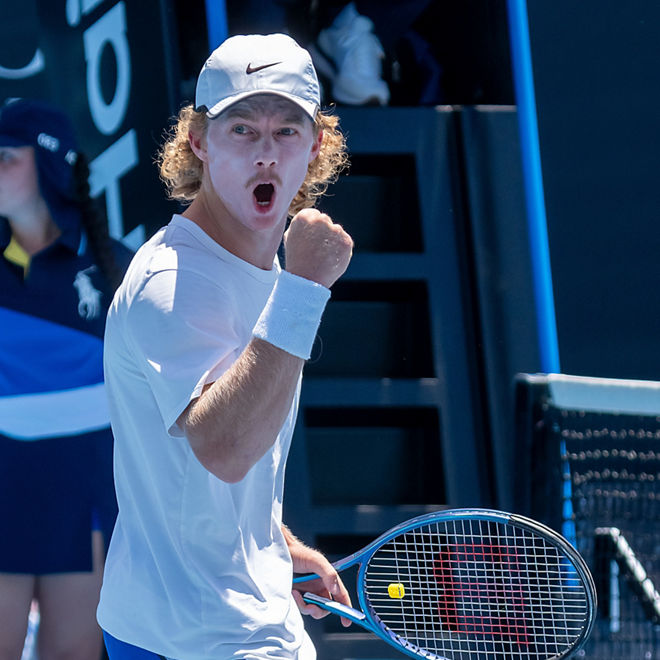
Melbourne, January 2024. Dane Sweeny is playing the fifth set of his Australian Open debut against Francisco Cerúndolo, but his father cannot stay until the end. Clay, who also coaches him, has to get back to work. “My dad actually had to go in the fifth set because he had to go do work back at home,” Sweeny explained afterwards. “He had to catch a flight and go do some cleaning jobs, unfortunately.” Sweeny had come through three rounds of qualifying and was playing in a Grand Slam main draw for the first time. His father had been able to accompany him that far, but the business helping to fund the journey needed him too.
More than two years later, Sweeny has beaten Lorenzo Musetti 3–6, 6–1, 6–2, 6–2 to reach the third round of the US Open for the first time. The 25-year-old Australian will face Luciano Darderi this Saturday for a place in the last 16. “I’m just grateful to be even able to compete in grand slams. The tennis journey is such a rollercoaster,” he said after beating the Italian. Between that afternoon in Melbourne and this week in New York, Clay sold his business so he could travel with him, while Dane spent two months away from tennis, unsure whether he wanted to return. His deepest run at a major comes after having to rebuild more than his ranking.
A court drawn on the beach
Father and son did not need a tennis court for their earliest rallies. In Mooloolaba, on Australia’s Sunshine Coast, they drew lines in the sand and started hitting. Dane first picked up a small plastic racquet at two and remembers those beach sessions from when he was around four or five. They also played at school after lessons had finished. “I remember people used to come up and watch me and my dad rallying because I was so small and so young,” he told Tennis Australia. He grew up admiring Lleyton Hewitt, finding a connection that went beyond nationality: “He wasn’t a big guy and neither am I, but just his hustle and his competitiveness and I think I could just relate because of his stature.” Sweeny stands 1.70 metres tall.
Clay taught him to play, although Dane trained at the National Academy between the ages of about 12 and 20. His father remained, he says, the most influential person in his career. “He has always been relentlessly in my corner and supporting me and believing in me.” That support came at a financial and personal cost, which Sweeny acknowledges without describing his family as poor. “They’ve never been poor, but not ever been super well-off, so they’ve had to financially sacrifice a lot and emotionally sacrifice a lot,” he explained in January 2026. By then, Clay had sold his cleaning business so he could accompany his son on tour. Dane also wanted to make his own contribution clear: “I’ve been pretty independent from when I started making enough money, kind of fund myself.”
 Sharing an Airbnb to stay on tour
Before that 2024 debut, Sweeny shared an Airbnb with a group of friends to keep accommodation costs down. “Tennis is a pretty expensive sport, so I have to try to make those dollars last as long as I can,” he explained. It was not the first time he had looked for ways to fund the next trip. In 2019, aged 18, he launched a crowdfunding campaign with a target of A$10,000. “Travelling the world as a professional tennis player isn’t as luxurious as it seems towards the bottom of the rankings where I am positioned at the moment,” he wrote then. During 2023, he competed in 32 cities across 15 countries, stopping in places as varied as Ecuador, Puerto Rico, India, Croatia and China. Travel was part of his job, but it was also a bill that had to be paid before he knew how much the next tournament would bring in.
Sweeny estimates that a season costs around A$100,000 without a coach and between A$200,000 and A$250,000 with one travelling alongside him. He also acknowledges the advantage of coming from a country that hosts a Grand Slam and having access to opportunities associated with it. The A$120,000 he earned for that first-round appearance in 2024 shows what a difference one tournament can make: “It will definitely pay for my whole year and I can probably afford to bring my dad with me or maybe even another coach for most of the year now, which is unreal.” The prize money meant more than being paid for a result. It allowed him to travel with support, prepare better for tournaments and spend less time worrying about the bills. “It puts a lot less pressure on me,” he said.
Two months without wanting to play
Yet after Wimbledon in 2024, he took a two-month break from tennis. The problem was not simply paying for travel: he had lost his enjoyment of the sport, and his confidence increasingly depended on results. “I didn’t want to be out there. I felt like I was suffering. I wasn’t enjoying the journey,” he told ‘The First Serve’. He reached a point where he did not know whether he would return. During the break, he discovered that he missed competing and the feeling of the ball coming off his strings. Coming back meant rediscovering those sensations, as well as winning again.
His return took him through the ITF circuit, the lowest tier of professional tennis, and brought eight titles during 2025. Away from the court, breathing exercises and journalling are among the practices he uses to stay grounded. He also launched the channel ‘Life on the Tour’ with Calum Puttergill, sharing the travel and expenses of circuit life: something to invest time in and build a community around, beyond match results. When Tennis Australia asked him about the biggest lesson the sport had taught him, he replied: “That discipline is liberation, discipline is freedom.”
“This too shall pass”
In January 2026, after beating Gaël Monfils to win his first Grand Slam main-draw match, he wrote on the camera: “This too shall pass.” It was not a phrase to help him overcome defeat, but a way to stay grounded after victory. “The only constant in life is change, really,” he explained. “This is a big moment, it’s exciting, but it will come back down. And the same when things are really tough.” That week also allowed him to enjoy something unusual: having his girlfriend, his father, his friend Sam, who was helping him, and the rest of his family nearby. “You probably heard my sister the whole time,” he joked with reporters. “I don’t get that any other week of the year. That is the only difference, and it is a tremendous difference.”
Now, a place in the third round in New York guarantees him US$290,000 in prize money and more financial breathing room to sustain his career. Against Musetti, he secured his biggest win, but his reaction once again focused on the opportunity to be there: “To soak up the atmosphere and get a win, a couple of wins, in front of this crowd, is awesome.” In Melbourne, he had explained what those earnings made possible: “I can just directly reinvest into my tennis.” This Saturday, he will compete again, looking to keep enjoying the game.
 Last related articles