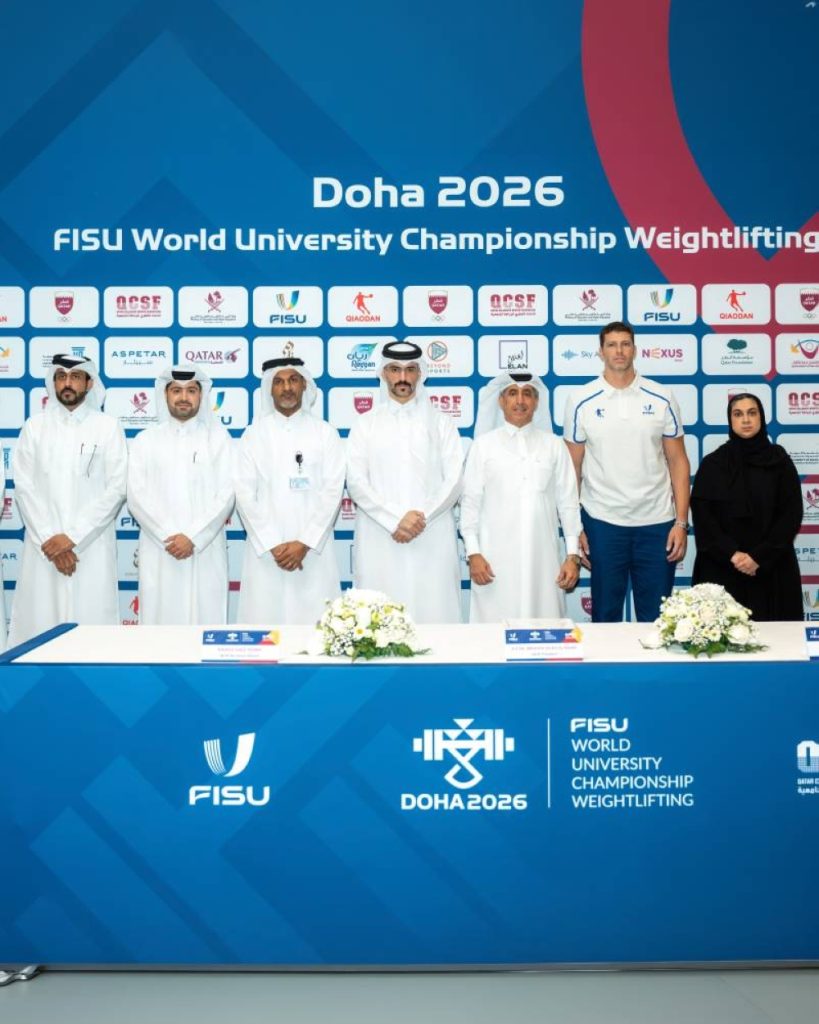
Qatar is hosting the FISU World University Weightlifting Championship for the first time, bringing around 116 student-athletes from 21 delegations to Doha from 8 to 12 September. The tenth edition is organised by the International University Sports Federation -FISU- and the Qatar Collegiate Sports Federation -QCSF-, with medals awarded over five days at the Education City Student Center. The competition expands the country’s calendar of international events through a format that requires athletes to combine sporting performance with university eligibility.
The Championship is the second global event organised by the QCSF since its official launch in 2023, when Doha hosted the FISU University World Cup 3×3 Basketball. QCSF President Ibrahim Alnaimi described the weightlifting competition as “another milestone” in Qatar’s commitment to university sport. Its organisation also involves a network comprising the Qatar Olympic Committee, Qatar Foundation, the Ministry of Education and Higher Education, Qatar Airways and Aspetar. The participation of sporting, academic, public and private institutions gives a concrete structure to the country’s university sport strategy. Doha also adds a sporting particularity: the Championship is taking place just over a month after the new weight categories of the International Weightlifting Federation -IWF- came into effect.
Education City and its ‘living room’
The competition is being held in the multi-purpose hall at the Education City Student Center, located within a 12-square-kilometre academic complex that brings together local institutions and international university campuses. Qatar has 34 higher education institutions and has concentrated a significant part of this network in Education City. Commonly described as the campus’s “living room”, the Student Center serves as a place for meeting, dining and leisure, as well as hosting sporting and cultural activities. The choice places the Championship within the students’ everyday environment instead of moving it to one of the country’s large arenas normally used for professional events.
The venue features competition and warm-up platforms, barbells, plates, and scoring and timing systems approved or validated by the IWF. To be eligible, weightlifters must be between the ages of 18 and 25 at the end of 2026, hold the nationality of the country they represent and compete for the same country as they do in events organised by their international federation. Medals are awarded separately in the snatch, clean and jerk, and total, which is calculated by adding together the best valid lift in each of the two exercises. One athlete can therefore make the podium in three different classifications.
 Sixteen newly introduced categories
The World University Championship uses the bodyweight categories introduced by the IWF on 1 August. The men’s competition comprises the 60, 65, 70, 75, 85, 95, 110 and over-110-kilogram categories, while the women compete at 49, 53, 57, 61, 69, 77, 86 and over 86 kilograms. The programme therefore includes eight weight classes for men and another eight for women. With three titles awarded in each category, Doha will distribute medals across 48 classifications. The lighter divisions opened the competition, which will progress towards the women’s over-86-kilogram and men’s over-110-kilogram events scheduled for the final day.
The change affects more than the name of each event. Weightlifters have had to decide which division best suits their body composition and adapt their training, nutrition and weight management to different limits. It also changes how the results can be compared with those from the previous World University Championship, held in Tartu in 2024. FISU has presented the performances recorded there as a reference for this year’s competitors, but many do not have a direct equivalent because the weight classes have been reorganised. The results in Doha will begin to establish university benchmarks for the new categories, while the IWF also applies new world standards in the snatch, clean and jerk, and total.
Student-athletes from 21 delegations
The women’s competition features representatives from 17 delegations, while 20 are participating in the men’s events. The field includes student-athletes from Bulgaria, Canada, Chinese Taipei, Ecuador, Hungary, Ireland, Moldova, Poland, Puerto Rico, the Republic of Korea, Romania, Slovakia, Spain, Sri Lanka, the United Kingdom, the United States and Qatar, as well as Azerbaijan, Denmark, Finland and Iraq in the men’s competition. Every session can be watched live through FISU’s streaming platform, while the organisers will publish results, photographs and highlights through their digital channels.
FISU President Leonz Eder has presented the Championship as an opportunity for its participants to “shine, interact and grow as people”. That combination also summarises the purpose Qatar has given the event: staging a competition governed by international technical standards within its main university environment. Following the 3×3 event in 2023, the World University Weightlifting Championship allows the QCSF to broaden its experience with another federation and a different competition model. Its scale is smaller than that of a mega-event, but it brings together students from 21 delegations, uses academic facilities and connects the country’s international event strategy with a university sport structure intended to continue beyond a single week of competition.
 Last related articles