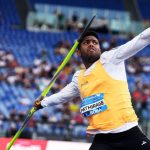
The first two throws by Rumesh Tharanga Pathirage in the Diamond League Final gave little indication that a historic night was about to unfold: 80.42 and 79.73 metres. His third attempt reached 89.04, moved him into the lead and proved beyond everyone else. Poland’s Dawid Wegner finished second with 87.47, while Keshorn Walcott, the 2012 Olympic champion and 2025 world champion, took third with 83.99. In Brussels, Tharanga became the first Sri Lankan athlete to win the final of athletics’ leading international one-day circuit. “I’m the first ever Sri Lankan to win the Diamond League Final and that makes me extremely proud,” he said afterwards.
The victory came two years after five centimetres kept him out of the Paris Olympic Games, and after a decision that could have taken him towards a different sport. Tharanga had been a promising fast bowler, but walked away from cricket because he did not trust the available pathways to progress. He chose an individual event in which he hoped the distance would speak for him, continued working with the local coach who had developed him and found support from his country’s Air Force. Then, in April 2026, came the paradox that captures part of his journey: Sri Lanka Cricket, the governing body of the sport he had left behind, awarded him ten million rupees to help finance his career as a javelin thrower and his preparations for Los Angeles 2028.
Cricket let him slip away
Tharanga grew up in Kalutara, a coastal town south of Colombo, in a family already familiar with throwing events. His father had competed in the shot put and discus and initially steered him towards the latter. The young Tharanga was also a runner: in 2011, while in Grade 5 at Sripalee National College in Horana, he won the 75 metres at the All Island School Games. He began playing cricket a year later and became vice-captain of the Kalutara District team. In 2017, he threw the javelin 42 metres at a schools competition, after which Tony Prasanna helped him secure a place at St Peter’s College in Colombo. “My first throw was around the 30-metre mark. After only two months of training, I increased my throw to 63 metres,” he later recalled.
Cricket still appeared to offer a possible career. At under-18 level, Tharanga bowled at approximately 134 kilometres per hour and finished second in his category during a national search for young fast bowlers, part of the same programme that discovered Eshan Malinga, who would later represent Sri Lanka. His only competitive appearance for St Peter’s College sounds almost impossible to improve upon: according to his account, he bowled four overs, took five wickets and then scored a half-century. Even so, he felt that performance alone did not guarantee progress. “In cricket, there is political involvement and intense competition,” he explained. “Cricket is a team sport. It takes a lot more than just talent to make it to the national team. But in javelin, if I have talent, I will be recognised.”
The five centimetres that cost him Paris
In June 2024, Tharanga competed at the Asian Throwing Championships in Mokpo, South Korea. He reached 85.45 metres, won the competition and set both a championship record and a new national record. The automatic qualifying standard for the Paris 2024 Olympic Games was 85.50. He fell five centimetres short and was also unable to qualify through the points-based ranking system. “Missing my Olympic debut by just five centimetres, I felt that luck and misfortune were swinging in both directions at the same time,” he said. While other members of the Sri Lankan delegation travelled to France, he had to watch the Games from home.
His frustration extended beyond those five centimetres. Tharanga and Prasanna had spent months requesting international opportunities in which he could pursue the qualifying standard and improve his ranking, but according to his account, none arrived until the qualification period was nearing its end. In addition, the javelin supplied by Sri Lanka Athletics -SLA- after he had requested new equipment failed the technical inspection in South Korea because of differences in its weight or regulation dimensions. “I was told that the javelin was illegal,” he explained. He had to compete with another implement he had not used in training and still broke the national record. “If I had been given an international tournament from the beginning of the year, I think I would have reached my goal,” he said.
The coach he chose to keep
As his results began to move beyond the usual scale of Sri Lankan athletics, former champions and officials advised him to train permanently abroad. Tharanga chose to remain with Prasanna, who had guided his development since adolescence. Former national record holder Sachith Maduranga recalled how, when Tharanga was still very young, the thrower told him that he would one day break his junior record. He eventually kept that promise. “He has trained me since childhood and brought me to where I am today. Many of my achievements are thanks to his guidance,” Tharanga said of a coach he retained even when his progress created the possibility of joining an international training structure.
That loyalty did not mean rejecting knowledge from abroad. During a stay in Australia, Tharanga spent approximately two weeks working with world champion Kelsey-Lee Barber and her coach, Mike Barber, at the Queensland Institute of Sport. He then returned to Sri Lanka to continue alongside Prasanna. He has also found backing from the Sri Lanka Air Force -SLAF-, where he holds the rank of corporal and which contributes financially to his preparation. Tharanga has described the difficulties facing athletes trying to become professionals outside the country’s dominant sport: “In Sri Lanka, except cricket, there is no real space to fund other sports. It’s very hard being a javelin thrower. The financial problem in athletics is real.” His progress depended on training, but also on access to equipment, travel and competitions where performances could be converted into ranking points and qualification.
When cricket came back to help
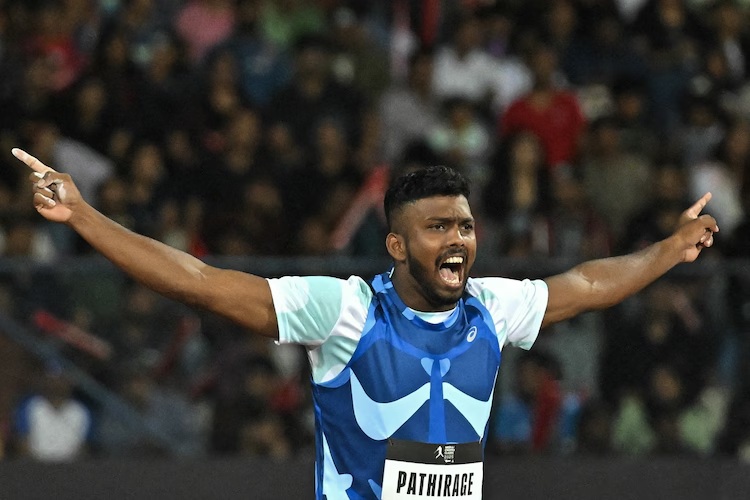
On 28 April 2026, Sri Lanka Cricket awarded Tharanga a grant of ten million Sri Lankan rupees. The funding was approved under the direction of its president, Shammi Silva, and the Executive Committee, following a request from the Minister of Youth Affairs and Sports, Sunil Kumara Gamage. The organisation presented the initiative as part of its efforts to support sports beyond cricket and assist athletes capable of succeeding internationally. Money generated by the sport Tharanga had left behind would now support the thrower hoping to return Sri Lanka to an Olympic podium. It did not repair the pathway he believed had closed during his teenage years, but it acknowledged that his talent had acquired national significance.
Between those five centimetres in 2024 and the grant in 2026, Tharanga raised the national record to 86.50 metres, reached the final of the 2025 World Championships in Tokyo and finished seventh. This season, he broke the 90-metre barrier for the first time, set a personal best of 92.62 in Rome and claimed five Diamond League victories, culminating in the trophy in Brussels. Even there, he did not believe he had shown the full extent of his ability: “I know that I could do much better than 89.04, but the conditions were difficult. I’m used to much higher temperatures.” His next major destination will be the Aichi-Nagoya 2026 Asian Games, where he will arrive as one of the continent’s leading athletes.
 Last related articles