Kendrick Nunn is preparing to join Qatar’s national team ahead of the 2027 Basketball World Cup, which the country will host, after travelling there to complete his passport formalities. The American Panathinaikos guard, one of the most influential players in the EuroLeague, is set to become the leading figure in a team with which he has no known previous family, developmental or professional ties. According to reports from Greece, the agreement would be worth around €10 million over five years. The financial terms have not been made public, but the arrangement raises a question that goes beyond that figure: how far does a national team continue to represent its basketball community when it recruits its biggest star through negotiations resembling a club signing?
For Nunn, the move offers a double benefit: a World Cup opportunity that would be difficult to secure with the United States and, if the reported payment is confirmed, a substantial financial reward for taking it. He represented his country at U16 and U17 level, but never with the senior team. Qatar, meanwhile, has qualified automatically as host and wants to improve its competitiveness in a tournament it last contested in 2006. The sporting interests are clear: the hosts gain a top-level scorer, while the player finds an international stage he would struggle to reach through the American national team. The passport makes that exchange possible.
A permitted arrangement that challenges the model
The rules of the International Basketball Federation -FIBA- allow a national team to include one restricted-status player on its final roster. The regulations distinguish between circumstances according to nationality, the age at which a passport was obtained and significant links with the country, taking account of residence, education, basketball activity and family connections. They also regulate changes of national representation after competing at youth level, as Nunn did with the United States. Acquiring citizenship and receiving sporting eligibility approval are therefore separate processes.
National teams are built around a sense of belonging that can develop through many routes: birth, family, migration, residence or sporting development. Recruiting talent in exchange for payment, without a prior relationship with the country, introduces a different logic. The ability to recruit begins to compete with the ability to develop players. For a well-funded federation, filling a gap can be quicker than spending years developing the player it needs. Responsibility extends to the institutions promoting these arrangements and the system permitting them, as well as the athletes accepting a professional opportunity.
Lorenzo Brown and Spain’s immediate solution
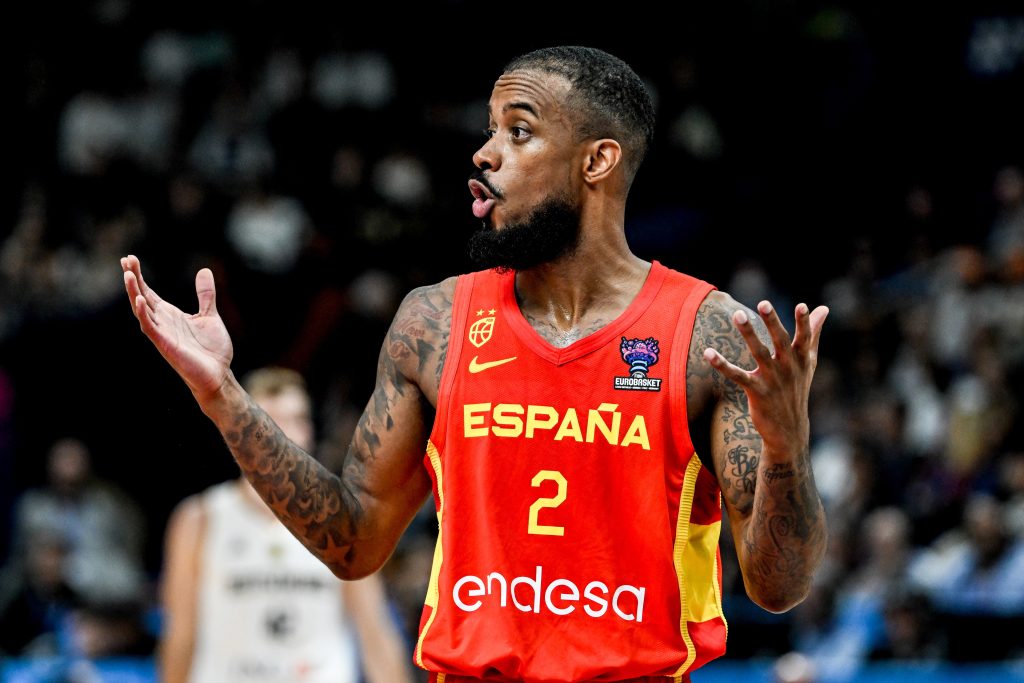
Lorenzo Brown’s case allows the same contradiction to be examined in Spain. His exceptional grant of citizenship in 2022 addressed a sporting need during the transition from the national team’s most successful generation, with Ricky Rubio’s injury and Sergio Rodríguez’s absence among the contributing factors. Brown had not developed his career in Spain and had no previous ties comparable to those of other naturalised players. ‘Básquet Plus’ reported that he received no cash payment for becoming Spanish, although an EU passport could offer professional advantages. The financial distinction from the reports surrounding Nunn matters; recruiting an immediate solution to a national-team need is the common ground.
Brown played a decisive role in winning EuroBasket 2022 and represented Spain again at the Paris 2024 Olympic Games. Recognising his contribution on the court does not remove the question of the criteria used to bring him into the team. Spain’s circumstances have also changed: Aday Mara, Sergio de Larrea and Baba Miller have joined the NBA this season, alongside Hugo González and Santi Aldama. A new generation is beginning to fill the space that previously looked uncertain. Brown’s central role has receded, and a return appears increasingly distant from the direction of the current rebuilding process.
Spain also has the examples of Nikola Mirotic and Serge Ibaka, although their careers and connections with the country are different. Mirotic developed in Real Madrid’s youth system and represented Spain at age-group level. Ibaka arrived in Spain as a teenager, played for L’Hospitalet and Manresa, and moved from there to the NBA. Their countries of birth do not diminish the role Spanish basketball played in their development. Their relationship with Spain was built through experience within the country.
A passport also has professional value
The advantages do not always involve direct payment. Anthony Randolph, a European champion with Slovenia in 2017, denied being paid to represent the national team and explained his reasons in an interview with ‘The Undefeated’, now ‘Andscape’: “For the exposure and the benefits of having an EU passport.” He noted that it allowed Real Madrid to bring in another American player and would make it easier for him to find work in Europe. His explanation shows how naturalisation can have financial value without a federation paying a player to change national representation.
In the Philippines, payments to national-team recruits even became a subject of parliamentary debate. During the process of granting citizenship to Andray Blatche in 2014, Senator Sonny Angara acknowledged that Marcus Douthit, another American recruited for the national team, was receiving at least 500,000 pesos a month; the amount promised to Blatche was not disclosed. These precedents differ from the agreement attributed to Nunn, but they document how paying for the services of a naturalised player has been part of this market for years.
Shane Larkin with Türkiye, Mike Tobey with Slovenia and Jordan Loyd with Poland add to the list of Americans who have found international opportunities elsewhere. These cases illustrate a supply of high-level players who, facing intense competition for places on the United States team, can meet other federations’ needs. The athlete gains opportunities; the receiving country gains an immediate improvement. The imbalance emerges when that solution depends more on budgets or benefits offered than on the connection that justifies competing under a country’s flag.
 Last related articles