Juan Mata announced his retirement from professional football on Wednesday at the age of 38, after 20 seasons. A World Cup and European Championship winner with Spain, he won the Champions League with Chelsea, spent eight years at Manchester United and played for clubs including Valencia, Galatasaray, Vissel Kobe and Melbourne Victory. At the height of his career, he spoke about the privileges of his profession from an unusual perspective for a player of his standing. Financial security was the most obvious one. What also mattered to Mata was what it gave him: the time and freedom to decide what to do with his life once he stopped playing.
In 2016, during an interview with Spanish broadcaster ‘laSexta’ at his home in Manchester, Mata recited the opening of Bluebird, a poem by Charles Bukowski, in English. In the same interview, he spoke about how different his life was from those of friends who had been out of work or had moved away to find a job. “The world of football, or my career, isn’t real life,” he said. Three years later, he told Guillem Balagué on the ‘BBC’ that most people have to keep working to support their families and pay the bills, while a successful football career can give you the breathing space to decide how to spend your time. “That is the real privilege of football.”
Books and life outside the dressing room
It was Esteban Granero, whom he met in Real Madrid’s academy, who introduced him to Bukowski and the Spanish musician Quique González. They saw each other every week when they both lived in London, talking about politics and economics among other things. Mata told ‘El País’ he was reading Ham on Rye and was drawn to the way Bukowski used irony and humour to write about loneliness and the harsher realities of the world around him. By then, Mata was already writing his blog, One Hour Behind, even after defeats. When Balagué asked whether he might one day write a novel, he left the door open. He liked the idea of telling his own story, though he knew how difficult it was to make a reader feel something. “I need to be sure of what I want to say, and to say it in a way that I want to.” Later that year, in 2019, he published his autobiography, Suddenly a Footballer.
During his time at Chelsea, Mata took the Tube, phoned restaurants to book his own tables and showed friends around when they came to stay. Sometimes, as he was getting up for training, they were just getting back from a night out. “It was practically a hostel,” he recalled in ‘El País’. He also tried to fit exams around training and matches. He studied journalism while playing for Real Madrid Castilla and later took distance-learning courses in sport and exercise science and marketing while at United.
Getting to know a place from the inside
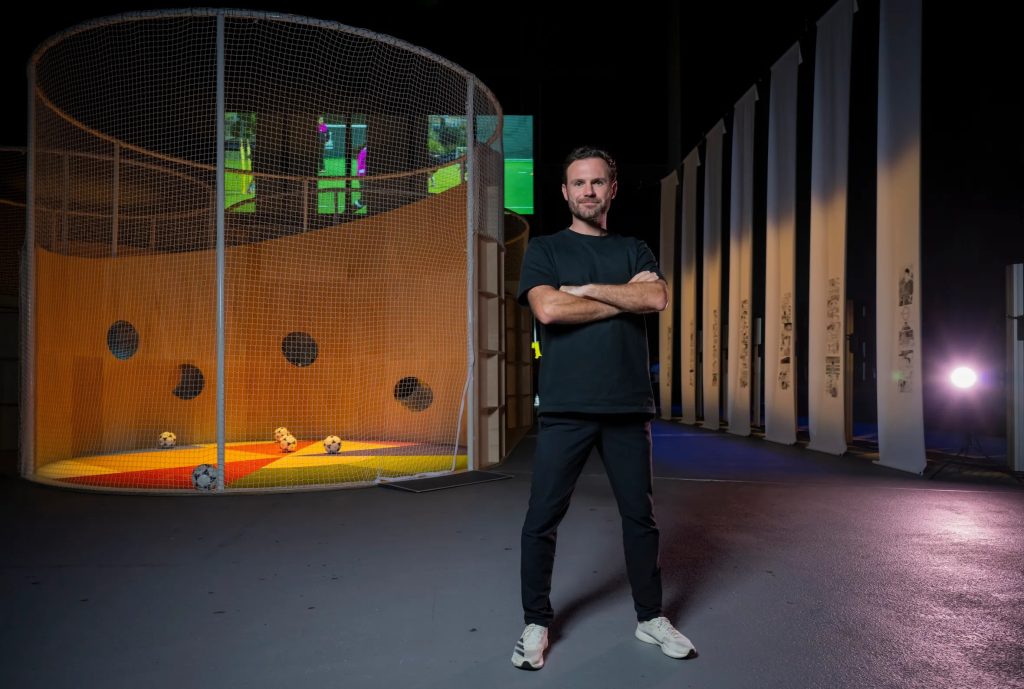
In Manchester, an afternoon off might take him to the Whitworth, a jazz club or the streets of the Northern Quarter. He shared photographs of English landscapes and, through the curator Hans Ulrich Obrist, whom he had met in London, got to know artists including Tino Sehgal. “I realised his views on art and my views on football crossed over,” Mata told ‘The Art Newspaper’ of Sehgal. He took part in one of the artist’s pieces in 2023. Two years later, he co-curated Football City, Art United with Obrist and Josh Willdigg. The exhibition paired 11 artists with 11 footballers, among them Ryan Gander and Eric Cantona.
Granero had recommended Haruki Murakami’s Norwegian Wood during a Spain youth training camp. When Mata moved to Japan to play for Vissel Kobe, he recognised the atmosphere of Murakami’s novels in the jazz bars and on the commuter trains. “I see things from his novels reflected in everyday life,” he told ‘El País’. He began reading Yukio Mishima and took an interest in Japan’s long period of isolation. In Australia, while playing for Western Sydney Wanderers, he wanted to understand how the A-League was run and what its clubs meant to their communities in a country where Australian rules football and rugby league have bigger followings. He later joined Melbourne Victory, where he will remain a minority shareholder and chair of the football committee.
Using football to widen opportunities
In February 2017, Mata video-called his grandfather, Manuel García, from the Manchester United team bus. He was ill but had watched the match and, before they said goodbye, told Mata how much he had enjoyed his assist. He died a few days later. “I thought about everything football had given me. And I thought about what I wanted my legacy to be,” Mata wrote in ‘The Players’ Tribune’. That August, he launched Common Goal with Jürgen Griesbeck, becoming the first footballer to publicly pledge 1% of his salary to social projects through the initiative. More than 500 people and organisations have since signed up, including over 200 professional athletes. Mata now co-chairs its board.
The link between football and education also runs through his investment in San Diego FC. Before joining the ownership group in 2024, Mata had visited Right to Dream academies in Egypt and Denmark and trained with their young players. The San Diego academy combines schooling with football training and offers its residential students a full five-year scholarship regardless of how they perform on the pitch. “The academy is a fundamental part of this club,” Mata said at its opening. His business interests also extend to women’s football through Mercury13 and to Formula 1, where he joined the group investing in Alpine through Otro Capital.
Who gets a say in football?
In September, Mata and Griesbeck launched Unleash Football in Madrid. The initiative asks fans and players what they would change about the game, with topics ranging from ticket prices and the fixture calendar to women’s football. The aim is to put their proposals in writing and take them to the people who make the decisions. “I’ve been playing professional football for 20 years and, as a player, no one has ever asked me what the future of football will or could look like,” he said at the Web Summit in Lisbon on 12 November. By then, the project had already gathered views from around 1,000 people.
To announce his retirement, Mata returned to the dressing room at Juventud Estadio, the club in Oviedo where he first played organised football at the age of ten. In the video, which lasts barely 50 seconds, he sits alone with his boots in his hands. Then he stands up and hangs them on a peg. “Thanks, football,” he wrote when he shared it.
 Last related articles