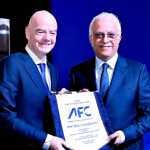
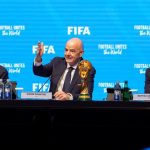
The president of the Asian Football Confederation -AFC-, Shaikh Salman bin Ebrahim Al Khalifa, publicly backed Gianni Infantino’s re-election on Friday at the Extraordinary Congress in Tokyo, Japan, with the FIFA president in attendance. The announcement shifts the political balance in the governance dispute at the International Federation of Association Football –FIFA-: Salman had joined the presidents of UEFA and CONCACAF in challenging the handling of the abandoned FIFA Forward Enterprise project. He now supports another Infantino term while Europe’s demands for answers remain outstanding.
“We reaffirm our full commitment to supporting you and your leadership as you seek a new mandate as FIFA president,” Salman said. The Asian confederation president acknowledged their earlier differences but explained that talks in Zurich, Switzerland, had produced an understanding. He called for progress through a shared vision and sought to separate those disagreements from his electoral support. The reconciliation played out before AFC member associations less than a month before the deadline for FIFA presidential nominations.
From joint criticism to electoral support
The confrontation began with FIFA Forward Enterprise -FFE-, a proposal to attract private investment through a new commercial entity linked to FIFA competitions. The project’s preparation and lack of consultation prompted a joint response from the leaders of the Union of European Football Associations -UEFA-, the Confederation of North, Central America and Caribbean Association Football -CONCACAF- and the AFC. Their alignment gave the challenge an intercontinental dimension. The project was withdrawn, and Infantino apologised this month for mistakes in the communication and consultation processes.
In Tokyo, the rapprochement included reciprocal endorsements. Infantino praised Salman’s thirteen years at the helm of the AFC and offered his support for him to continue, with the Bahraini official also preparing to seek re-election. The exchange weakens the critical alliance’s ability to maintain a common position on FIFA’s leadership. One of its members has publicly separated objections to FFE from the presidential election, creating room to support Infantino without necessarily endorsing all the decisions that triggered the dispute.
Japan has yet to decide
Japan’s position shows that Salman’s endorsement coexists with national decisions that remain open. Japan Football Association -JFA- president Tsuneyasu Miyamoto told Reuters that his organisation was looking to align with the AFC but had not yet decided its position. He also said he did not believe all Asian associations shared the same view. Miyamoto linked the rapprochement to discussions between the AFC and FIFA, the withdrawal of FFE and Infantino’s apology.
The AFC has 47 member associations, 46 of which belong to FIFA and have a vote at its Congress. Saudi Arabia and Qatar had already expressed support for Infantino before the Tokyo declaration. Salman now adds the political weight of the continental presidency and signals a rapprochement to other federations. The electoral impact will depend on the positions adopted by those associations, which cast their own votes. The declaration improves the president’s prospects, although the picture of national support is still taking shape.
Support does not settle the governance questions
UEFA is pursuing a different course: it has requested answers to 42 questions covering twelve topics, setting a deadline of 2 November. The letter, sent by its general secretary, Theodore Theodoridis, to his FIFA counterpart, Mattias Grafström, addresses FFE, the FIFA Peace Prize and other governance decisions. FIFA has stated its intention to answer questions submitted by Council members while maintaining the confidentiality of internal communications. The request keeps accountability for past decisions on the agenda alongside discussions about future reforms.
The next electoral milestone is 18 November, the deadline for nominations for the March 2027 election. The endorsement announced in Tokyo narrows the political base from which a joint challenge to the president could emerge: those who questioned FFE no longer share the same position on his continued leadership. Institutionally, the answers to UEFA and the terms of the governance review will allow scrutiny of the safeguards introduced after the crisis. Political reconciliation and procedural reform are therefore following related paths whose outcomes will need to be assessed separately.
 Last related articles