Almaty staged one of Asia’s most consequential ju-jitsu gatherings from July 13 to 18, combining continental championships with the ninth General Assembly of the Ju-Jitsu Asian Union in what effectively served as a final rehearsal ahead of the 2026 Asian Games.
The event transformed Almaty Arena into a dual arena of governance and elite competition, offering federations a rare opportunity to align strategy while testing performance levels against Asia’s best.
The General Assembly, chaired by Abdulmunem Al Hashemi, focused on structural coordination across the continent and readiness for Nagoya, where ju-jitsu is expected to deliver one of its most competitive editions at the Asian Games. Discussions centred on regional alignment, officiating standards and operational consistency among member federations.
On the tatami, the United Arab Emirates reinforced its status as a leading force in Asian ju-jitsu. The Emirati team opened strongly in the youth divisions with a haul of 15 medals, underlining the depth of its development system and long-term investment in the sport. That momentum carried into the senior competition, where the UAE added nine medals on the opening day to remain firmly among the title contenders.
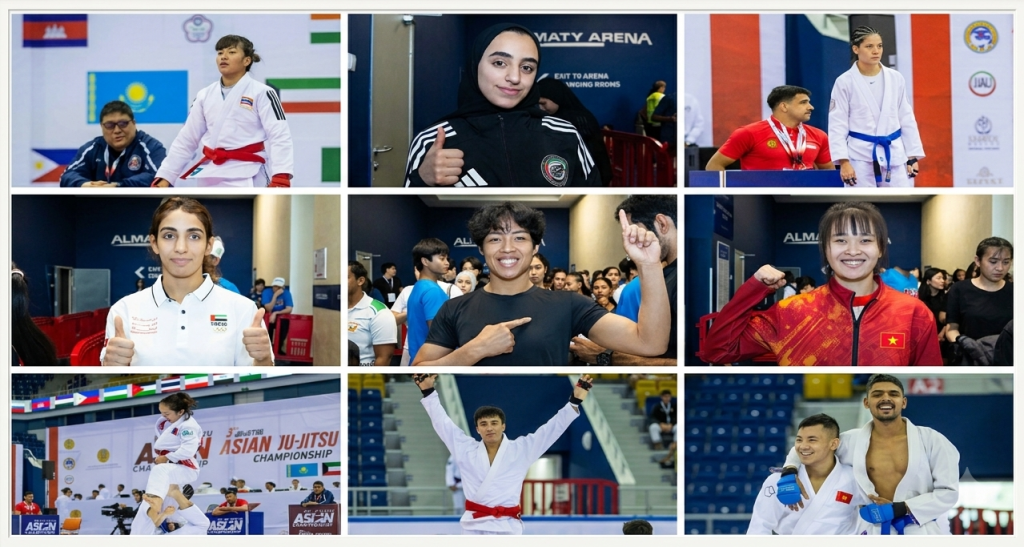
Among the standout performances, Annie Ramirez of the Philippines delivered a defining moment by claiming her third consecutive Asian title in the women’s -57kg category. Her victory over a Mongolian opponent in the final not only confirmed her consistency at continental level but also played a key role in lifting the Philippines into the top tier of the team standings.
Host nation Kazakhstan, alongside India, Vietnam, Uzbekistan and Kyrgyzstan, contributed to a highly competitive field, reflecting the growing depth of the sport across Central and South Asia. The narrowing performance gap between established powers and emerging programmes was evident throughout the competition.
Beyond the medal table, Almaty functioned as a comprehensive benchmark for readiness. With less than two months remaining before Nagoya, teams used the championships to finalise selections, assess officiating standards and refine tactical approaches.
As the Asian Games draw closer, the signals from Almaty point to an increasingly competitive landscape, where traditional dominance offers no guarantees and marginal gains could prove decisive in the race for medals.
 Last related articles