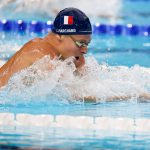
Two-time Olympic champion and seven-time world champion Hunter Armstrong will compete in the Enhanced Games in May, a competition that allows the use of substances banned in traditional sport to enhance performance. The 25-year-old American swimmer has announced, however, that he intends to race without doping and plans to remain part of the Olympic circuit with his sights set on Los Angeles 2028. “I am excited to compete in the first Enhanced Games and to do so as a non-enhanced athlete,” the swimmer said, stressing that he wants to maintain his status within international anti-doping testing programmes.
The Enhanced Games, whose first edition will take place in Las Vegas, have been launched as an alternative competition where the use of banned substances and other technologies prohibited in conventional sport is permitted. Backed by private investors, the project will feature swimming, athletics and weightlifting events with multi-million-dollar prize incentives. Several swimmers have already announced their participation, including James Magnussen, Kristian Gkolomeev and Andrii Govorov, although most of them have stepped away from the Olympic circuit. Armstrong’s case presents a different scenario. “If I don’t join Enhanced, I lose everything. If I do join Enhanced, I at least have a chance of not losing everything,” he said.
Armstrong’s case breaks the traditional model in swimming
The American plans to compete in the Enhanced Games without using banned substances while continuing to comply with World Aquatics anti-doping protocols, which would create an unprecedented situation in international swimming. His goal is to remain eligible for Team USA at future championships and Olympic Games. “I appreciate having autonomy over this decision and being able to compete as a natural athlete while complying with all international testing standards,” Armstrong said, arguing that his participation in the competition should not automatically exclude him from the traditional circuit.
The decision comes after a difficult year financially. Armstrong lost his main sponsor last summer and suddenly found himself without sufficient income to sustain his career. “My back was against the wall,” he explained. “Do I retire because I don’t have enough income, or do I find a less orthodox way to keep swimming and try to stand on the podium at a home Olympics?” In recent months he has taken on several jobs to support himself, working as a club coach, substitute teacher and real estate agent, as well as doing manual work such as carpentry and electrical repairs. “Even with all that, it’s not enough to live in Columbus, Ohio,” he said.
An Olympic champion who cannot live from his sport
The contrast with his achievements is striking. Armstrong won Olympic gold with the United States in relay events at Tokyo 2020 and Paris 2024, held the world record in the 50-metre backstroke for more than a year and collected fifteen medals at World Championships between 2022 and 2024. With that résumé, his case has reopened debate about the financial sustainability of elite careers in Olympic sports. “This was my only option to continue swimming full time,” the swimmer said.
Financially, the Enhanced Games offer a very different model. The organisation pays participating athletes a salary and provides additional bonuses for victories and world records. Armstrong plans to compete in the 50 backstroke and 100 freestyle events. If he breaks the world record in the 50 backstroke, currently held by Kliment Kolesnikov, he could receive a bonus of $250,000. “If I can swim fast and still comply with anti-doping testing, I don’t see why I should have to give up competing at the highest level,” he said.

World Aquatics rules and an uncomfortable precedent
The situation clashes with regulations recently approved by World Aquatics, which prohibit participation in its competitions for athletes who take part in events that allow banned substances. The organisation’s president, Husain Al Musallam, made the position clear when the rule was announced: “Those who enable doped sport are not welcome at World Aquatics or our events.” Armstrong says he consulted officials from the international federation before making his decision but did not receive a clear answer regarding his eligibility. “Nobody really knows what’s going to happen and nobody will give me an answer,” he said. A spokesperson for the federation indicated that each situation will be assessed “case by case”.
The precedent raises new questions within international swimming. Other swimmers such as James Magnussen, Shane Ryan and Ben Proud have also announced plans to compete in the Enhanced Games, although most have done so after stepping away from the Olympic circuit. Armstrong intends to take a different path and continue his career with Los Angeles 2028 in mind, where he could compete as one of the leading figures of the United States team at a home Olympics. “I’m not going to get an answer by waiting,” the swimmer said, accepting the uncertainty as he continues preparing for the upcoming season.
 Last related articles