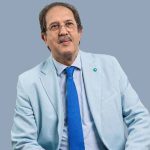
The loss of the Barranquilla 2027 Pan American Games left a deep wound in Colombian sport. The decision by Panam Sports, announced on 3 January 2024 due to “repeated breaches of the current contract by the Colombian Government”, not only removed the country from one of the continent’s major multi-sport events, but also damaged the credibility of its sports institutions inside and outside Colombia. For Ciro Solano Hurtado, president of the Colombian Olympic Committee -COC-, the consequences were “incalculable” and the recovery process has only just begun.
Solano had kept away from international interviews since that episode. Public opinion and part of the sports environment pointed to the Olympic Committee itself, despite the fact that the institutional and financial guarantee for Games of this scale rests with the Colombian State. In that context, the Panama 2026 South American Youth Games opened the space to speak again with the official, in a conversation with SportsIn at the Westin Hotel in Costa del Este, in Panama City, where Colombian Olympism is trying to move from the wound to reconstruction.
The loss of Barranquilla and the blow to credibility
Asked about the current health of the Colombian Olympic Committee, Solano defended the work carried out in recent years, but acknowledged the institutional impact of losing the Pan American host city. “Since the time of Baltasar Medina and this administration, we have firmly believed that Colombia can be a continental power. We have trained our coaches, we have sealed successful alliances with governments. Unfortunately, in this last four-year period we have had quite a few difficulties because of the economic situation the country is going through,” he explained.
The official acknowledged a “great personal and institutional sadness” over not organising the Games in Barranquilla, an event that, in his view, would have generated infrastructure, sporting legacy, economic activity and decentralisation. “The blow we received was devastating for us. Some organisations lost confidence in Colombia, our country image was seriously damaged and, at the end of the day, we as sports officials lose one of our few assets: credibility,” said Solano. That impact, he added, explains his decision to step away from public exposure: “That was one of the main reasons why I moved away from the public eye and focused more strongly on my role as president of the Colombian Olympic Committee, and on getting back up, as high-performance sport teaches you when you have fallen and have to keep going.”
The wound, however, has not closed the country’s Pan American ambition. “We are not going to give up on seeking a Pan American Games for Colombia, because in our memory we remember with special affection and nostalgia the Cali 1971 Pan American Games,” he said.
A sports policy that cannot start from zero every four years
The president of the COC also placed the Barranquilla case within a broader weakness shared by several South American countries: the lack of state-level sports policies. “There is no state policy, there is a policy of the government of the day that lasts four years and immediately dies when the next government comes in. There is no continuity with anything, everything starts from zero,” said Solano, before summing up his diagnosis with a particularly critical phrase: “It is a disastrous vision that exists in Colombia and in all the countries on this side of the hemisphere.”
The official argued that sport needs stable plans that go beyond governments, electoral calendars and administrative changes. “As a sports leader, you expect a state policy to last over time and to be above the governments of the moment,” he said. In that reading, the loss of the Pan American Games cannot be explained only by a specific breach, but by a structural fragility in the relationship between the State, sport, funding, planning and Olympic institutions.
 Panama 2026 and the balance of Colombia’s next generation
The Panama 2026 South American Youth Games offered Colombian Olympism an initial picture of its generational renewal. Solano assessed the result positively, although he acknowledged that Colombia finished below its recent standards. “The balance is positive, even though we dropped in the medal count and ended up in fourth place, perhaps unthinkable given the experience of the 2022 Games, where we finished second and with a high level of performance,” he explained.
The president of the COC highlighted the dominance of Brazil, which he described as a country with a “superlative” level both in terms of population and sporting performance, and admitted that Colombia lost medals in disciplines where it is traditionally strong. “Other countries were better than us, such as Venezuela and Argentina. We are not going to look for excuses, but the coaches and we as officials have the obligation to break down what happened and work with this generation that is projected towards the next Olympic cycles,” he said.
Santo Domingo 2026 and the challenge of sustaining prominence
Colombia’s medal haul in Panama ended with 87 medals, made up of 26 golds, 18 silvers and 43 bronzes, a result that Solano sees as a working base for the coming years. “In the end, I take away the total of 87 medals, where we reached 26 golds, 18 silvers and 43 bronzes, a haul that excites us to continue with the processes,” said the president of the COC, who also warned about one of the major challenges at these ages: keeping young athletes inside the sports system as they move towards university, face a lack of funding and encounter the difficulties of sustaining high-performance processes in development categories.
The next test will come soon with the XXV Central American and Caribbean Games Santo Domingo 2026, where Colombia will seek to maintain the prominence achieved in San Salvador 2023, when it finished second. Solano knows the country will have to compete medal by medal with powers such as Mexico and Cuba, while trying to recover the confidence lost after Barranquilla and “return to the place” that, he argues, Colombian Olympism earned over the last two decades as an institution capable of training, organising, cooperating and projecting sporting talent across the region.
 Last related articles