At its annual congress, the European Judo Union highlighted record event numbers, growing financial stability and a broader commitment to inclusion, signalling Europe’s increasingly central role in international judo.
The European Judo Union has underlined its growing influence within global judo following its 77th Ordinary Congress, where leaders pointed to expansion in competition, governance and social responsibility.
Addressing delegates, EJU President Dr László Tóth described the past three years as a period of significant development. He congratulated newly elected and re-elected presidents of member federations and emphasised Europe’s rising profile in international decision-making.
That influence has been reinforced by the election of eight European representatives to the International Judo Federation’s Executive Committee, a result that positions Europe as a key voice in shaping the sport’s future.

Catarina Rodrigues
Central to the President’s address was the scale of the EJU’s competition calendar. After organising 107 events in 2023 and 101 in 2024, the Union reached a record 114 events in 2025. The figures were presented as evidence of organisational capacity and long-term planning across the continent.
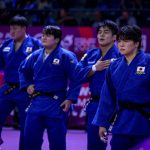
Europe’s role as a host of major international competitions was also highlighted. In 2025, European countries staged four of the five IJF World Championships, including the Senior World Championships in Hungary, the Cadet World Championships in Bulgaria, and the Veterans and Kata World Championships in France.
Beyond competition, the EJU reported continued growth in its media and commercial activities. Expansion of JudoTV and broadcast partnerships contributed to a 33 per cent increase in revenue between 2024 and 2025, strengthening the Union’s financial sustainability.

Human Rights Commission
The Congress also showcased a broader strategic vision. Initiatives such as the IJF Academy, youth and grassroots programmes, kata festivals and the development of adapted judo were presented as central pillars of the EJU’s work. Adapted judo, in particular, was described as a defining programme, aimed at widening access to the sport for people with disabilities and their families.
Looking ahead to 2026, the EJU outlined plans to open its Club Championships to global participation and to launch a joint project with France Judo focused on colour belt competitions, aimed at expanding participation beyond elite levels.
Delegates also approved the EJU Human Rights Declaration, committing the organisation to principles of equality, accessibility, safeguarding and diversity. New host nations for major events, including Montenegro, North Macedonia and Moldova, were confirmed, reflecting what officials described as increasing interest from countries of all sizes.
Concluding the Congress, Dr Tóth highlighted judo’s ability to transcend political and cultural divisions. The overall message was one of confidence and continuity, with the European Judo Union positioning itself as both a stable governing body and an increasingly influential force in international judo.
 Last related articles