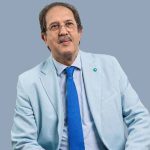
In an exclusive interview with SportsIn during the South American Youth Games, Fernando Ucha, president of the Uruguayan Olympic Committee -COU-, delivers a blunt diagnosis of the structural situation facing sport in his country: “We are in a very bad place, as harsh as that sounds, we are the worst in the class.” The remark does not come after a disappointing performance, but just after Panama 2026, where Uruguay delivered a strong campaign with 4 golds, 6 silvers and 7 bronzes. That paradox runs through the whole conversation: competing well while admitting that the country has fallen behind in facilities and training conditions.
Ucha took over the COU presidency for the 2024-2028 term after already working inside the organisation, where he had been responsible for the sports area. That is why, in the interview, he speaks more about continuity with adjustments than about rupture. “I already knew what the Olympic Committee was like, because I was part of this institution. In the previous period I was in charge of the sports area, so I knew very well how it worked, and that made it very easy to continue along the path we had already set,” he explains. From there, he adds that he tried to “put his own stamp on it and improve certain aspects of internal work so that we could respond more quickly to the urgent needs of Uruguayan sport”. The COU reflects that stage in its recent documents and places the new cycle within a medium-term planning framework.
A strategic plan to organise priorities
The first major decision of his term was to organise those urgencies within a broader working framework. Ucha says the COU spent six months developing a strategic plan with the participation of federations, officials, coaches, athletes and the National Sports Secretariat. “The first thing we did with our working team was to put together a strategic plan for the Olympic Committee,” he says. “We brought together all the proposals and conclusions from a process that lasted six months, in which all the living forces of the Olympic Committee took part.” That plan, in fact, appears in the COU’s institutional roadmap for 2025-2032.
Three pillars emerged from that process, which Ucha describes as the “road map” of his term: sports infrastructure, sporting legacy and education. “We believe Uruguay has fallen a long way behind on sports infrastructure,” he explains, before placing athlete and coach development among the priorities as well, together with the need to leave a stronger base for future Olympic cycles. The COU’s own planning documents place infrastructure improvement and technical strengthening among their main areas of action.
“We used to be at the forefront of infrastructure”: the diagnosis
The harshest moment of the interview comes when SportsIn asks him to compare what he has seen in Panama with what Uruguay has today. Ucha does not avoid the question. “We are in a very bad place, as harsh as that sounds, we are the worst in the class, as I like to say,” he states. He then brings that judgment down to concrete examples: “From being a country that used to be at the forefront of sports infrastructure, today Uruguay does not have a 50-metre swimming pool, today Uruguay does not have a proper velodrome, we are missing a huge amount of infrastructure.” The criticism is not framed as a general complaint, but as a direct reading of the material gap with which, in his view, the country competes against its neighbours.
From there, he links the lack of facilities to sporting performance. “Results come from having the right spaces, the sports equipment with which you compete internationally, in other words, creating all the possible conditions for an athlete to train on the same level as developed countries, without giving away sporting disadvantages,” he argues. Ucha also explains that the COU is working “very closely with the government and with the regional authorities” and is trying to expose public officials to major events so they can see what other countries in the region are doing and what effect that investment has on competitive level.
 Panama 2026 as a sign of what Uruguay can do
In that context, Uruguay’s performance in Panama 2026 takes on even more importance. The delegation closed the Games with 4 golds, 6 silvers and 7 bronzes, above the 3 golds, 5 silvers and 10 bronzes from Rosario 2022, according to the COU’s official reports. Ucha interprets that as evidence of sustained work and, at the same time, as a sign of how far the country could still grow if its structural conditions improved.
When he talks about those results, he places the emphasis more on names and processes than on medal totals. He recalls the gold in 3×3 basketball, won against Paraguay by 15-14 even though, in his view, the favourites were Chile, Argentina and Brazil. He also highlights the surprise of Angelina Solari in swimming, the performance of Antonella Bonomi in the 2,000-metre steeplechase and the result of Isabella Marenco on floor. “I could go on detailing every medal, because at these ages they are the result of the work of parents and coaches, together with the Uruguayan Olympic Committee, but the credit belongs to them, to the boys and girls who give everything to put their country as high as possible,” he says.
The Olympic dream and sport as a social tool
The most personal part of the interview comes when SportsIn asks him what he dreams about. Ucha admits that it is not a question he is asked often, but he answers directly. “Of course I have dreams,” he says. The first is to see Uruguay win another Olympic gold. He recalls that the country has two in football, from Paris 1924 and Amsterdam 1928, and also mentions the silver in rowing at London 1948 and the silver in cycling at Sydney 2000 as signs of where that ambition could be rebuilt. “To win an Olympic gold, you need investment, teamwork and several Olympic cycles,” he sums up.
That sporting horizon is mixed, in his discourse, with a broader idea about the social role of sport. Back in Uruguay after Panama 2026, Ucha insists that the message to the authorities cannot be only about medals. “Sport is a great tool for a society that is becoming more and more closed in on itself, and young people look at sport with disdain without imagining that it is a great tool for facing the challenges life puts in front of us,” he says. In his interview with SportsIn, his diagnosis is harsh when he speaks about infrastructure, but not resigned: he argues that Panama 2026 shows Uruguay still has the human and sporting base to grow, as long as the country chooses to back it with the resources to match.
 Last related articles