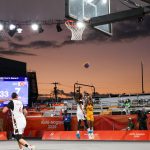
The International Basketball Federation -FIBA- has published its impact assessment of the FIBA 3×3 Champions Cup 2026, held from 13 to 15 March at CentralWorld Square in Bangkok. The second edition generated 59.8 million impressions, 48 million views and 1.3 million engagements across the organisation’s digital channels. The tournament also attracted more than 19,300 attendees representing 45 nationalities over three days and secured television and digital distribution across markets on four continents.
3×3 basketball was already growing before this competition was created. That expansion was driven by the World Tour, the Women’s Series, World Cups, continental cups and a digital ecosystem designed to connect with younger audiences. The Champions Cup represents another route within that expansion: a stable host for its first five editions, local and global sponsors, free entry at an urban venue, a parallel youth competition, social-first content and a direct connection with the pathway to the Los Angeles 2028 Olympic Games -LA28-. Two years are not enough to establish a long-term record, but the tournament is no longer merely a promising launch: it has completed two consecutive editions and improved its main indicators in its second year.
More distribution than engagement
The sharpest growth came in visibility and content consumption. Impressions increased by 60%, from 37.4 million in 2025 to 59.8 million in 2026, while views rose from 26.6 million to 48 million, an increase of 80%. Engagements also grew, although at a slower rate, from 1.1 million to 1.3 million, or 18%. Facebook increased its share from 29% to 41% of total engagement. An indicative comparison between engagements and impressions shows the ratio falling from approximately 2.9% to 2.2%, although FIBA has not disclosed the methodology used. The figures show that the Champions Cup reached considerably more screens, but the proportional increase in active engagement was smaller.
The on-site dimension completed the picture, with more than 19,300 attendees over the three days — admission was free — and full capacity throughout the event, according to FIBA. International distribution also achieved broad geographical coverage through broadcasters and platforms including the Olympic Channel, TRT, TVP, RTS, Arena Sports, DAZN, Shinai Sports, CBC and beIN Sports, as well as the official FIBA 3×3 YouTube channel. The federation has not published total broadcast hours, viewing figures or a complete comparison with the inaugural edition, but its presence across Europe, Asia, the Americas and Africa increased the tournament’s international availability.
Five editions to build a local presence
The choice of Bangkok forms part of a long-term project. When FIBA launched the Champions Cup in December 2024, it announced that Thailand would host its first five editions. Thai energy drink Sponsor and Red Bull joined as co-title sponsors, while Channel 7HD provided part of the domestic coverage from the inaugural event. FIBA 3×3 Managing Director Alex Sanchez explained at the time that remaining in Bangkok for five years offered an opportunity to establish a strong footprint for the discipline in the country. The second edition provides the first available year-on-year assessment of that strategy.
CentralWorld Square contributes to the model by placing the competition in one of the city centre’s main retail and entertainment locations, open both to basketball supporters and people passing through the area. The tournament once again included ceremonies, exhibitions, a fan zone and activities with content creators, as well as an initiative focused on local development. The Road to Champions Cup programme organised competitions in Nakhon Si Thammarat, Khon Kaen, Chiang Mai and Ayutthaya before staging its finals in Bangkok. It featured men’s and women’s Open divisions, boys’ and girls’ U18 competitions and a mixed U12 category, with 500,000 baht in prize money. The formula therefore connects an international showcase with opportunities for young players and a local presence extending beyond the three days of the main tournament.
A competition connected to LA28
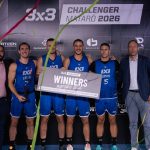
The sporting significance also increased in 2026. The United States won the men’s competition after defeating Spain 19-14, while the Netherlands beat Azerbaijan 21-12 in the women’s final. Caden Pierce and Noortje Driessen were named MVPs. Both champions qualified for the 2027 World Cup and Champions Cup. The Netherlands also secured a place in the Cups-based Olympic Qualifying Tournament. As the United States already holds a men’s place at LA28 as the host nation, that qualifying opportunity passed to runners-up Spain. The Champions Cup has therefore moved beyond being simply an early-season meeting of champions and become directly integrated into the Olympic qualification system.
The results from Bangkok form part of a wider expansion. During 2025, the FIBA 3×3 ecosystem surpassed ten million followers, generated 1.5 billion impressions, 1.1 billion views and 118 million engagements, and achieved television distribution across 234 territories. Within that broader growth, the Champions Cup is testing its own formula: remaining at the same venue, combining local and international commercial support, occupying a free urban space, developing youth activity and offering sporting rewards linked to the World Cup and the Olympic Games. Two editions are not enough to confirm the project’s long-term success, but they are beginning to show that Bangkok can provide another route to growth for FIBA 3×3.
 Last related articles