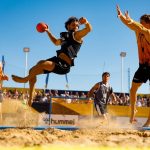
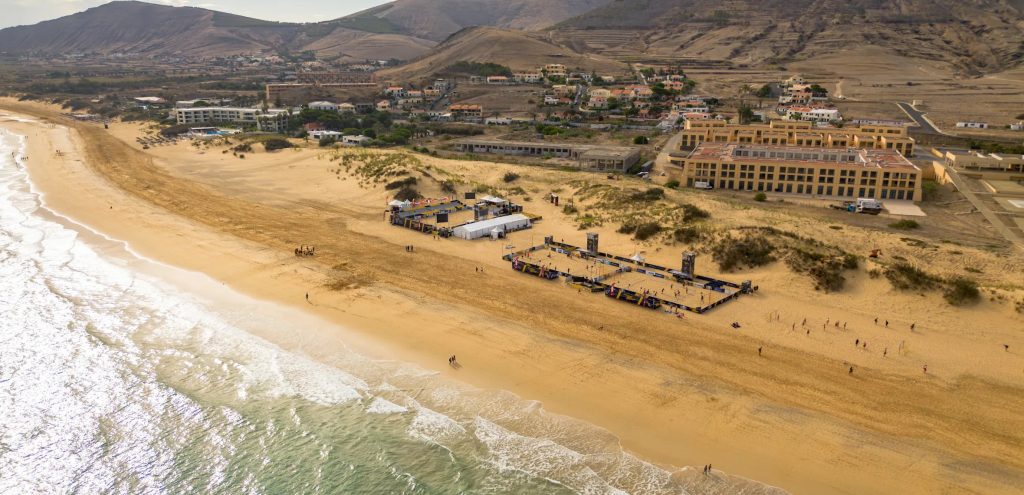
Porto Santo, in the Madeira archipelago, Portugal, hosts the EHF Beach Handball Champions Cup from Thursday to Sunday, with 32 teams from eleven countries divided equally between the men’s and women’s competitions. The tournament’s twelfth edition takes place on the island for the fifth consecutive year, with courts beside Cabeço beach. Hosting the continental competition has become part of the island’s tourism strategy, supported this year by additional transport services to bring participants to the venue.
The event brings together the European Handball Federation -EHF-, the Portuguese Handball Federation -FPA- and the Madeira Handball Association, with support from the regional government. Wednesday’s welcome ceremony took place at The Navigator Columbus hotel. According to ‘Diário de Notícias da Madeira’, mayor Nuno Baptista said the event involved more than 400 people and highlighted the island’s ability to welcome the clubs despite its “double insularity”, reflecting Porto Santo’s position as a smaller island within an offshore archipelago. Gabriela Horváth, responsible for beach handball at the EHF, praised the organisers’ work over recent editions.
A competition within the tourism strategy
The regional government has earmarked up to €60,000 for the Portuguese federation through a tourism promotion agreement. Regional Secretary for Tourism, Environment and Culture Eduardo Jesus links the support to attracting visitors outside the usual peak season and generating business for accommodation providers, restaurants and transport services. “When we support an event of this kind, we are supporting much more than the staging of a competition,” he said in comments reported by ‘Funchal Notícias’. The funding aims to diversify tourism activity and promote Porto Santo as a destination for international sporting events.
Travel arrangements have also required specific coordination. Additional Binter flights between Madeira and Porto Santo were announced for 15–21 October, excluding Sunday, with Monday’s extra service allocated to tournament-related transport. An additional sailing by the Lobo Marinho ferry from Funchal was also scheduled for Wednesday, before the vessel entered maintenance. Despite those measures, Baptista warned during the welcome ceremony that return travel still needed to be secured for around twenty athletes: “The planes are full, completely full.” His warning reflected the situation on Wednesday, as the municipality sought solutions to complete the travel arrangements.
Three courts and an international audience
The schedule uses three courts across the four days, with the same format for men and women. Each tournament begins with four groups of four teams; the top three advance to a main round comprising two groups of six, while the remaining teams contest places thirteen to sixteen. The top four in each main-round group reach Saturday’s quarter-finals. Sunday’s semi-finals take place across two courts before the closing matches and finals move exclusively to the main court. Placement matches also determine the final positions of eliminated teams.
Broadcast coverage extends the event’s reach beyond the island: every match on every court is streamed on EHFTV, with paid passes available for the full tournament or the final day. Coverage also includes live scores, competition content and behind-the-scenes footage on the EHF’s social media channels. Fans will be able to vote for the best player, goalkeeper and defender in each tournament. The approach combines match coverage with stories about the participants and opportunities for audience involvement.
Defending champions and a new generation
Portugal has five teams in the competition and Spain four. Nazaré BHT defend the men’s title and Ciudad de Málaga the women’s, after both defeated the respective GRD Leça teams in the 2025 finals. The club competition also features international experience: 12 Monkeys Köln BHC have members of Germany’s 2026 world championship-winning squad, while Associação Desportiva – ADG include players from the Argentina team that won the women’s world title in Zagreb, Croatia. The tournament closes the calendar of major European club beach handball events.
Among the debutants are Young Guns Bremen, Germany’s runners-up, whose women’s squad comprises players aged fifteen to twenty-one. Club Handbol Xàbia, Next Wave, Hiekka Hauskaa and Beaurepaire Beach Handball also make their first appearances in the women’s competition. They join a field that includes The Danish Beachhandball Dream, champions in 2023 and 2024 and fourth last year. The past five editions have produced five different men’s champions and four women’s champions, contrasting with Porto Santo’s continuity as host. The new titles will be decided on Sunday following the weekend’s knockout rounds.
 Last related articles