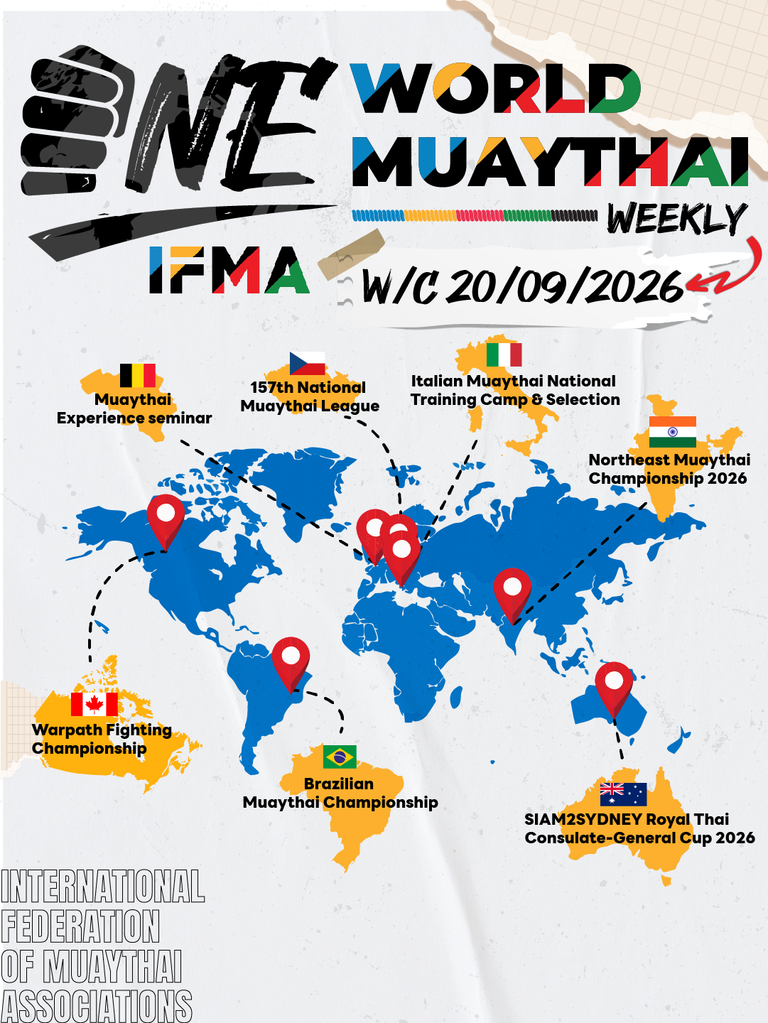
The International Federation of Muaythai Associations –IFMA– has brought together activities held between 19 and 27 September in Italy, Brazil, India, Canada, Belgium, Czechia and Australia. The programme includes national team training camps, qualifying championships, a regional competition, an interprovincial fight card, the opening round of a league, cultural workshops and an amateur tournament. The initiatives differ in scale, but they are connected by their role within the sport’s development structure.
The selection of events shows how each organisation adapts the development of the discipline to its own requirements. Italy is building continuity between its junior and senior categories; Brazil is using its national championship to select its team; India is strengthening competition between regions; Canada is bringing together two provincial structures; Czechia maintains a regular league; Australia provides competitive experience for amateur athletes; and Belgium is taking the practice and culture of muaythai into a museum.
National team selection and preparation
The activity began in Grosseto, where Federkombat brought together members of the Italian national teams and young athletes with the potential to join them on 19 and 20 September. The programme at Singha Fight Club included a senior national team camp, a junior “Azzurrabili” training camp and the second national gathering for that age group. The federation’s platform recorded 24 entries for the Collegiale Nazionale JR/SR held on 19 September as part of sessions designed to improve technical and tactical skills and support the identification of emerging talent.
In Recife, the 21st Brazilian Traditional Muaythai Championship served as the official selection event for the 2027 IFMA World Championships. Held on 19 and 20 September, the competition brought the country’s main national tournament to the state of Pernambuco for the first time. It also coincided with the 21st anniversary of the Brazilian Traditional Muaythai Confederation –CBMTT–, an organisation recognised by the Brazilian Olympic Committee and IFMA, and featured male and female categories ranging from youth to senior competition.
 Competition throughout the year
The Northeast Muaythai Championship takes place from 21 to 24 September in Aizawl, the capital of Mizoram, providing a platform for athletes from different states in north-east India. Sikkim sent a 15-member delegation comprising athletes and technical staff to the competition, which is organised by the state association with the support of the United Muay Thai Association of India –UMAI–. In Calgary, WARPATH 002 will bring together representatives of Ontario and Alberta on 26 September through a four-bout card sanctioned by Muay Thai Canada and headlined by Noah Giraldo against Adel Darras.
The Czech Muaythai Association will open its 2026–2027 National League season in Brno on 26 September, with bouts across senior, junior, women’s and children’s categories. The format keeps athletes active throughout the season and allows their development to be monitored beyond a single championship. On the same day, Sydney will host the Siam2Sydney Royal Thai Consulate-General Cup, an elimination tournament for C-class amateurs that will also include several professional bouts. The team winning the most gold medals will receive the Royal Thai Consulate-General Cup.
Muaythai enters the museum
Antwerp offers a different model focused on education and cultural outreach. Thai instructors Kru Chalee, Khu Por and Khiaw Phet will lead sessions for experienced children and adults at The Bulldogs in Merksem on 26 September, in collaboration with the Royal Thai Embassy. The following day, the Museum aan de Stroom –MAS– will stage a Wai Kru demonstration and a muaythai workshop from 13:00 to 14:00, with no advance registration required.
The seven initiatives illustrate the different functions that can coexist within one international federation without following a single format. Training camps prepare national teams, national championships determine who represents them, regional events bring competition to new areas and leagues provide continuity. Amateur tournaments increase the competitive experience available, while cultural activities introduce muaythai to audiences with no previous direct connection to the sport.
 Last related articles