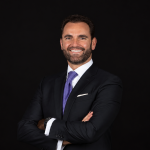
Across more than two decades within FIS, Janez Fleré has become an essential figure for anyone trying to understand the technical and administrative foundations of Alpine Skiing. Born in Bariloche, he first stepped on snow as a child and, over time, built a professional path defined by experience, calm leadership and a deep command of the rules. His role as a reference point for regulatory and administrative questions reflects a career shaped by service and approachability.
His early days in the sport began on wooden skis, within a family environment closely tied to the mountains. That background eventually led him to represent Argentina at the Lake Placid 1980 Olympic Winter Games, a chapter he recalls with modesty. “It was a different context. I was Argentinian champion, but I was never an amazing skier,” he says. The Olympic experience also marked the end of his competitive career before he shifted towards family life and new professional projects.
From racer to international technical reference
His return to skiing came in 1995, when he began volunteering for his national federation. The need for new technical delegates pushed him to obtain his TD licence, opening the door to working as Chief of Race in Argentina and as a delegate in Chile. Shortly afterward, he started attending FIS congresses and joined sub-committees linked to rules, classification and technical delegates, consolidating his role on the administrative side of the sport.
His international involvement took a decisive turn when Bariloche was selected to host the 2003 World Junior Championships, a project that would ultimately be abandoned due to the country’s political crisis. At the same time, a phone call from Sarah Lewis in 2002 offered him a temporary role coordinating the Ladies’ Europa Cup. He accepted and moved to Europe for six months, a period that quickly became a longer-term opportunity. His family relocated as well, and from then on, his connection with FIS became a long-term commitment.
The interpreter of the rules and the living memory of Alpine Skiing
Within FIS, his work soon expanded beyond circuit coordination. Fleré began receiving proposals from National Ski Associations worldwide, analysing their scope and forwarding them to the relevant committees. His ability to explain the intention behind regulations and his broad understanding of the system made him the person consulted whenever doubts emerged. “You need to understand the spirit of the rule,” he explains, noting how difficult it can be to draft texts that truly reflect their purpose.
The nickname ‘The Oracle’, given by colleagues such as Sandra Spitz, illustrates how much his accumulated experience is valued. Many documents of the international rulebook have passed through his hands, and his guidance has been central in maintaining coherence between committees and sub-committees. The trust placed in him stems from his detailed knowledge and his ability to guide without imposing.
Changes, future prospects and a bond with South America
Among the most challenging episodes he recalls is the cancellation of a race that could not be held under safe snow conditions. With more than one hundred athletes waiting at the start gate, he assumed responsibility for calling off the event, a decision he describes as one of the toughest moments of his career. The pressure, the need to guarantee safety and the exhaustion that followed strengthened his understanding of the weight carried by every decision in Alpine Skiing.
Throughout his career he has witnessed the sport evolve in areas such as equipment, technology and the growing relevance of broadcast coverage. He also sees opportunities in the Southern Hemisphere, where he hopes his native South America might once again host World Cup races. He mentions venues such as Ushuaia in Argentina, or potential sites in Chile, whose future depends on institutional support. In his words, “if it’s a World Cup, it means we need to go around the world, and there are possibilities.”
In nearly twenty-five years of dedication to FIS, Janez Fleré has left a profound mark as a coordinator, adviser and technical specialist. His career brings together personal experiences, complex decisions and a quiet, consistent contribution to the internal functioning of Alpine Skiing at international level.
 Last related articles