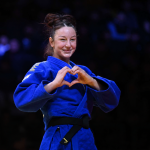
Kathrin Marchand is competing these days at the Milano Cortina Winter Paralympic Games after already having taken part in the Olympic Games and the Summer Paralympics, a journey that has given her an unusual place in German sport. But behind the rower who returned after a stroke and the skier who found her way into a new discipline in little more than a year is a woman who grew up measuring life through effort, work and the ability to keep going when her body was asking for something else.
Long before that sequence of comebacks, Marchand already lived sport as something natural. “I’ve been doing sports since I was a child,” she recalled in an interview with the International Ski and Snowboard Federation -FIS-. She began with gymnastics, moved on to field hockey and eventually took up rowing at 14, almost as a natural extension of the world around her: “My whole family was a rowing family, so I switched to that sport.”
From rowing to a life shaped by self-demand
For years, rowing gave her structure, routine and a very clear identity. It also taught her how to live with pressure. A shoulder injury sidelined her for a month and broke up one of the key partnerships of her career with Kerstin Hartmann, a period she has described as one of the moments that marked her most deeply. “I really learned to push myself on my own,” she said of a stage in her life when she realised that, even within a team sport, there were battles she had to fight alone.
When she stepped away from elite sport after the Rio 2016 Games, Marchand believed she was entering a different life. She wanted to finish her exams, work as a doctor and enjoy a kind of normality that had been postponed for years. But she swapped the boat for hospital shifts without fully abandoning the same inner logic. Her days filled with on-call duties, work and a rhythm that left almost no room for other people. “Before the stroke, I was so focused on working to become a doctor that I had no time for my friends or my family. I was only working,” she later explained.
The stroke that stopped her and changed the way she understood the body
In 2021, at 31, she suffered a stroke that abruptly broke that momentum. For months, she had to return to the most basic movements and accept something that until then had not formed part of the way she saw herself. In rehabilitation, she was surrounded by patients over 70, and that contrast forced her to accept that she, too, was a patient. “Until my stroke, I thought I was a healthy person. And suddenly, I was sick,” she told ‘ntv’. Later, once she was able to look back without the shock of those first moments, she found a line that captured the change: “When you survive a stroke, you have the honor to be alive.”
That period also changed her relationship with effort. Marchand, who for years had understood performance as a combination of discipline and endurance, began to speak about the body in different terms. “I learned that breaks are more important than the exercise itself. You learn that your body is not a machine,” she explained. Sport then returned with a different meaning, no longer as an obligation tied to results but as a form of rehabilitation and recognition. She slowly made her way back to the water, encouraged by a neighbour who rowed and pushed her to get back into the boat. There she found a feeling that had never fully left her: “Rowing is meditative.” In that repeated movement, on the water and out in the open air, she could focus on one single thing and shut out everything else.
An awkward beginning
Her return did not end there. After rowing came cross-country skiing, a discipline she entered as a newcomer with the mindset of a veteran. Marchand has said that she watched Johannes Høsflot Klæbo through what she called “visual learning”, fascinated by the smoothness of his technique and the way he climbed without any visible strain. At first, though, the picture was far less elegant: in her early videos she looked awkward, almost stumbling, and she had no problem sharing them herself. There too she found something she had not expected: the freedom of starting from scratch, without the weight of expectations. “It was really nice to learn something new and to see that you can improve, that you can get better if you invest time and energy,” she said. Skiing also pulled her away from a habit deeply rooted in rowing: “In rowing, I’m never alone, but in skiing I have to take care of myself.”
That adjustment came with another layer that is harder to explain. Marchand lives with a disability that often goes unnoticed at first glance: she has lost a third of her visual field in both eyes and still deals with limitations on the left side of her body. More than once, that has left her having to offer explanations she does not always want to give, especially when she performs well and someone on the outside decides that “nothing is wrong with her”. Over time, she has chosen to leave that part to the classifiers and focus instead on a more balanced life. She still works as a doctor, but for fewer hours than before; her days are divided between water, snow, the gym, rest and the people close to her. And when she looks ahead, she does so without the rigidity of earlier stages: first come the Los Angeles 2028 Paralympic Games in rowing; after that, there may still be time to keep joking about the other goal she mentioned recently with a laugh, a possible move to ‘Let’s Dance’ in 2029.
 Last related articles