Katie Shanahan claimed the first major senior international title of her career by winning the women’s 200m backstroke at the European Aquatics Championships Paris 2026 in 2:06.13. The British swimmer took control before the halfway point and finished 1.49 seconds ahead of defending champion Camila Rebelo of Portugal, who won silver in 2:07.62. France’s Pauline Mahieu completed the podium in 2:08.63. “I was really not expecting that at all! I knew I was in a really good place coming off the back of the heats and the semi-finals and I knew tonight I just really, really wanted to get my hand on the wall first. I’ve been second at Europeans three times,” Shanahan explained after turning several years of near misses into her first senior European title.
Her time added another dimension to the victory. Shanahan lowered her previous best of 2:07.45, set when she finished fourth at the 2023 World Championships, by 1.32 seconds. She also broke the British record of 2:06.66 established by Gemma Spofforth at the 2009 World Championships in Rome during the era of the subsequently banned polyurethane suits. Shanahan took 0.53 seconds off that mark and finished only five hundredths outside the European Championships record. The performance carried even greater significance because of everything she had endured since the previous year. “This has been the hardest year of my career. There have been 101 things going on this season! But to do that time – if you’d told me in January, I wouldn’t have believed you.”
Ten days out of the water and starting again
Her difficulties began at the 2025 World Championships in Singapore, where she competed while ill. Shanahan finished 18th in the 200m individual medley and, after recording the tenth-fastest time in the 200m backstroke heats, withdrew before the semi-finals. Towards the end of that year, the accumulated demands of a heavy competition schedule led to an overuse injury in her lower back. The pain continued to worsen until she could no longer swim backstroke in January 2026. “I had to take 10 days out of the water as I was in so much pain with my back and I wasn’t sure what was going on. I got an MRI and found out that it was overload issues and my disc was inflamed and everything was inflamed, so I had to start from literally nothing and build up again,” she recalled.
Her rehabilitation did not simply involve waiting for the pain to disappear. Shanahan reduced her workload in the pool and moved part of her preparation into the gym, while her physiotherapist, Jesse Costello, examined the movement of her hips, lower back and mid-thoracic spine. All these areas are involved when a swimmer holds a streamlined position or performs a turn, so the treatment sought both to restore those movements and to correct imbalances that could have been placing additional strain on the injured area. Costello used mobility assessments, force plates and other measurement systems to obtain objective data and design a specific programme to strengthen her hips and spine.
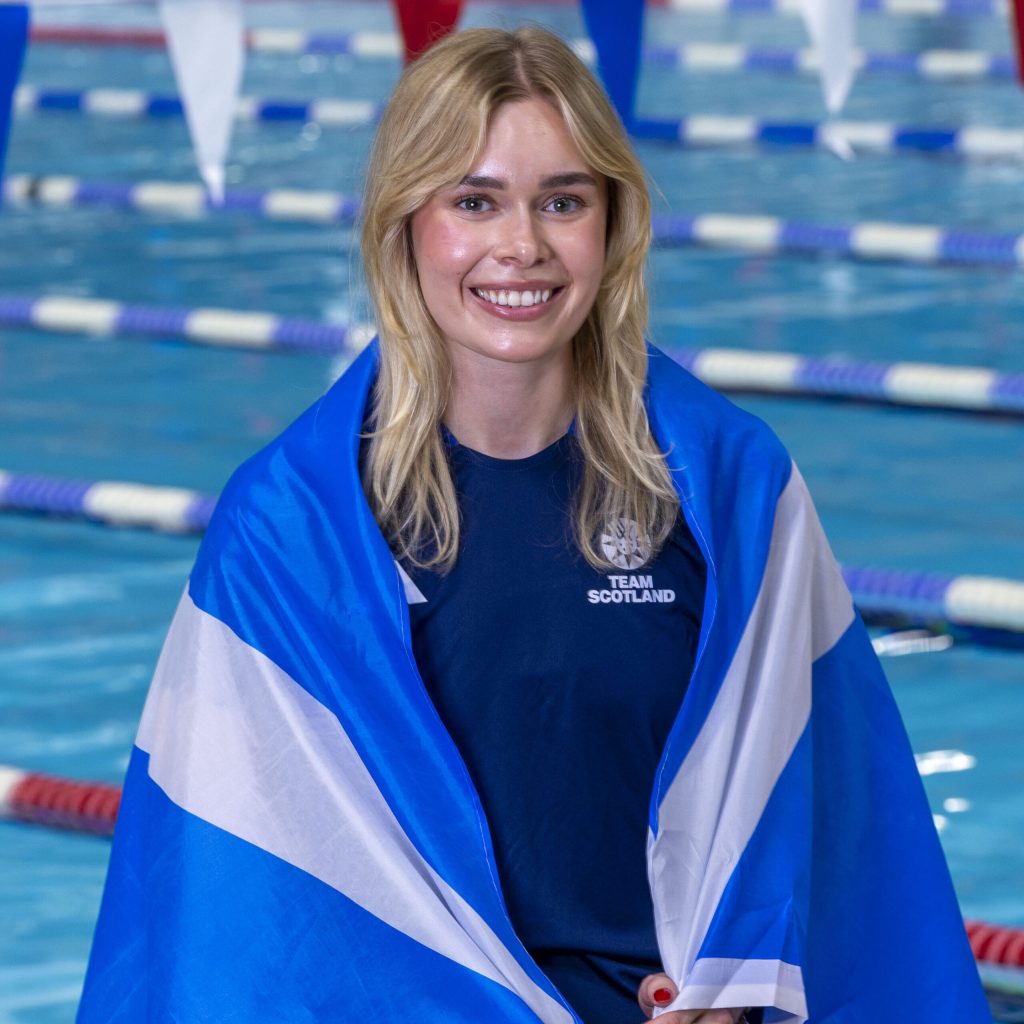 The team that helped her return
Before the injury, Shanahan saw her physiotherapist approximately once every two weeks. During rehabilitation, that increased to as many as three appointments a week. She worked with a multidisciplinary team from the sportscotland Institute of Sport, covering physiotherapy, physical preparation, physiology, psychology, nutrition and performance lifestyle support. Once she was able to train again, she completed a three-week altitude camp, with Costello and the wider team monitoring her progress remotely and coordinating with her coaches. “I had so much support from the sportscotland Institute of Sport. To be honest, I actually wouldn’t have properly been able to swim at trials without Jesse as my physio, who was absolutely amazing, and I had a lot of psychology support as well,” she said.
Her route to Paris still contained two further setbacks. Shortly before the British Championships, Shanahan became ill again and lost another week of preparation. She reached the April trials with “only about a couple of weeks of training” behind her, but won the 200m backstroke and secured her place at the Commonwealth Games. She then fractured a hand in May and had to adapt her training once more. Despite everything, she won silver in the 200m backstroke in 2:08.54 at Glasgow 2026, added another silver in the 4x100m medley relay and finished fourth in the 200m individual medley. Less than three weeks later, she cut 2.41 seconds from her individual time to become European champion. The sequence — illness, a back injury, another illness and a fractured hand — explains why her gold represented more than the result of one outstanding final.
The baby used for underwater demonstrations
Shanahan’s relationship with the pool began long before she could remember her first strokes. She was born in Glasgow on 25 June 2004 and grew up in Bishopbriggs. Her mother took her to parent-and-baby swimming classes when she was six months old. “She always tells the story that all the parents and mums would be too scared to dunk their babies under the water but apparently I used to love it, so I’d always be the demonstration because I loved it so much,” Shanahan later recalled. She began competing with Scotia Amateur Swimming Club in Bishopbriggs before moving to City of Glasgow and training at Tollcross International Swimming Centre. She was selected for a Scottish team for the first time at the age of 12 and also took part in ballet, dance and gymnastics until she was 13 or 14, although swimming was always her priority. One of the defining influences during that period was her coach Danielle Brayson, whom she described as “such a good coach and role model” who “always brought fun to the sessions”.
Her international progress was rapid. Shanahan won six medals — three golds and three silvers — at the 2019 European Youth Olympic Festival in Baku, before collecting another six at the 2021 European Junior Championships, including the 200m and 400m individual medley titles. She earned two bronze medals at the Birmingham 2022 Commonwealth Games, in the 200m backstroke and 400m individual medley, and became European 200m backstroke silver medallist a few weeks later. She finished fourth in that event and seventh in the 400m individual medley at the 2023 World Championships, before reaching two finals on her Olympic debut: fifth in the 200m backstroke and seventh in the 400m individual medley at Paris 2024. Two years later, she returned to the same city to complete the most difficult chapter of her career. The swimmer who had been unable to contest her specialist stroke in January started again from zero, rebuilt her body with the help of a multidisciplinary team and ended the summer not only as European champion, but as the fastest British woman in history over 200m backstroke.
 Last related articles