Jordan arrive at their first FIFA World Cup with a generation that has already changed the scale of the national team. One name stands above the rest in that story: Mousa Al-Taamari, the Stade Rennais winger known by some as the ‘Jordanian Messi’. “Jordanian players are defined by grit and determination,” he told FIFA, a phrase that fits the spirit of ‘Al-Nashama’, the nickname of a team associated with nobility, resilience and the will to compete until the end.
Before becoming the first Jordanian to play in Ligue 1, before being welcomed as a hero in Amman and before carrying part of a country’s hopes into the World Cup, Al-Taamari was a boy whose life moved between street football, school and the mosque. He memorised the Quran in full, taught younger children to recite it at Al Saliheen Mosque and became known as “Sheikh Mousa”, while his career was still far from Europe and the biggest stadiums. His path also had a less glamorous stop: he left football for two months and worked in a bakery in Hay Nazzal out of financial need, a stage that explains better than any statistic the journey of a player shaped far from football’s traditional centres of power.
From Amman to European football
Al-Taamari was born in Amman, into a family marked by a passion for football, and started playing from a very young age before joining Shabab Al-Ordon, the club where he rose through the ranks before reaching the first team and Jordan’s top flight at 19. “I was born in Amman, the capital, into a family that loves football. I’ve always loved football and I began playing for a club when I was eight or nine years old, at Shabab Al-Ordon,” he said in an interview with Ligue1.fr, where he also explained that, since childhood, he had dreamed of making football his career and playing in one of Europe’s five major leagues.
As a young man, he practised kickboxing on the recommendation of his teacher at the mosque, who encouraged him to work on that discipline to improve his physical and mental level. Al-Taamari explained in an interview that kickboxing was the first sport he practised in his youth, under the guidance of Issa Abu Nassar, now Jordan’s national kickboxing coach, before he ultimately committed fully to football. That combination of street, mosque, combat and training helps explain a competitive profile that Jordan have turned into one of their main weapons.
Family, bakery and a career that nearly stopped
At home, his future was not seen in the same way by everyone. His mother asked him to focus on his studies, not because she did not believe in him, but because she saw how difficult it would be for a boy to build a professional career from Jordan. His father, by contrast, backed his talent and encouraged him to follow the football path. “My mother wanted me to focus on my studies. It’s not that she didn’t believe in me, she just said that it would be difficult to make my dream come true in Jordan. However, I was stubborn and challenged her; I wanted to see where football could lead me,” Al-Taamari explained.
Life, however, forced him to stop before he could take off. Al-Taamari stepped away from football for two months and worked in a bakery in Hay Nazzal, in Amman, to cover his needs. It was not a sporting pause, but a decision of survival at a time when the professional dream still guaranteed nothing. That stretch of his story, between work shifts and training sessions, strengthened an ambition that later took him to Al-Jazira, to standout performances in the AFC Cup and to his first European opening with APOEL in 2018.
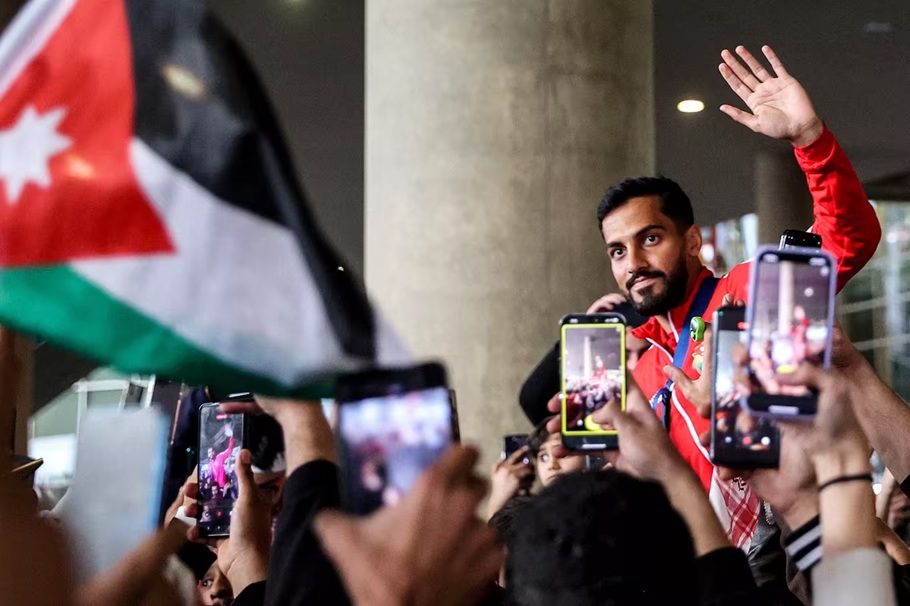
The player who did not want to be the Jordanian Messi
Cyprus was his first major leap. At APOEL, Al-Taamari became a champion, was named the best player in the Cypriot league and turned into an idol for supporters who began calling him the “Jordanian Messi”. The nickname travelled beyond Cyprus, but it never fully matched the way he understands himself as a footballer. “I know certain people call me that but I don’t like the nickname,” he admitted, before explaining that it was born in Cyprus, at a time when the team needed results and the supporters found in his effort, goals and ability to unbalance defenders a figure to hold on to.
Then came OH Leuven, Montpellier and Rennes, with Al-Taamari already established as the first Jordanian player to compete in one of Europe’s five major leagues. In France, his speed, dribbling, pressing and ability to attack space widened his international impact, but his message with the national team remained far from the label of a single star. “There are no superstars in our national team,” he said before the decisive stage of World Cup qualifying, insisting that every player had taken on the responsibility of making happy a fanbase that filled stadiums, squares and cafés on the road to the World Cup.
Qualification arrived after a campaign in which Al-Taamari was one of Jordan’s central figures, with seven goals and two assists, and with the team taking the decisive step after a 3-0 win over Oman and Iraq’s defeat to Korea Republic. “It’s a dream come true for every player, coach and fan. Thanks to God, we were able to achieve it. We felt how happy and proud the people were of us, and that alone makes every sacrifice over the years worthwhile,” he said after qualification. The World Cup will now be the natural extension of that journey, although Al-Taamari has already made clear that Jordan do not want simply to take part: “Of course, just qualifying for the World Cup is a historic achievement, but we won’t stop there. Our goals and ambitions are now greater – we want to showcase both Jordan and our football on the global stage.”
 Last related articles