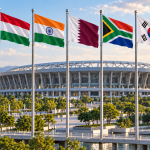
Panama took on the challenge and delivered as host of the IV South American Youth Games, a multi-sport event of this magnitude not seen in the isthmus for 53 years, since the XI Central American and Caribbean Games.
From a sporting perspective, this youth competition left several high points, but also some low ones that raise concern about the future development of athletes aiming for major results and long-term prominence.
High points
Combat sports continue their rise as a key strength for Panama in multi-sport events, now with a new generation of athletes following the path paved by those who have already made their mark at both the Pan American Games and the Olympic Games.
Yumaira Russell and Aisha Williams won gold medals in the 65kg and 73kg divisions respectively in wrestling, which contributed five medals overall.
In boxing, the impressive performance of Norman Simmons in the 90kg division placed Panama at the top of the podium in a sport that added three medals.
Fencing, while not a combat sport based solely on physical skills, also saw the triumph of Panamanian épée fencer Caleb Caldito Chan, who delivered dominant victories on his path to gold.
Sports such as taekwondo and karate came close to gold, but still contributed five medals each to the tally. In taekwondo, Natalia Pérez, one of Panama’s young prospects in the sport, earned silver after falling in the -44kg kyorugi final to Poliana Silva of Brazil. In karate, flag bearer Dessire Frías in the -53kg category and Isabel Mendoza in the -59kg division also reached their respective finals after impressive performances, though both were defeated in the title bouts.
Artistic gymnastics remains one of Panama’s strongest sports, thanks to the success of Hillary Heron and Karla Navas. At these South American Youth Games, their leading young representative Aylin Goon Lan reached the podium with bronze in the balance beam event.
Team sports also delivered more than respectable performances, with flag football – set to debut as an Olympic sport at Los Angeles 2028 – standing out the most after a dominant gold medal run in the women’s competition and a silver medal finish in the men’s division.
Baseball was not far behind, winning gold, followed by the men’s 3×3 basketball team, where Panama was not among the favorites but still eliminated teams such as Argentina before defeating Venezuela for the bronze medal in a revenge result from the round-robin stage.
Men’s football salvaged a bronze medal in a difficult tournament that saw Panama face Paraguay, Argentina and Bolivia.
Low points
The host nation was left with the major disappointment of failing to win a medal in athletics, one of the disciplines in which Panama has historically excelled, as shown by Olympic performances from the legendary Lloyd LaBeach and Irving Saladino, Panama’s only Olympic champion.
But what is being done to carry on the legacy of figures such as Alonso Edward and Gianna Woodruff? That is one of the major questions surrounding a sport that has lacked solid development projects and support.
Failing to win even one medal in athletics is one of the main issues that must be addressed, with the first step being the definition of a work plan alongside the country’s athletics federation to analyze the barriers preventing stronger results.
Swimming also fell short, with Raúl Antadillas standing as the main exception after winning bronze in the 100m breaststroke and silver in the 50m breaststroke.
Antadillas, together with Emily Santos – the second-youngest Panamanian athlete ever to compete at the Olympic Games – now emerges as one of the sport’s leading figures in Panama, following in the footsteps of great names such as Édgar Crespo and Eileen Coparropa.
Today, Panama has more swimming pools that have been renovated to meet requirements somewhat closer to international standards, but the number of swimmers standing out beyond Central America remains low in terms of results.
Futsal also ran into a very different competitive reality, as Panama failed to reach the podium in either category.
Panama, a nation that has appeared in multiple men’s Futsal World Cups and was a pioneer in the recent women’s futsal world championship, did not achieve positive results, largely due to the lack of regulation-standard courts for the sport, something that had previously been overcome even at senior national team level to the point of winning a Concacaf championship.
However, the level in South America, as in other countries across the continent, has continued to rise not only because of better playing facilities, but also because of the different development projects that have strengthened the sport.
In the end, Panama closed the South American Youth Games with a total of 29 medals – six gold, six silver and seventeen bronze – but also with a clearer perspective of its sporting reality, one that in the coming months will reveal how many initiatives will truly be put in place at the leadership level for stronger long-term development.
 Last related articles