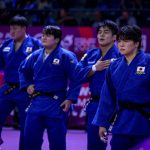
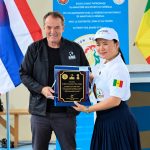
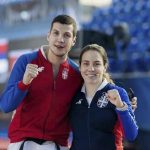
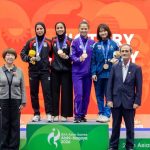
One week after the start of the Olympic qualification period for Los Angeles 2028 in Ulaanbaatar, the World Judo Tour moves to China for the Qingdao Grand Prix 2026. The event is the second tournament on the road to LA28 and once again offers key World Ranking List points at an early stage of the cycle, but already a relevant one for those seeking to position themselves in the four-year race towards the Olympic Games.
Qingdao returns to the calendar after its inaugural edition in 2025, as China adds another stop within its broad experience as a host country for events on the international circuit. The Chinese Judo Association has previously staged grand prix, grand slam and World Judo Masters competitions, an experience now linked again to a coastal city with economic weight, tourist projection and the capacity to welcome the international judo community.
Qingdao, another Chinese stop on the World Judo Tour
The president of the International Judo Federation -IJF-, Marius Vizer, welcomed the judo family back to China and highlighted confidence in the local organisation. “Welcome back to China. The city of Qingdao is preparing to open its doors to the World Judo Tour again. We can be sure we are in safe hands here,” he said. Vizer also underlined Qingdao’s profile as a modern city, with an active port, business importance and a mix of traditional and contemporary Chinese architecture with Western European influences.
The president of the Chinese Judo Association, Xugang Zhan, framed the tournament in terms that go beyond competition. “Judo carries far more meaning than being just a competitive sport,” he said. According to Zhan, China has long maintained a commitment to the development and international promotion of judo, and the organisation of the Qingdao Grand Prix 2026 reflects its willingness to strengthen international exchanges, deepen co-operation and build friendships through the sport.
Organisation, participation and Olympic pathway
The draw also reflected the institutional dimension of the event. Representing the IJF were general treasurer Naser Al Tamimi, sport director Kosei Inoue and referee director Tina Trstenjak. The local organisation included representatives of the Chinese Judo Association, the Shandong Judo Association and the Qingdao Sports Development Center, within a framework of co-operation between the international federation, the national federation and local authorities.
Al Tamimi thanked the Chinese federation, the country’s authorities, the city of Qingdao, Shandong province, the media and the sponsors for their support of the Grand Prix. Yan Yue, vice-president and secretary general of the Chinese Judo Association, also recalled that the competition brings together almost 500 athletes from 57 countries and highlighted the joint work with the local organising committee under the umbrella of the IJF. The figure confirms the international scale of a tournament that comes just one week after Ulaanbaatar and is already part of the first phase of qualification towards Los Angeles 2028.
 Two first golds and early signs of the cycle
The opening day began with five categories and several leading names from the World Judo Tour, including Xinran Hui, Balabay Aghayev, Mascha Ballhaus, Hifumi Abe and Timna Nelson Levy. However, the start of a new Olympic cycle once again confirmed that rankings are a guide, but not a guarantee. Hui, the world number one and a major home hope at -48 kg, fell in the quarter-finals to Kristina Dudina, while Aghayev, a recent winner in Ulaanbaatar and favourite at -60 kg, was eliminated by Olympic champion Yeldos Smetov.
China finally found its first gold of the tournament through Wenna Zhuang, who won the -48 kg final against Tugce Beder and celebrated the title in front of her home crowd. “It means everything to me to have won here in front of my family and friends because Qingdao is my home,” the Chinese judoka said. Hui later added a bronze for the host team and Dudina earned the first Grand Prix medal of her career. At -60 kg, Hayato Kondo gave the gold to Japan, while Charlie Ayre, ranked 96th in the world, reached his first Grand Prix final and showed how the start of the cycle can open space for new hierarchies.
Qingdao therefore stands as the second judo stop on the road to Los Angeles 2028, with Olympic points at stake, broad participation and an organisational structure supported by co-operation between the IJF, the national federation and local authorities. The race towards LA28 has only just begun, but the Chinese Grand Prix confirms that the journey is not built only on the tatami, but also on each event’s ability to sustain the calendar, project organisation and reinforce the international connection of the World Judo Tour.
 Last related articles