The NBA All-Star takes place this weekend at the Intuit Dome in Los Angeles with a new format, an earlier tip-off time and an unprecedented push involving content creators. The league is once again reshaping its flagship event in an effort to halt declining television audiences and restore competitiveness to a showcase that drew more than 20 million viewers in the United States during the 1990s, but reached only 4.7 million in 2025 — the second-lowest figure in its history.
The scale of the challenge was summed up by Kevin Durant, who will suit up for Team USA Stripes alongside veterans such as LeBron James and Kawhi Leonard. “They said it was the worst All-Star Game that people watched. So we’re going to see. Who knows what’s going to happen? This format might change the game, but who knows? We’ll see.” Durant also questioned the broader debate around effort levels: “You should ask the Europeans and the World team if they’re going to compete. If you look at Luka Doncic and Nikola Jokic now… is that competition?” Amid recurring criticism about a lack of defense and intensity, the NBA is attempting to reignite interest by combining international rivalry, financial incentives and expanded digital engagement.
Falling ratings and the search for relevance
In 1993, at the height of Michael Jordan’s global impact, the All-Star Game surpassed 23 million viewers in the United States. In 2025, the game played in San Francisco drew 4.7 million viewers, down 13% from the previous year and overtaken that weekend by the Daytona 500. Saturday’s programming marked the lowest-rated edition on record, while the Celebrity Game also posted historic lows.
Yet while traditional television numbers have declined, digital performance has expanded. The Friday and Saturday nights of the most recent All-Star weekend generated close to one billion views across official NBA social media accounts. League Pass subscriptions rose 56% year over year during that weekend, total watch time increased by 36%, and global social media reach climbed 12% to 4.7 billion views. The league increasingly measures engagement beyond live broadcast figures.
USA vs the World and a format built for intensity
The headline innovation is a triangular tournament featuring three teams: Team Stripes, composed of veteran American players; Team Stars, featuring younger U.S. talent; and Team World, made up of international players. The format includes 12-minute mini-games in a round-robin structure, with the top two teams advancing to a final. The total prize pool stands at $1.8 million, with $125,000 awarded to each player on the winning team, $50,000 to finalists and $25,000 to the remaining participants. The concept echoes the NHL’s 4 Nations Face-Off held in 2025, which featured teams from the United States, Canada, Finland and Sweden.
Sunday’s All-Star Game has also been moved three hours earlier to 5:00 p.m. ET, making it accessible at 11:00 p.m. in Spain and 6:00 a.m. in China. The NBA aims to strengthen its international reach and capitalize on the growing prominence of global stars such as Luka Doncic and Victor Wembanyama, who has already stated his intention to compete at full intensity in this edition.
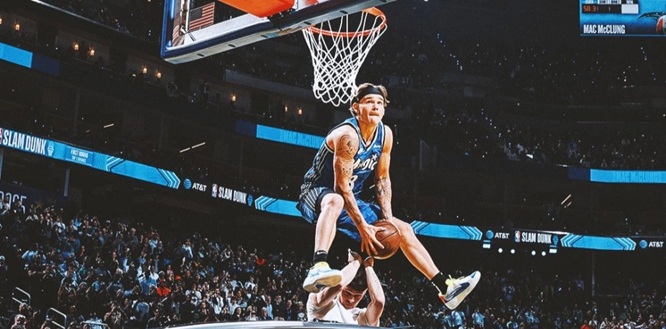
Lower TV numbers but higher economic returns for host cities
The digital strategy has been reinforced by the presence of more than 200 content creators throughout the weekend, representing a combined audience of over one billion followers. NBA Crossover will again serve as the hub of activations, including the PlayStation NBA Creator Cup, live streams, on-court competitions and fan experiences. “We’re excited to join forces with more creators than ever and provide engaging content that showcases this event to different audiences,” said Bob Carney, Senior Vice President of Social and Digital Content at the NBA.
Commercially, the event remains a major platform. Every sub-event carries a title sponsor, including Castrol, Ruffles, AT&T, KIA and State Farm. The 2025 edition generated an estimated economic impact of $429 million, with $328 million in the San Francisco metropolitan area and $100 million in media exposure, according to a study by Temple University. Total attendance reached 142,881 spectators. For 2026, the Government of California projects at least $250 million in economic impact for the Los Angeles metropolitan region, where the All-Star previously generated $116 million in 2018. Ticket prices range from $78 to $350 on Friday, $443 to $2,000 on Saturday, and from $928 to $3,200 for Sunday’s main event, underscoring the All-Star’s continued commercial strength despite fluctuating television ratings.
 Last related articles