Vinicius Junior will miss the Clásico against FC Barcelona on 25 October after receiving a four-match suspension for pulling Villarreal player Nathan Saliba’s hair and his subsequent protests. Real Madrid are preparing an appeal, but their chances of making him available for that match are limited: reducing the ban to three or even two games would not be enough, as Barcelona are their second opponents during the suspension. The punishment comprises two matches for each offence and also rules him out against Sevilla, Racing Santander and Valencia.
The ban comes as his sporting status and relationship with sections of the Bernabéu crowd face further strain. The club have renewed his contract but also recruited an alternative in Yan Diomande; the whistles have continued, and his recent performances have lacked the influence he exerted in his best seasons. Madrid can submit their appeal on Thursday and, if they do so before 15:00 Spanish time, the Appeals Committee must rule before midday on Friday. A small reduction would not allow him to play in the Clásico: the immediate problem is the suspension, but the underlying challenge is to regain his influence in a team with more options.
Madrid already have an alternative
The summer’s planning helps explain the new situation. Madrid had put forward a contract offer they did not intend to improve while pursuing Diomande as another attacking option. Both ultimately committed their futures to the club: on 6 August, Madrid announced the Brazilian’s extension until 2032 and the Ivorian’s arrival on a contract running until 2033. Madrid secured their star’s future and added a younger winger with speed and the ability to beat defenders. José Mourinho confirmed that Diomande can play in Vinicius’ position or on the right. The backup plan is already part of the squad and has a role regardless of whether the Brazilian stays and remains, at least for now, Madrid’s first-choice left winger.
The strained relationship with the crowd is not confined to one poor match. Vinicius was whistled in January and at various points during the season, and heard whistles again against Villarreal on Saturday, despite starting on the bench. There have also been applause and performances that restored the connection, but the recurring criticism shows that the bond needs rebuilding. It does not represent every supporter, although it constitutes a public expression of dissatisfaction with a player instrumental in recent title wins. His performances, reactions to substitutions and succession of controversies have brought scrutiny that extends beyond opposition fans: he also needs to win back a substantial section of his own stadium.
From Ballon d’Or contender to a less secure role
The benchmark remains the Vinicius who scored in the 2022 and 2024 Champions League finals and finished second to Rodri in the 2024 Ballon d’Or, a ceremony the Madrid delegation did not attend. Since then, his form and performances have declined markedly, and the Bernabéu has not consistently seen the Brazilian star at his best. Under Xabi Alonso, spells on the bench and substitutions contrasted with his status as an attacking focal point in Carlo Ancelotti’s final seasons. Álvaro Arbeloa sought to rebuild his confidence: “If I want a chance of winning titles, I need Vinicius on the pitch.” That backing produced results for a time: a statistical analysis published by ‘El País’ in March showed that he was receiving 21% more passes and generating more chances than under Alonso. The improvement proved temporary.
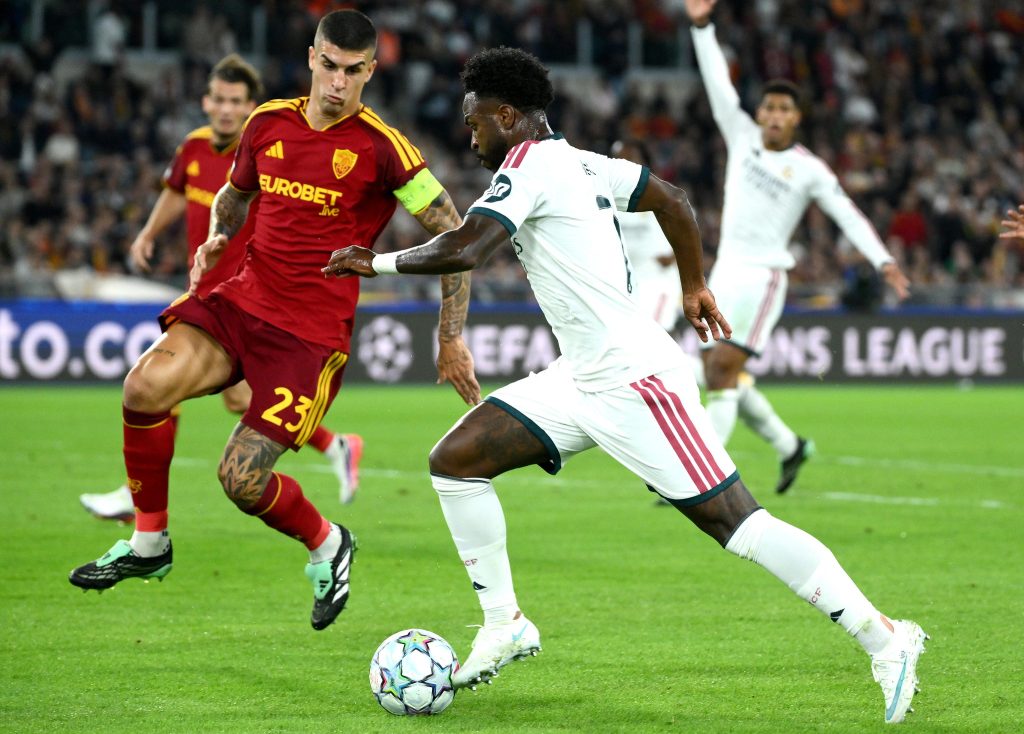
Mourinho has continued to use him, but recent matches show that his presence no longer prevents the coach from seeking other solutions. He started on the bench against Villarreal and in the starting XI against Roma on Wednesday, when his attempted backheel led to the turnover that began the move for the hosts’ second goal. He went off around the 58th minute, alongside Denzel Dumfries, in Madrid’s first set of substitutions. His league suspension removed any need to rest him for Sevilla, yet the coach still chose to change the attack. Madrid completed their comeback with the substitutes playing prominent roles. Vinicius later acknowledged both his initial frustration and the outcome of the decision: “In the end, he was right; the team improved.”
Protests now carry a sporting cost
The debate over his behaviour now has a concrete consequence: his protests after being sent off added two matches to the ban. The Disciplinary Committee treated that reaction as a separate offence from the hair-pulling and imposed the minimum punishment for each. After the Roma match, the Brazilian insisted that he was the one receiving yellow cards and that attacking players needed protection. Confrontations with opponents such as Pablo Maffeo form part of the background to that public image. The Spanish press has reported concern within the Technical Committee of Referees -CTA- about the tense atmosphere surrounding Madrid matches.
His recent record with Brazil also requires more than a headline figure. Vinicius scored four World Cup goals: one against Morocco, one against Haiti and two against Scotland, but none in the knockout matches against Japan and Norway. After the round-of-16 exit, he acknowledged that the team could have gone further and apologised. At Madrid, he now admits that “I’m not at my best”. His contract until 2032 maintains the club’s commitment, but cannot, by itself, restore his former status. The suspension creates room for other options in LaLiga and leaves his next opportunities in the Champions League, with Diomande, Endrick and Carlos Espí among Mourinho’s attacking alternatives.
 Last related articles