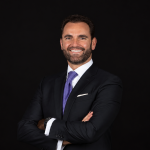
The path of Simon Møss towards success in beach handball did not begin with a planned decision, but rather as the result of an injury that put his indoor career on hold. During a summer camp for indoor handball, a serious back injury caused a fracture in his spine, forcing him to step away from what should have been a key stage in his development as a player. “My beach handball journey actually started because of a serious back injury that I sustained during a summer camp in indoor handball,” he explains.
After a long recovery process, a phone call changed the course of his career. The then youth national coach for indoor handball, Claus Hansen, invited him to try beach handball. “When I had finally recovered, he called me and asked if I wanted to try my hand on the sand,” Møss recalls. That almost casual invitation opened a new sporting chapter that would go on to define his international career.
A career built on the sand… with one goal still missing
Over time, Møss found in the sand far more than just a different discipline. “Through the people and the experiences that the sport has given me, I discovered that beach handball has a very special community,” he says. “There is a unique unity across nations and an atmosphere that is almost impossible to explain and simply has to be experienced.” That sense of belonging proved decisive in consolidating his bond with the discipline. “The combination of community, experiences and the pursuit of big goals is where I find my passion and motivation,” summarises the Danish player, who made his debut with the national beach handball team in 2017.
Since then, the Denmark men’s beach handball team has become his main competitive stage. Møss has scored more than 1,000 points for the national side and won gold at the European Championship in 2021, along with a bronze in 2023 and silver medals at the World Championships in 2022 and 2024. At club level, he was named MVP of the Champions Cup in 2019 and won the competition in 2023 with Rødby Beach Boys.
Despite that record, one objective continues to shape his motivation. “When you get a taste of standing on top of the podium, you become even more motivated — especially when you are still missing a world championship gold,” he admits. “It is one of the major driving forces behind my continued beach handball career: the dream of getting that world championship gold medal around my neck,” adds Møss, who combines his sporting career with a professional role in the banking sector.

The national team, shared experiences and a new generation on the rise
Beyond titles, Møss highlights the importance of the collective journey. “Being part of the Danish national team is something very special. We are a group that has been through a lot together and share many experiences,” he explains. That shared history has built a strong identity both on and off the court, while also opening the door to a new generation. “There are young players knocking on the door, and at some point a generational change will be inevitable — the only question is when,” he notes.
One of his most memorable stories dates back to the 2019 European Championship. A last-minute eye test revealed that he had been competing with severely impaired vision. “The optician told me, half jokingly, that I was almost blind,” he recalls. The contact lenses arrived just before departure and, against all expectations, Denmark went on to win their first-ever European Championship gold. “That tournament completely changed our self-perception and showed us that we could actually be among the very best,” he says.
Beach handball as a space for international connection
Møss’ journey has also been shaped by relationships beyond Denmark. Long-standing cooperation between Rødby Beach and the Aarhus-based club HEI Beach Handball played a key role in his development, as did personal bonds formed with players from other countries. “I started learning Spanish as a hobby because I got tired of not understanding what opposing players were saying on the court,” he explains.
That interest developed into close relationships with Spanish player Hugo Madera and Portuguese player Rui Rodrigues, and even led to occasional appearances with the Portuguese club Tigres. For Møss, beach handball has become a space for cultural exchange and personal growth, where competition coexists with a strong sense of shared identity.
The case of Simon Møss is not an isolated one. In recent years, many players have found in beach handball a pathway for continuity or specialisation after demanding indoor careers. In Spain, profiles such as Luisa García Toro, Miriam Sempere, Inoa Lucio and Remei Prat illustrate different routes to the sand, from definitive transitions to gradual shifts. At international level, careers such as those of Jelena Erić and Lucie-Marie Kretzschmar have followed similar paths.
 Last related articles