The World Skateboarding Tour -WST- World Cup Rome 2026 opened skateboarding’s road to the Los Angeles 2028 Olympic Games -LA28- with a Park final that confirmed the new level of the discipline. The event held at The Spot Skatepark, in Ostia, brought together skaters from 47 countries and closed its programme on Sunday with Japanese victories for Mizuho Hasegawa and Issei Sakurai, in a competition featuring Olympic champions, world champions and some of the leading names of the cycle that has just begun.
The event carried a meaning that went beyond the results. The stands were full, the international broadcast followed the competition live and Rome again presented itself as one of the central venues on the circuit, with Park in Ostia and Street in Colle Oppio, where the championship continues until 21 June. The start of the Road To LA28 offered a clear reading: since its Olympic debut at Tokyo 2020 and its consolidation at Paris 2024, Olympic skateboarding now competes with ever greater depth, youth and demands.
Highest women’s score in history
Hasegawa, world number one and winner in Rome in 2025, defended her title with a Golden Run of 96.33 points, the highest score in women’s Park history on the World Skateboarding Tour. The 15-year-old Japanese skater needed her final attempt to overtake Sky Brown, who had produced three runs above 90 points and looked on course to complete an almost perfect final. The scene offered a powerful image of the new Olympic cycle.
Brown had anticipated that competitive tone after the semi-finals. “I want to put on a good show and land my runs, so I feel amazing,” she told Olympics.com before a final in which she again showed her weight within international Park skateboarding. The British skater also summed up the mix of pressure and enjoyment that defines elite skateboarding: “The feeling doesn’t get old: the nerves and people screaming for me. I love it.” Her second place, behind an inspired Hasegawa, reinforced the feeling that the road to LA28 begins with an open rivalry and a higher bar.
 Japan accelerates and Spain stays among the elite
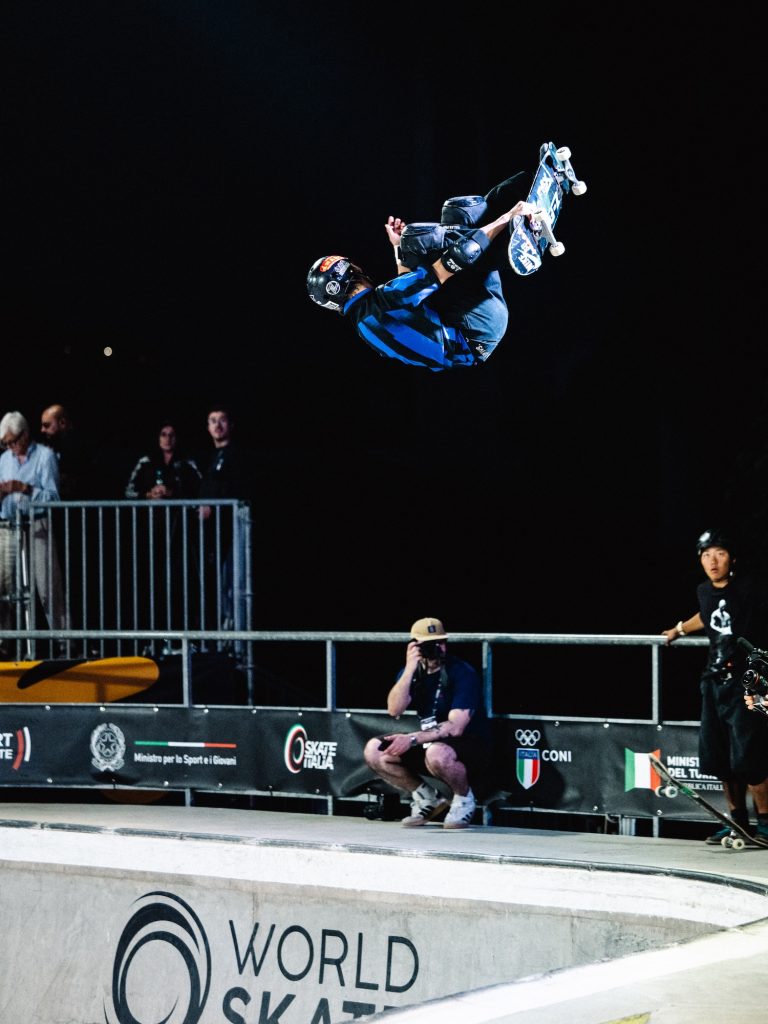
The men’s final completed Japan’s dominance in Ostia with Sakurai’s victory. The 17-year-old skater claimed his first WST title and became the first Japanese skater to win a men’s Park competition on the circuit. His performance came in a final of extremely high quality, with Tom Schaar second and Egoitz Bijueska third, on a night that World Skate presented as one of the major competitive leaps in the discipline.
Bijueska, the reigning world champion, again placed himself among the leading names on the circuit and kept Spain within the reference group at the start of the Olympic cycle. His third place in Rome, after winning there in 2025, confirms his consistency in an increasingly demanding setting. In the women’s competition, Naia Laso also reached the final, another sign of Spanish presence in a discipline where the gap between prospect, contender and Olympic candidate narrows with every stop.
Rome, an Olympic city for urban skateboarding
Rome’s role is also part of the reading of the championship. Ostia, with The Spot Skatepark, and Colle Oppio, with the Street event set against the backdrop of the Colosseum, have placed the city on the international skateboarding map. The event does not only measure the best skaters in the world, but also projects a relationship between sport, urban space and local transformation. “Now you have hundreds of kids coming here, skating and staying here, and they leave with a good feeling of our city. Economically and for the perspective of our city, it’s massive,” Mark Dominic Di Lello, co-founder of The Spot, told Olympics.com.
The championship also left room for a more human look at the pressure of competitive skateboarding. Canadian skater Richie Bullbrook, who has linked his road to LA28 to a personal promise to his father, summed up the mental side of a discipline that is often associated from the outside only with risk. “Nobody will admit it, but we all get scared,” he said, before defending the importance of focusing on the process rather than the result. The WST World Cup Rome 2026 now continues with the Street event in Colle Oppio, while the road to Los Angeles 2028 has already begun with records, new generations and a level that forces skaters to compete in a different way.
 Last related articles