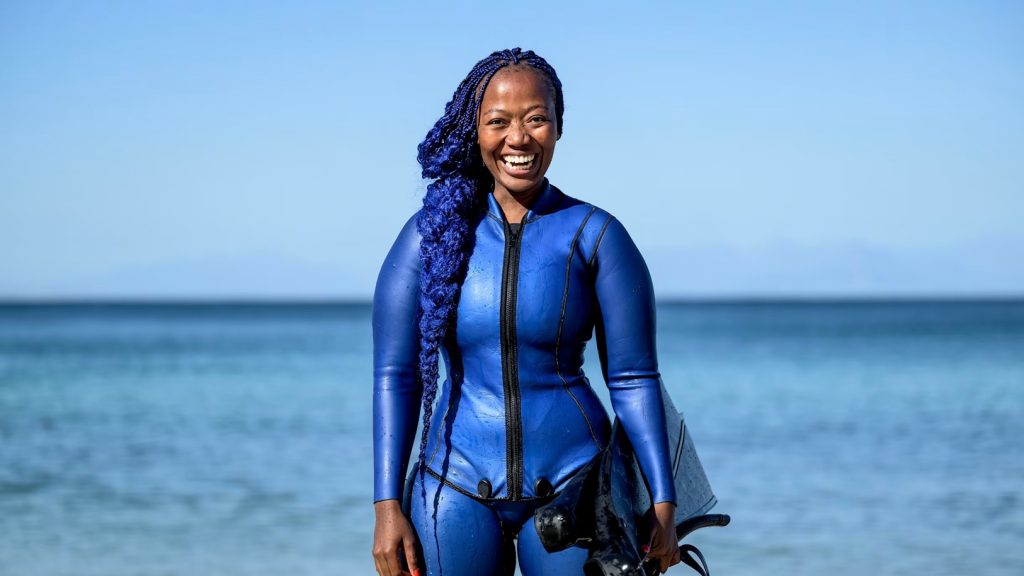
Zandile Ndhlovu was 28 when she discovered what lay beneath the surface of the ocean. It happened in Bali, on a trip she took at a difficult personal moment and with a relationship with water shaped by fear, distance and the stories she had heard since childhood. “I didn’t even know how to use a snorkel”, she would later recall. At first, she panicked. Then she looked down and found a world that changed her life: “When I met the ocean, I finally found home”.
Eight years later, Ndhlovu is South Africa’s first Black female freediving instructor and the founder of The Black Mermaid Foundation. Her story does not begin at sea, but in Soweto, far from the coast, in a childhood where water appeared more as a desire than as real access. One of her clearest memories is Spring Day, when children would go out into the street in swimming costumes even though there was no pool, throwing buckets of water at each other. “That is probably one of the most memorable things of my childhood”, she said.
A childhood far from the sea and shaped by fear
Ndhlovu saw the ocean for the first time at around 12, during a family trip to the Eastern Cape. What she found was not a beach understood as a place to play, but a boundary loaded with warnings. “We’re always told there’s a snake in the water and it’ll take you”, she explained. In her surroundings, the sea was a sacred place, linked to ancestors and danger, not a territory to explore. If someone went in beyond their knees, the question was: “Why are you trying to kill yourself?”.
In South Africa, apartheid also separated Black communities from many coastal spaces and from beaches considered safer. Ndhlovu says a narrative was built over years that said “that’s not your place”. Even when she began moving through diving spaces, that feeling of not belonging was still there. “I was always the only Black person on the boat”, she recalled, among comments about her hair, wetsuits that had not been designed for her body and conversations that reinforced that condition of being “the other”.
 Bali and the moment the ocean became home
The turning point came in 2016. Ndhlovu was going through a personal break, after a traditional marriage. She needed space before telling her family that it was not working. With the savings she had, she asked a travel agency to send her anywhere for two weeks. The destination was Bali. There, she signed up for a snorkelling trip without really knowing what she was going to find. When she jumped into the water, she thought she was drowning, even though she knew how to swim. Then calm arrived. “I just remember how the sun pierced the water”, she said. The blue, the coral, the fish and that intense life below the surface gave her a mixture of awe and belonging. “I just fell into wonder, and I fell into awe”, she said of an experience that turned her initial fear into a new way of looking at the world.
Before that, Ndhlovu had studied Biochemistry, worked in sales and gone through a corporate career that she came to feel as a burden. She later studied diversity and inclusion, a field where she found tools to help organisations name their own problems. “I found language to help other organisations name the challenges they were facing”, she explained about that stage.
After Bali, she started training in scuba diving, but still did not think of becoming an instructor. The definitive change came in 2019, during a freediving course in Sodwana with a PADI instructor. From the first pool session and then in the sea, she felt there was something more than a sporting practice. “I knew that this is where I wanted to be, that this is where I wanted to create change, create access”, she explained. In 2020, she qualified as a freediving instructor and only later fully understood the meaning of that step: she was the first Black South African woman to do so.
The Black Mermaid Foundation and the mission to open the ocean
Freediving gave Ndhlovu a way to understand fear from within. What she feared most ended up becoming one of the most liberating experiences of her life. “It’s like you’re flying through space, like you’ve left your body”, she said of the feeling of floating in the sea without effort. That relationship with fear also runs through the way she lives. For Ndhlovu, freediving teaches people to stay in the present and not run away when discomfort appears. “We live in a world that tells us if something is uncomfortable we need to stop”, she explained. In freediving, however, “the only way forward is to touch that fear”. Her advice to those who feel they are arriving late to a different life sums up that lesson: “It’s never too late, you’re never too old”.
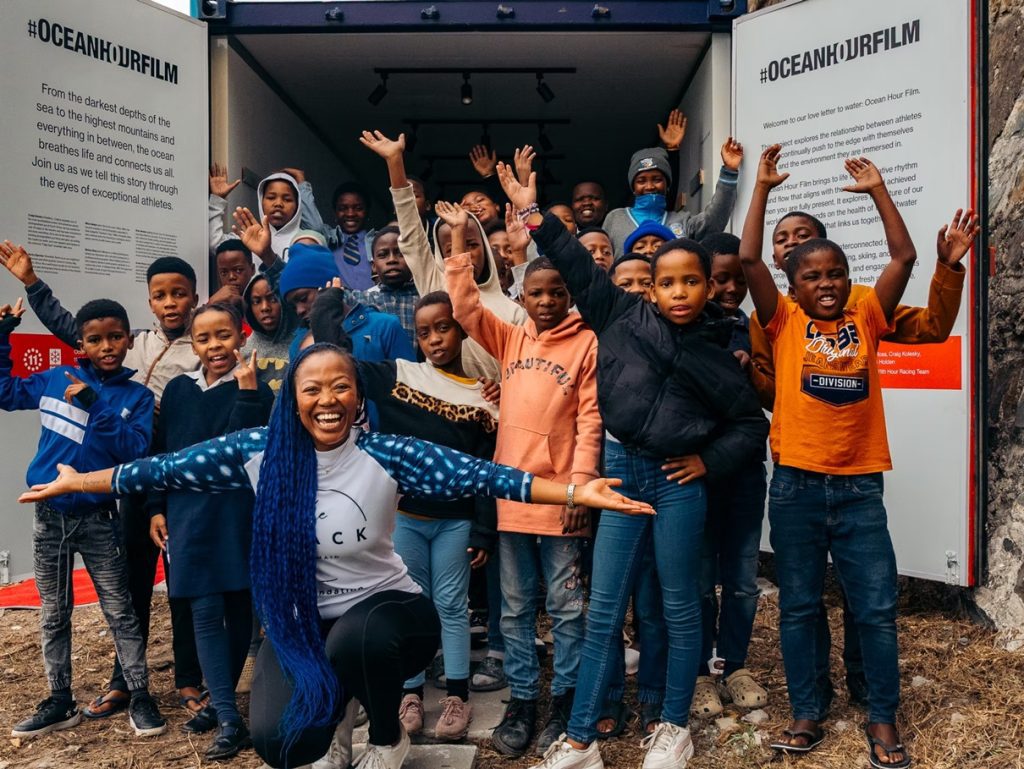
Out of that experience came The Black Mermaid Foundation, an organisation working to create diverse representation in ocean spaces. The foundation takes children from different communities on snorkelling excursions and connects those outings with ocean education and conservation. Ndhlovu puts it clearly: “Proximity doesn’t equate to access”. The foundation’s mission is to break that boundary from childhood. “I wanted to change the narrative”, she explained. It also seeks to challenge the repeated idea that Black people do not swim or do not belong in the ocean, and to allow children to build a different emotional relationship with water. “These waters are yours, too”, she has said when speaking about access to the sea and the need not to ask permission to occupy those spaces.
One of the memories that best explains her work is that of a girl who was afraid to put her head underwater. First, she did it while holding Ndhlovu’s hand for three seconds. Then for five. When she was supposed to come up, she did not. When she lifted her head, she said she had been looking at a starfish. “She’d stopped shaking”, Ndhlovu said. Seeing her eyes move from fear to awe made her cry. For Ndhlovu, the change also reaches families. She has seen parents surprised as they watch their children underwater and has heard phrases such as: “Never in my life did I think that we could do such things, too”. That is why her goal is to expand the foundation along the coast of South Africa and then across the African continent.
 Last related articles